 Add to Chrome
 Add to Firefox
 Add to Edge
Stay or Stray - A Dynamical Systems Viewpoint of Popularity Bias
Aug 11, 2026
Popularity bias in recommendation systems arises when a majority user class generates disproportionate interaction data, causing the system to increasingly favour it while degrading recommendation quality for niche users. While extensive empirical evidence of popularity bias exists, the dynamics leading to its emergence are not well understood. In this work, we study the coupled evolution of recommender model updates and user engagement through the lens of dynamical systems. We formulate a stochastic process and analyse its asymptotic behaviour through an ordinary differential equation (ODE) framework grounded in two-time-scale stochastic approximation. We characterise the equilibrium points of this dynamical system, and derive conditions under which popularity bias is provably emergent, as well as conditions under which symmetric retention of all user classes is possible. We conduct experiments on synthetic data and real-world production logs derived from a large-scale commercial music recommendation platform to validate our theoretical results.

Inducing Robustness in a 2 Dimensional Direct Preference Optimization Paradigm
May 03, 2025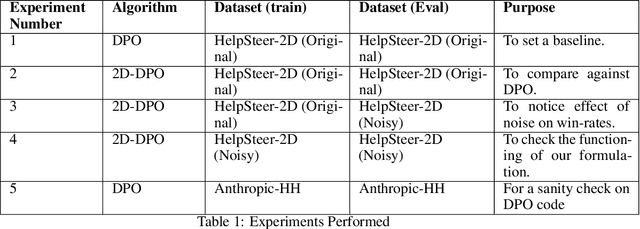
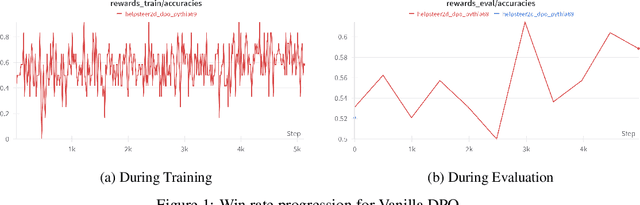
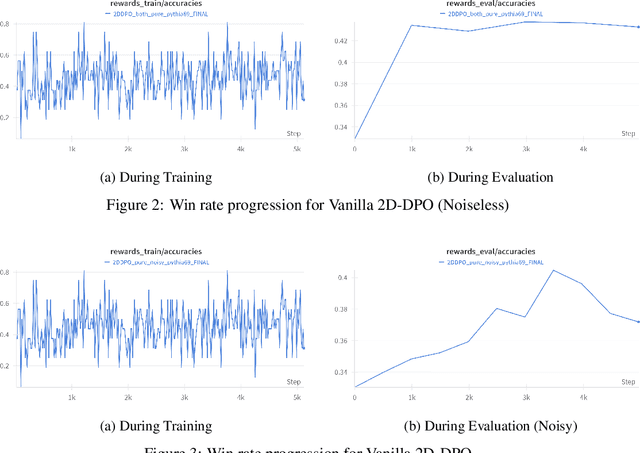
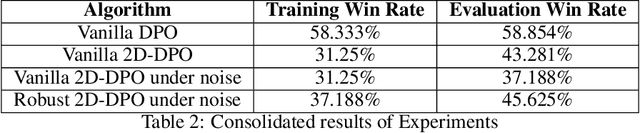
Direct Preference Optimisation (DPO) has emerged as a powerful method for aligning Large Language Models (LLMs) with human preferences, offering a stable and efficient alternative to approaches that use Reinforcement learning via Human Feedback. In this work, we investigate the performance of DPO using open-source preference datasets. One of the major drawbacks of DPO is that it doesn't induce granular scoring and treats all the segments of the responses with equal propensity. However, this is not practically true for human preferences since even "good" responses have segments that may not be preferred by the annotator. To resolve this, a 2-dimensional scoring for DPO alignment called 2D-DPO was proposed. We explore the 2D-DPO alignment paradigm and the advantages it provides over the standard DPO by comparing their win rates. It is observed that these methods, even though effective, are not robust to label/score noise. To counter this, we propose an approach of incorporating segment-level score noise robustness to the 2D-DPO algorithm. Along with theoretical backing, we also provide empirical verification in favour of the algorithm and introduce other noise models that can be present.