 Add to Chrome
 Add to Firefox
 Add to Edge
Pack only the essentials: Adaptive dictionary learning for kernel ridge regression
Apr 24, 2026
One of the major limits of kernel ridge regression (KRR) is that storing and manipulating the kernel matrix K_n for n samples requires O(n^2) space, which rapidly becomes unfeasible for large n. Nystrom approximations reduce the space complexity to O(nm) by sampling m columns from K_n. Uniform sampling preserves KRR accuracy (up to epsilon) only when m is proportional to the maximum degree of freedom of K_n, which may require O(n) columns for datasets with high coherence. Sampling columns according to their ridge leverage scores (RLS) gives accurate Nystrom approximations with m proportional to the effective dimension, but computing exact RLS also requires O(n^2) space. (Calandriello et al. 2016) propose INK-Estimate, an algorithm that processes the dataset incrementally and updates RLS, effective dimension, and Nystrom approximations on-the-fly. Its space complexity scales with the effective dimension but introduces a dependency on the largest eigenvalue of K_n, which in the worst case is O(n). In this paper we introduce SQUEAK, a new algorithm that builds on INK-Estimate but uses unnormalized RLS. As a consequence, the algorithm is simpler, does not need to estimate the effective dimension for normalization, and achieves a space complexity that is only a constant factor worse than exact RLS sampling.

A single algorithm for both restless and rested rotting bandits
Apr 23, 2026In many application domains (e.g., recommender systems, intelligent tutoring systems), the rewards associated to the actions tend to decrease over time. This decay is either caused by the actions executed in the past (e.g., a user may get bored when songs of the same genre are recommended over and over) or by an external factor (e.g., content becomes outdated). These two situations can be modeled as specific instances of the rested and restless bandit settings, where arms are rotting (i.e., their value decrease over time). These problems were thought to be significantly different, since Levine et al. (2017) showed that state-of-the-art algorithms for restless bandit perform poorly in the rested rotting setting. In this paper, we introduce a novel algorithm, Rotting Adaptive Window UCB (RAW-UCB), that achieves near-optimal regret in both rotting rested and restless bandit, without any prior knowledge of the setting (rested or restless) and the type of non-stationarity (e.g., piece-wise constant, bounded variation). This is in striking contrast with previous negative results showing that no algorithm can achieve similar results as soon as rewards are allowed to increase. We confirm our theoretical findings on a number of synthetic and dataset-based experiments.
Improved large-scale graph learning through ridge spectral sparsification
Apr 22, 2026Graph-based techniques and spectral graph theory have enriched the field of machine learning with a variety of critical advances. A central object in the analysis is the graph Laplacian L, which encodes the structure of the graph. We consider the problem of learning over this Laplacian in a distributed streaming setting, where new edges of the graph are observed in real time by a network of workers. In this setting, it is hard to learn quickly or approximately while keeping a distributed representation of L. To address this challenge, we present a novel algorithm, GSQUEAK, which efficiently sparsifies the Laplacian by maintaining a small subset of effective resistances. We show that our algorithm produces sparsifiers with strong spectral approximation guarantees, all while processing edges in a single pass and in a distributed fashion.
Analysis of Nystrom method with sequential ridge leverage scores
Apr 22, 2026Large-scale kernel ridge regression (KRR) is limited by the need to store a large kernel matrix K_t. To avoid storing the entire matrix K_t, Nystrom methods subsample a subset of columns of the kernel matrix, and efficiently find an approximate KRR solution on the reconstructed matrix. The chosen subsampling distribution in turn affects the statistical and computational tradeoffs. For KRR problems, recent works show that a sampling distribution proportional to the ridge leverage scores (RLSs) provides strong reconstruction guarantees for the approximation. While exact RLSs are as difficult to compute as a KRR solution, we may be able to approximate them well enough. In this paper, we study KRR problems in a sequential setting and introduce the INK-ESTIMATE algorithm, that incrementally computes the RLSs estimates. INK-ESTIMATE maintains a small sketch of K_t, that at each step is used to compute an intermediate estimate of the RLSs. First, our sketch update does not require access to previously seen columns, and therefore a single pass over the kernel matrix is sufficient. Second, the algorithm requires a fixed, small space budget to run dependent only on the effective dimension of the kernel matrix. Finally, our sketch provides strong approximation guarantees on the distance between the true kernel matrix and its approximation, and on the statistical risk of the approximate KRR solution at any time, because all our guarantees hold at any intermediate step.
Maximum Entropy Semi-Supervised Inverse Reinforcement Learning
Apr 22, 2026A popular approach to apprenticeship learning (AL) is to formulate it as an inverse reinforcement learning (IRL) problem. The MaxEnt-IRL algorithm successfully integrates the maximum entropy principle into IRL and unlike its predecessors, it resolves the ambiguity arising from the fact that a possibly large number of policies could match the expert's behavior. In this paper, we study an AL setting in which in addition to the expert's trajectories, a number of unsupervised trajectories is available. We introduce MESSI, a novel algorithm that combines MaxEnt-IRL with principles coming from semi-supervised learning. In particular, MESSI integrates the unsupervised data into the MaxEnt-IRL framework using a pairwise penalty on trajectories. Empirical results in a highway driving and grid-world problems indicate that MESSI is able to take advantage of the unsupervised trajectories and improve the performance of MaxEnt-IRL.
Compositional Planning with Jumpy World Models
Feb 23, 2026The ability to plan with temporal abstractions is central to intelligent decision-making. Rather than reasoning over primitive actions, we study agents that compose pre-trained policies as temporally extended actions, enabling solutions to complex tasks that no constituent alone can solve. Such compositional planning remains elusive as compounding errors in long-horizon predictions make it challenging to estimate the visitation distribution induced by sequencing policies. Motivated by the geometric policy composition framework introduced in arXiv:2206.08736, we address these challenges by learning predictive models of multi-step dynamics -- so-called jumpy world models -- that capture state occupancies induced by pre-trained policies across multiple timescales in an off-policy manner. Building on Temporal Difference Flows (arXiv:2503.09817), we enhance these models with a novel consistency objective that aligns predictions across timescales, improving long-horizon predictive accuracy. We further demonstrate how to combine these generative predictions to estimate the value of executing arbitrary sequences of policies over varying timescales. Empirically, we find that compositional planning with jumpy world models significantly improves zero-shot performance across a wide range of base policies on challenging manipulation and navigation tasks, yielding, on average, a 200% relative improvement over planning with primitive actions on long-horizon tasks.
BFM-Zero: A Promptable Behavioral Foundation Model for Humanoid Control Using Unsupervised Reinforcement Learning
Nov 06, 2025Building Behavioral Foundation Models (BFMs) for humanoid robots has the potential to unify diverse control tasks under a single, promptable generalist policy. However, existing approaches are either exclusively deployed on simulated humanoid characters, or specialized to specific tasks such as tracking. We propose BFM-Zero, a framework that learns an effective shared latent representation that embeds motions, goals, and rewards into a common space, enabling a single policy to be prompted for multiple downstream tasks without retraining. This well-structured latent space in BFM-Zero enables versatile and robust whole-body skills on a Unitree G1 humanoid in the real world, via diverse inference methods, including zero-shot motion tracking, goal reaching, and reward optimization, and few-shot optimization-based adaptation. Unlike prior on-policy reinforcement learning (RL) frameworks, BFM-Zero builds upon recent advancements in unsupervised RL and Forward-Backward (FB) models, which offer an objective-centric, explainable, and smooth latent representation of whole-body motions. We further extend BFM-Zero with critical reward shaping, domain randomization, and history-dependent asymmetric learning to bridge the sim-to-real gap. Those key design choices are quantitatively ablated in simulation. A first-of-its-kind model, BFM-Zero establishes a step toward scalable, promptable behavioral foundation models for whole-body humanoid control.
TD-JEPA: Latent-predictive Representations for Zero-Shot Reinforcement Learning
Oct 01, 2025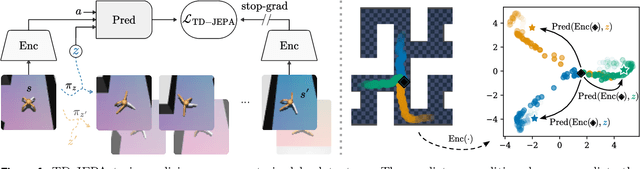
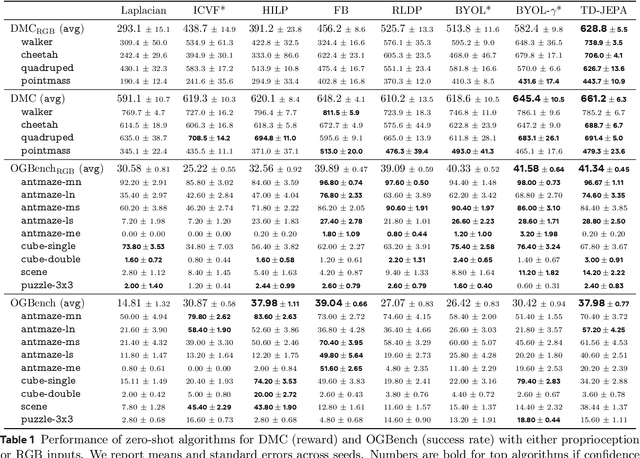
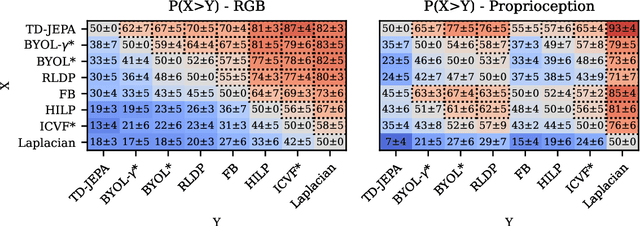
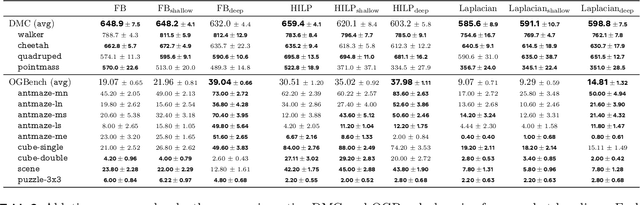
Latent prediction--where agents learn by predicting their own latents--has emerged as a powerful paradigm for training general representations in machine learning. In reinforcement learning (RL), this approach has been explored to define auxiliary losses for a variety of settings, including reward-based and unsupervised RL, behavior cloning, and world modeling. While existing methods are typically limited to single-task learning, one-step prediction, or on-policy trajectory data, we show that temporal difference (TD) learning enables learning representations predictive of long-term latent dynamics across multiple policies from offline, reward-free transitions. Building on this, we introduce TD-JEPA, which leverages TD-based latent-predictive representations into unsupervised RL. TD-JEPA trains explicit state and task encoders, a policy-conditioned multi-step predictor, and a set of parameterized policies directly in latent space. This enables zero-shot optimization of any reward function at test time. Theoretically, we show that an idealized variant of TD-JEPA avoids collapse with proper initialization, and learns encoders that capture a low-rank factorization of long-term policy dynamics, while the predictor recovers their successor features in latent space. Empirically, TD-JEPA matches or outperforms state-of-the-art baselines on locomotion, navigation, and manipulation tasks across 13 datasets in ExoRL and OGBench, especially in the challenging setting of zero-shot RL from pixels.
Zero-Shot Whole-Body Humanoid Control via Behavioral Foundation Models
Apr 15, 2025Unsupervised reinforcement learning (RL) aims at pre-training agents that can solve a wide range of downstream tasks in complex environments. Despite recent advancements, existing approaches suffer from several limitations: they may require running an RL process on each downstream task to achieve a satisfactory performance, they may need access to datasets with good coverage or well-curated task-specific samples, or they may pre-train policies with unsupervised losses that are poorly correlated with the downstream tasks of interest. In this paper, we introduce a novel algorithm regularizing unsupervised RL towards imitating trajectories from unlabeled behavior datasets. The key technical novelty of our method, called Forward-Backward Representations with Conditional-Policy Regularization, is to train forward-backward representations to embed the unlabeled trajectories to the same latent space used to represent states, rewards, and policies, and use a latent-conditional discriminator to encourage policies to ``cover'' the states in the unlabeled behavior dataset. As a result, we can learn policies that are well aligned with the behaviors in the dataset, while retaining zero-shot generalization capabilities for reward-based and imitation tasks. We demonstrate the effectiveness of this new approach in a challenging humanoid control problem: leveraging observation-only motion capture datasets, we train Meta Motivo, the first humanoid behavioral foundation model that can be prompted to solve a variety of whole-body tasks, including motion tracking, goal reaching, and reward optimization. The resulting model is capable of expressing human-like behaviors and it achieves competitive performance with task-specific methods while outperforming state-of-the-art unsupervised RL and model-based baselines.
Fast Adaptation with Behavioral Foundation Models
Apr 10, 2025Unsupervised zero-shot reinforcement learning (RL) has emerged as a powerful paradigm for pretraining behavioral foundation models (BFMs), enabling agents to solve a wide range of downstream tasks specified via reward functions in a zero-shot fashion, i.e., without additional test-time learning or planning. This is achieved by learning self-supervised task embeddings alongside corresponding near-optimal behaviors and incorporating an inference procedure to directly retrieve the latent task embedding and associated policy for any given reward function. Despite promising results, zero-shot policies are often suboptimal due to errors induced by the unsupervised training process, the embedding, and the inference procedure. In this paper, we focus on devising fast adaptation strategies to improve the zero-shot performance of BFMs in a few steps of online interaction with the environment while avoiding any performance drop during the adaptation process. Notably, we demonstrate that existing BFMs learn a set of skills containing more performant policies than those identified by their inference procedure, making them well-suited for fast adaptation. Motivated by this observation, we propose both actor-critic and actor-only fast adaptation strategies that search in the low-dimensional task-embedding space of the pre-trained BFM to rapidly improve the performance of its zero-shot policies on any downstream task. Notably, our approach mitigates the initial "unlearning" phase commonly observed when fine-tuning pre-trained RL models. We evaluate our fast adaptation strategies on top of four state-of-the-art zero-shot RL methods in multiple navigation and locomotion domains. Our results show that they achieve 10-40% improvement over their zero-shot performance in a few tens of episodes, outperforming existing baselines.