 Add to Chrome
 Add to Firefox
 Add to Edge
Manifold Mixup: Learning Better Representations by Interpolating Hidden States
Oct 04, 2018
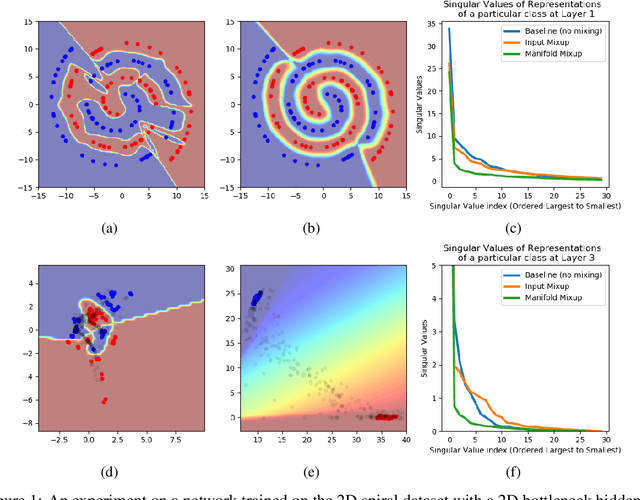
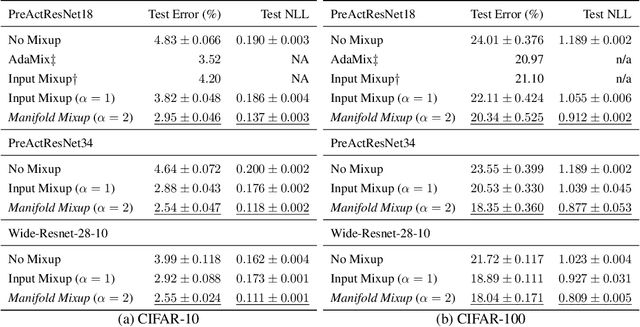
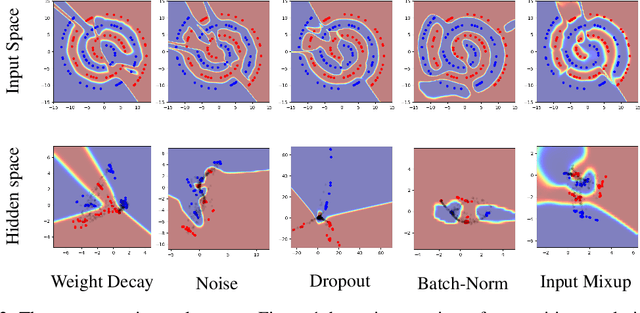
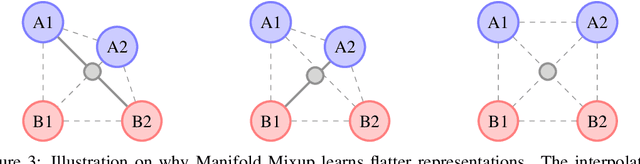
Deep networks often perform well on the data distribution on which they are trained, yet give incorrect (and often very confident) answers when evaluated on points from off of the training distribution. This is exemplified by the adversarial examples phenomenon but can also be seen in terms of model generalization and domain shift. Ideally, a model would assign lower confidence to points unlike those from the training distribution. We propose a regularizer which addresses this issue by training with interpolated hidden states and encouraging the classifier to be less confident at these points. Because the hidden states are learned, this has an important effect of encouraging the hidden states for a class to be concentrated in such a way so that interpolations within the same class or between two different classes do not intersect with the real data points from other classes. This has a major advantage in that it avoids the underfitting which can result from interpolating in the input space. We prove that the exact condition for this problem of underfitting to be avoided by Manifold Mixup is that the dimensionality of the hidden states exceeds the number of classes, which is often the case in practice. Additionally, this concentration can be seen as making the features in earlier layers more discriminative. We show that despite requiring no significant additional computation, Manifold Mixup achieves large improvements over strong baselines in supervised learning, robustness to single-step adversarial attacks, semi-supervised learning, and Negative Log-Likelihood on held out samples.

Fortified Networks: Improving the Robustness of Deep Networks by Modeling the Manifold of Hidden Representations
Apr 07, 2018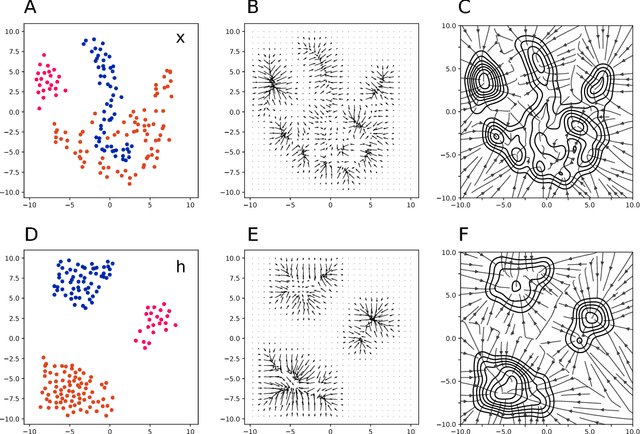
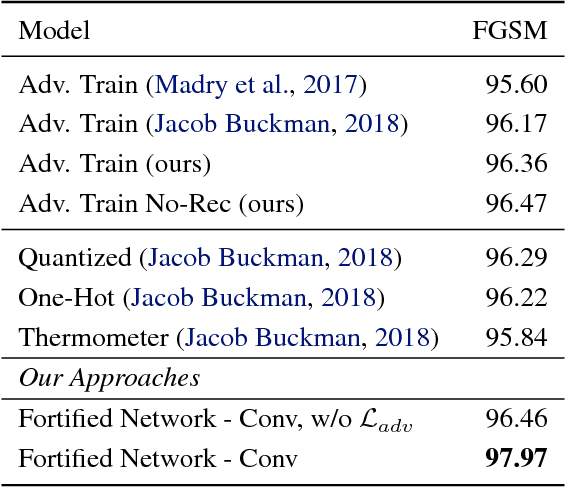
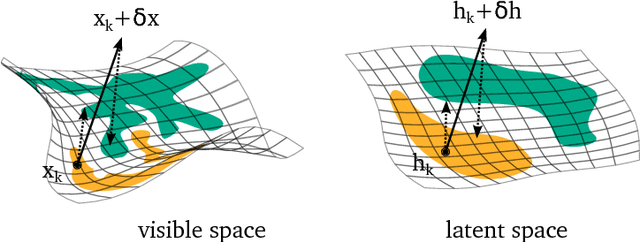
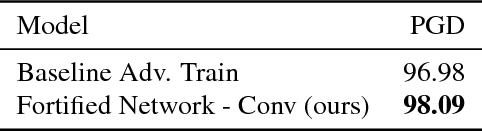
Deep networks have achieved impressive results across a variety of important tasks. However a known weakness is a failure to perform well when evaluated on data which differ from the training distribution, even if these differences are very small, as is the case with adversarial examples. We propose Fortified Networks, a simple transformation of existing networks, which fortifies the hidden layers in a deep network by identifying when the hidden states are off of the data manifold, and maps these hidden states back to parts of the data manifold where the network performs well. Our principal contribution is to show that fortifying these hidden states improves the robustness of deep networks and our experiments (i) demonstrate improved robustness to standard adversarial attacks in both black-box and white-box threat models; (ii) suggest that our improvements are not primarily due to the gradient masking problem and (iii) show the advantage of doing this fortification in the hidden layers instead of the input space.
GibbsNet: Iterative Adversarial Inference for Deep Graphical Models
Dec 12, 2017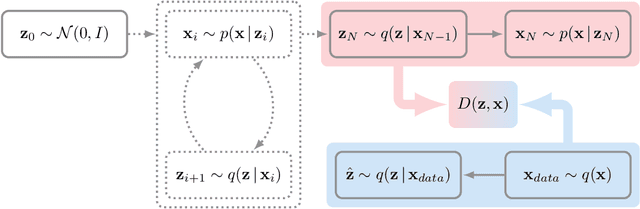
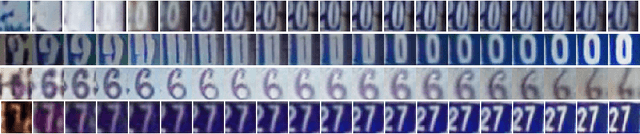
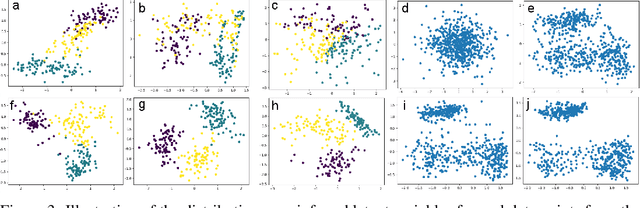
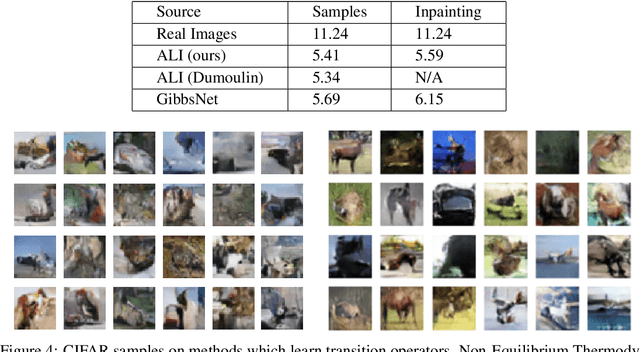
Directed latent variable models that formulate the joint distribution as $p(x,z) = p(z) p(x \mid z)$ have the advantage of fast and exact sampling. However, these models have the weakness of needing to specify $p(z)$, often with a simple fixed prior that limits the expressiveness of the model. Undirected latent variable models discard the requirement that $p(z)$ be specified with a prior, yet sampling from them generally requires an iterative procedure such as blocked Gibbs-sampling that may require many steps to draw samples from the joint distribution $p(x, z)$. We propose a novel approach to learning the joint distribution between the data and a latent code which uses an adversarially learned iterative procedure to gradually refine the joint distribution, $p(x, z)$, to better match with the data distribution on each step. GibbsNet is the best of both worlds both in theory and in practice. Achieving the speed and simplicity of a directed latent variable model, it is guaranteed (assuming the adversarial game reaches the virtual training criteria global minimum) to produce samples from $p(x, z)$ with only a few sampling iterations. Achieving the expressiveness and flexibility of an undirected latent variable model, GibbsNet does away with the need for an explicit $p(z)$ and has the ability to do attribute prediction, class-conditional generation, and joint image-attribute modeling in a single model which is not trained for any of these specific tasks. We show empirically that GibbsNet is able to learn a more complex $p(z)$ and show that this leads to improved inpainting and iterative refinement of $p(x, z)$ for dozens of steps and stable generation without collapse for thousands of steps, despite being trained on only a few steps.
ACtuAL: Actor-Critic Under Adversarial Learning
Nov 13, 2017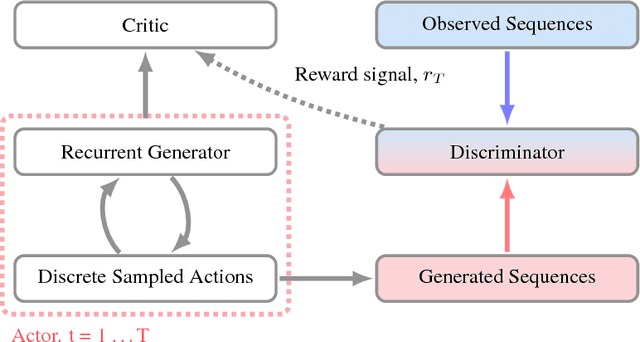
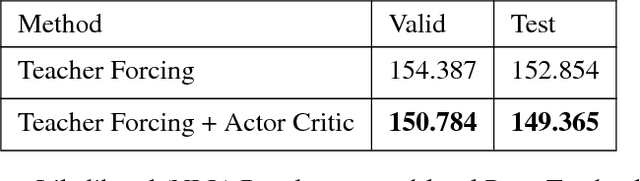
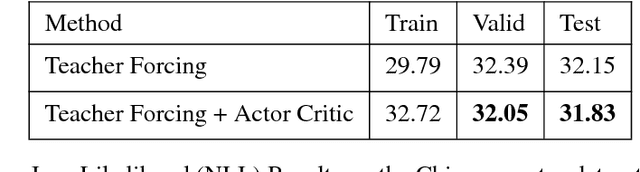
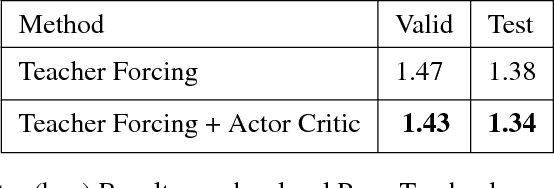
Generative Adversarial Networks (GANs) are a powerful framework for deep generative modeling. Posed as a two-player minimax problem, GANs are typically trained end-to-end on real-valued data and can be used to train a generator of high-dimensional and realistic images. However, a major limitation of GANs is that training relies on passing gradients from the discriminator through the generator via back-propagation. This makes it fundamentally difficult to train GANs with discrete data, as generation in this case typically involves a non-differentiable function. These difficulties extend to the reinforcement learning setting when the action space is composed of discrete decisions. We address these issues by reframing the GAN framework so that the generator is no longer trained using gradients through the discriminator, but is instead trained using a learned critic in the actor-critic framework with a Temporal Difference (TD) objective. This is a natural fit for sequence modeling and we use it to achieve improvements on language modeling tasks over the standard Teacher-Forcing methods.
Adversarially Learned Inference
Feb 21, 2017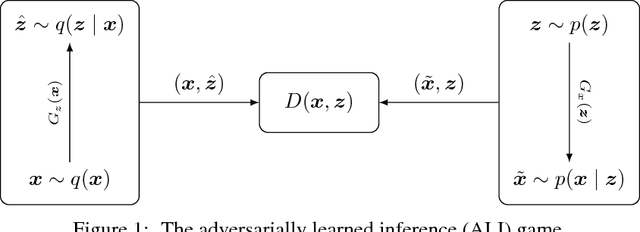
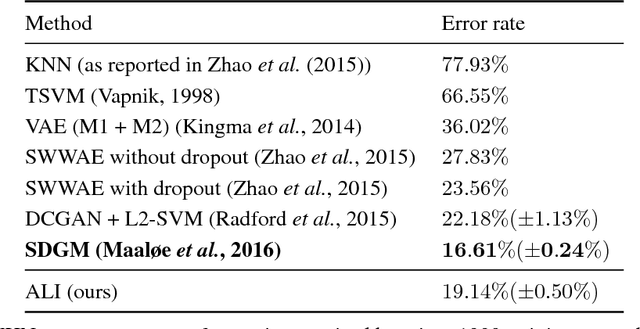
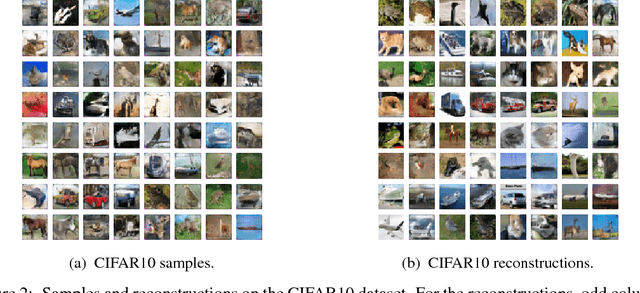
We introduce the adversarially learned inference (ALI) model, which jointly learns a generation network and an inference network using an adversarial process. The generation network maps samples from stochastic latent variables to the data space while the inference network maps training examples in data space to the space of latent variables. An adversarial game is cast between these two networks and a discriminative network is trained to distinguish between joint latent/data-space samples from the generative network and joint samples from the inference network. We illustrate the ability of the model to learn mutually coherent inference and generation networks through the inspections of model samples and reconstructions and confirm the usefulness of the learned representations by obtaining a performance competitive with state-of-the-art on the semi-supervised SVHN and CIFAR10 tasks.
Professor Forcing: A New Algorithm for Training Recurrent Networks
Oct 27, 2016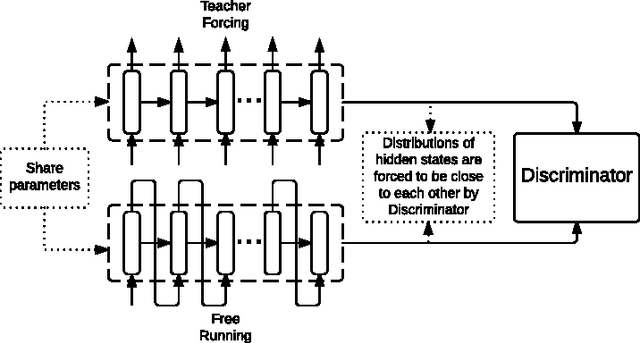
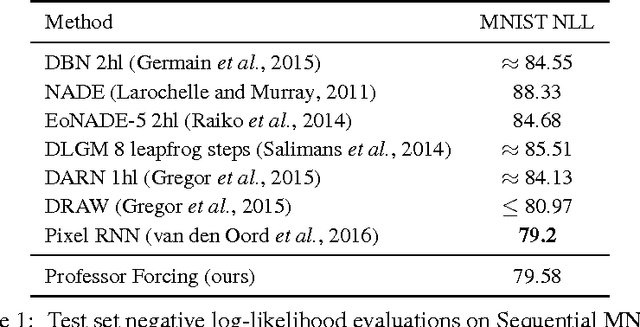
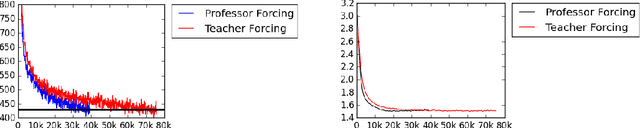
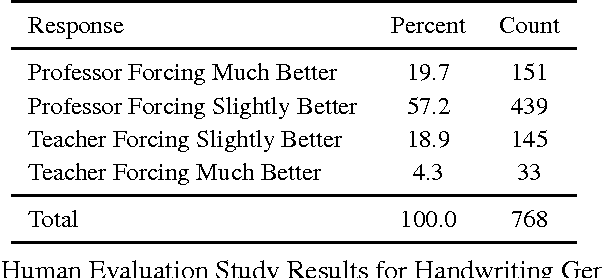
The Teacher Forcing algorithm trains recurrent networks by supplying observed sequence values as inputs during training and using the network's own one-step-ahead predictions to do multi-step sampling. We introduce the Professor Forcing algorithm, which uses adversarial domain adaptation to encourage the dynamics of the recurrent network to be the same when training the network and when sampling from the network over multiple time steps. We apply Professor Forcing to language modeling, vocal synthesis on raw waveforms, handwriting generation, and image generation. Empirically we find that Professor Forcing acts as a regularizer, improving test likelihood on character level Penn Treebank and sequential MNIST. We also find that the model qualitatively improves samples, especially when sampling for a large number of time steps. This is supported by human evaluation of sample quality. Trade-offs between Professor Forcing and Scheduled Sampling are discussed. We produce T-SNEs showing that Professor Forcing successfully makes the dynamics of the network during training and sampling more similar.
Theano: A Python framework for fast computation of mathematical expressions
May 09, 2016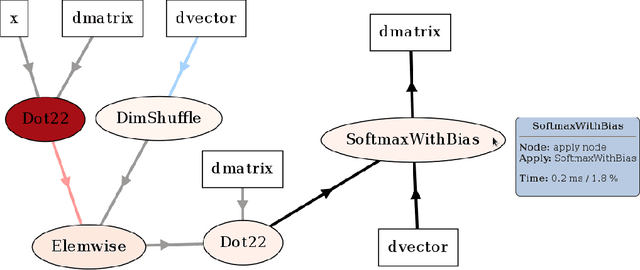
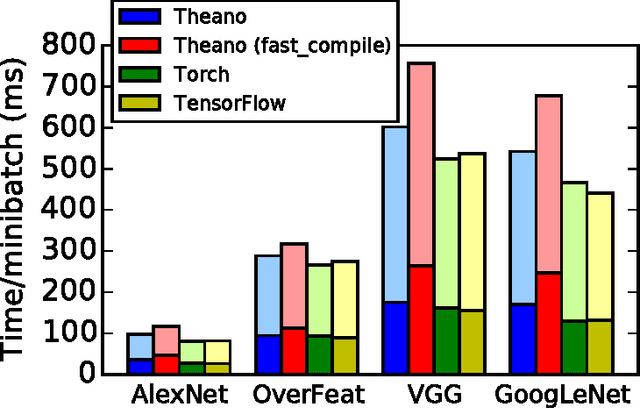
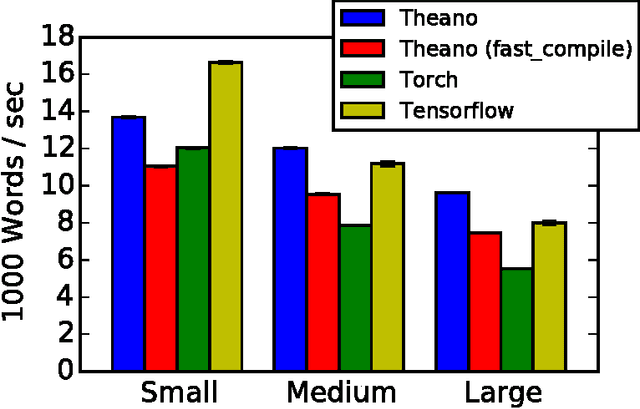
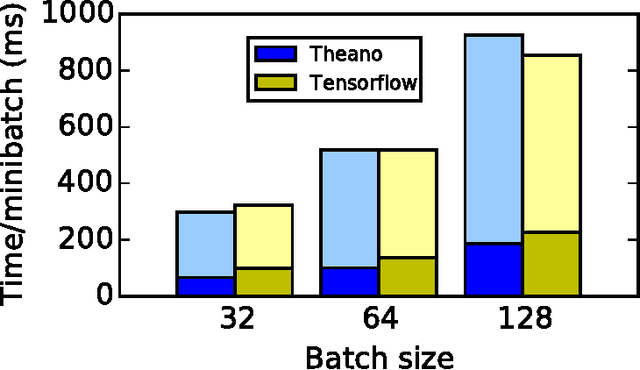
Theano is a Python library that allows to define, optimize, and evaluate mathematical expressions involving multi-dimensional arrays efficiently. Since its introduction, it has been one of the most used CPU and GPU mathematical compilers - especially in the machine learning community - and has shown steady performance improvements. Theano is being actively and continuously developed since 2008, multiple frameworks have been built on top of it and it has been used to produce many state-of-the-art machine learning models. The present article is structured as follows. Section I provides an overview of the Theano software and its community. Section II presents the principal features of Theano and how to use them, and compares them with other similar projects. Section III focuses on recently-introduced functionalities and improvements. Section IV compares the performance of Theano against Torch7 and TensorFlow on several machine learning models. Section V discusses current limitations of Theano and potential ways of improving it.
Variance Reduction in SGD by Distributed Importance Sampling
Apr 16, 2016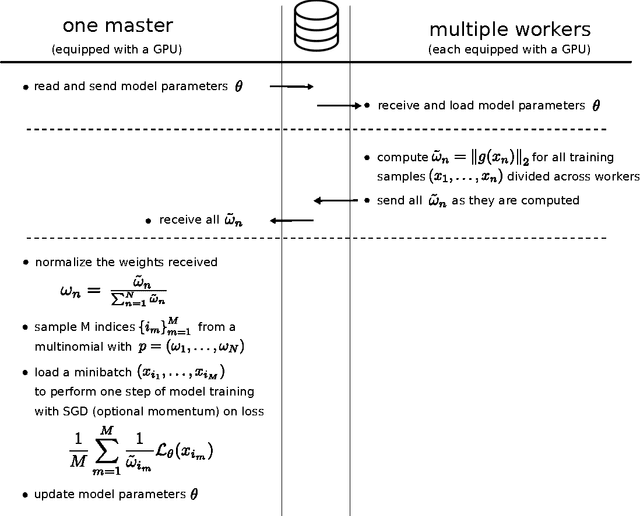
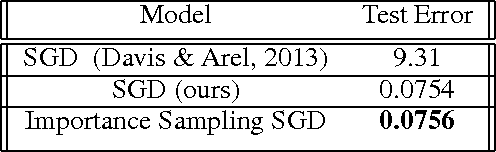
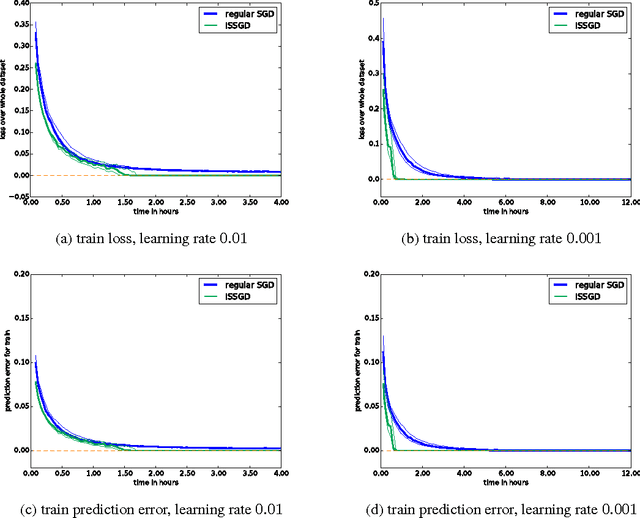
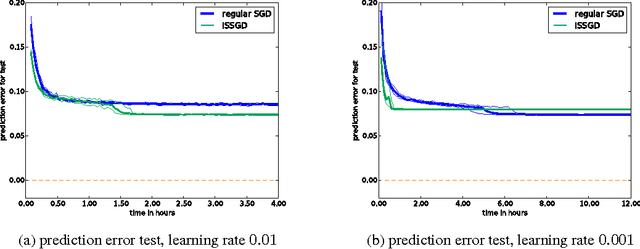
Humans are able to accelerate their learning by selecting training materials that are the most informative and at the appropriate level of difficulty. We propose a framework for distributing deep learning in which one set of workers search for the most informative examples in parallel while a single worker updates the model on examples selected by importance sampling. This leads the model to update using an unbiased estimate of the gradient which also has minimum variance when the sampling proposal is proportional to the L2-norm of the gradient. We show experimentally that this method reduces gradient variance even in a context where the cost of synchronization across machines cannot be ignored, and where the factors for importance sampling are not updated instantly across the training set.
Discriminative Regularization for Generative Models
Feb 15, 2016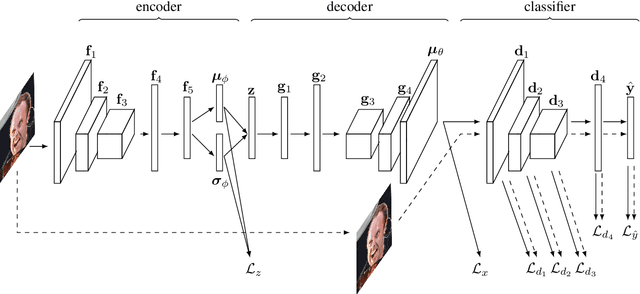
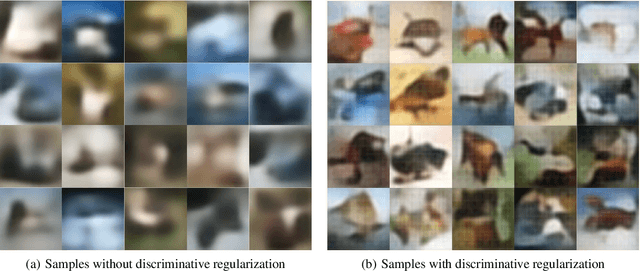
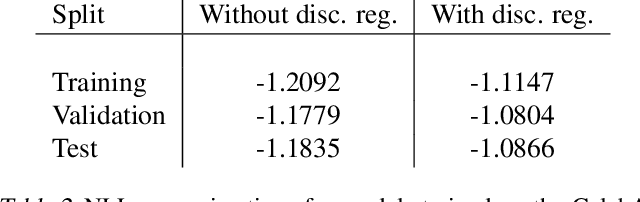
We explore the question of whether the representations learned by classifiers can be used to enhance the quality of generative models. Our conjecture is that labels correspond to characteristics of natural data which are most salient to humans: identity in faces, objects in images, and utterances in speech. We propose to take advantage of this by using the representations from discriminative classifiers to augment the objective function corresponding to a generative model. In particular we enhance the objective function of the variational autoencoder, a popular generative model, with a discriminative regularization term. We show that enhancing the objective function in this way leads to samples that are clearer and have higher visual quality than the samples from the standard variational autoencoders.