 Add to Chrome
 Add to Firefox
 Add to Edge
Simulator Adaptation for Sim-to-Real Learning of Legged Locomotion via Proprioceptive Distribution Matching
Apr 13, 2026
Simulation trained legged locomotion policies often exhibit performance loss on hardware due to dynamics discrepancies between the simulator and the real world, highlighting the need for approaches that adapt the simulator itself to better match hardware behavior. Prior work typically quantify these discrepancies through precise, time-aligned matching of joint and base trajectories. This process requires motion capture, privileged sensing, and carefully controlled initial conditions. We introduce a practical alternative based on proprioceptive distribution matching, which compares hardware and simulation rollouts as distributions of joint observations and actions, eliminating the need for time alignment or external sensing. Using this metric as a black-box objective, we explore adapting simulator dynamics through parameter identification, action-delta models, and residual actuator models. Our approach matches the parameter recovery and policy-performance gains of privileged state-matching baselines across extensive sim-to-sim ablations on the Go2 quadruped. Real-world experiments demonstrate substantial drift reduction using less than five minutes of hardware data, even for a challenging two-legged walking behavior. These results demonstrate that proprioceptive distribution matching provides a practical and effective route to simulator adaptation for sim-to-real transfer of learned legged locomotion.

Grounding Vision and Language to 3D Masks for Long-Horizon Box Rearrangement
Mar 24, 2026We study long-horizon planning in 3D environments from under-specified natural-language goals using only visual observations, focusing on multi-step 3D box rearrangement tasks. Existing approaches typically rely on symbolic planners with brittle relational grounding of states and goals, or on direct action-sequence generation from 2D vision-language models (VLMs). Both approaches struggle with reasoning over many objects, rich 3D geometry, and implicit semantic constraints. Recent advances in 3D VLMs demonstrate strong grounding of natural-language referents to 3D segmentation masks, suggesting the potential for more general planning capabilities. We extend existing 3D grounding models and propose Reactive Action Mask Planner (RAMP-3D), which formulates long-horizon planning as sequential reactive prediction of paired 3D masks: a "which-object" mask indicating what to pick and a "which-target-region" mask specifying where to place it. The resulting system processes RGB-D observations and natural-language task specifications to reactively generate multi-step pick-and-place actions for 3D box rearrangement. We conduct experiments across 11 task variants in warehouse-style environments with 1-30 boxes and diverse natural-language constraints. RAMP-3D achieves 79.5% success rate on long-horizon rearrangement tasks and significantly outperforms 2D VLM-based baselines, establishing mask-based reactive policies as a promising alternative to symbolic pipelines for long-horizon planning.
A Hybrid Modeling Framework for Crop Prediction Tasks via Dynamic Parameter Calibration and Multi-Task Learning
Mar 16, 2026Accurate prediction of crop states (e.g., phenology stages and cold hardiness) is essential for timely farm management decisions such as irrigation, fertilization, and canopy management to optimize crop yield and quality. While traditional biophysical models can be used for season-long predictions, they lack the precision required for site-specific management. Deep learning methods are a compelling alternative, but can produce biologically unrealistic predictions and require large-scale data. We propose a \emph{hybrid modeling} approach that uses a neural network to parameterize a differentiable biophysical model and leverages multi-task learning for efficient data sharing across crop cultivars in data limited settings. By predicting the \emph{parameters} of the biophysical model, our approach improves the prediction accuracy while preserving biological realism. Empirical evaluation using real-world and synthetic datasets demonstrates that our method improves prediction accuracy by 60\% for phenology and 40\% for cold hardiness compared to deployed biophysical models.
Humanoid Hanoi: Investigating Shared Whole-Body Control for Skill-Based Box Rearrangement
Feb 14, 2026We investigate a skill-based framework for humanoid box rearrangement that enables long-horizon execution by sequencing reusable skills at the task level. In our architecture, all skills execute through a shared, task-agnostic whole-body controller (WBC), providing a consistent closed-loop interface for skill composition, in contrast to non-shared designs that use separate low-level controllers per skill. We find that naively reusing the same pretrained WBC can reduce robustness over long horizons, as new skills and their compositions induce shifted state and command distributions. We address this with a simple data aggregation procedure that augments shared-WBC training with rollouts from closed-loop skill execution under domain randomization. To evaluate the approach, we introduce \emph{Humanoid Hanoi}, a long-horizon Tower-of-Hanoi box rearrangement benchmark, and report results in simulation and on the Digit V3 humanoid robot, demonstrating fully autonomous rearrangement over extended horizons and quantifying the benefits of the shared-WBC approach over non-shared baselines.
Multi-Quadruped Cooperative Object Transport: Learning Decentralized Pinch-Lift-Move
Sep 19, 2025We study decentralized cooperative transport using teams of N-quadruped robots with arm that must pinch, lift, and move ungraspable objects through physical contact alone. Unlike prior work that relies on rigid mechanical coupling between robots and objects, we address the more challenging setting where mechanically independent robots must coordinate through contact forces alone without any communication or centralized control. To this end, we employ a hierarchical policy architecture that separates base locomotion from arm control, and propose a constellation reward formulation that unifies position and orientation tracking to enforce rigid contact behavior. The key insight is encouraging robots to behave as if rigidly connected to the object through careful reward design and training curriculum rather than explicit mechanical constraints. Our approach enables coordination through shared policy parameters and implicit synchronization cues - scaling to arbitrary team sizes without retraining. We show extensive simulation experiments to demonstrate robust transport across 2-10 robots on diverse object geometries and masses, along with sim2real transfer results on lightweight objects.
Evaluating Robots Like Human Infants: A Case Study of Learned Bipedal Locomotion
Jul 08, 2025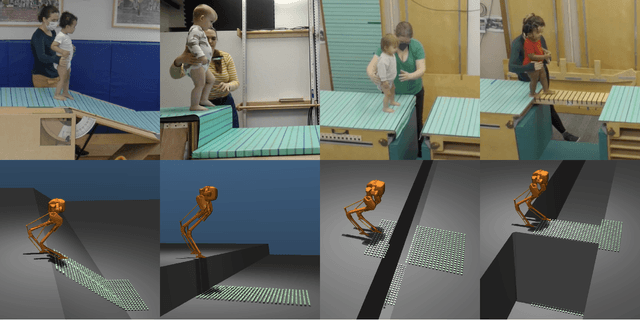
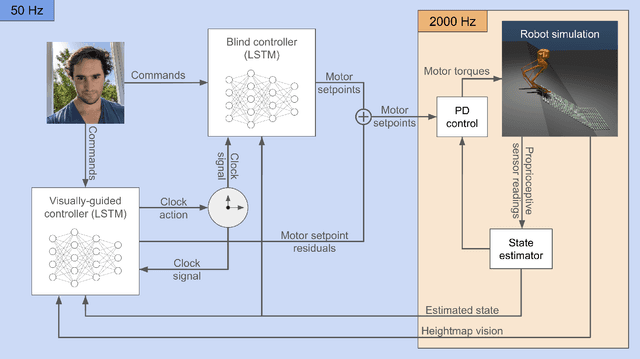
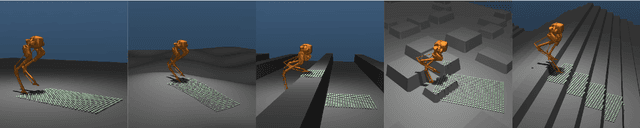
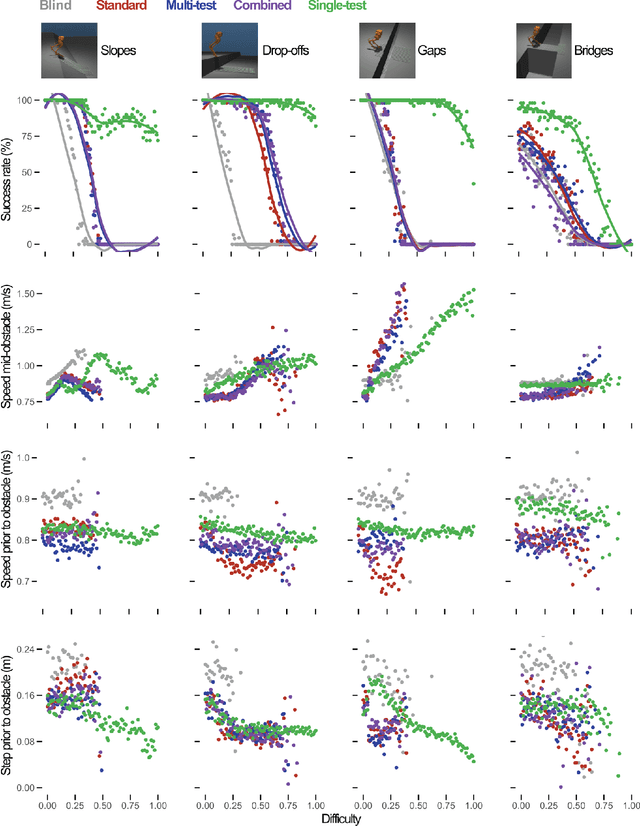
Typically, learned robot controllers are trained via relatively unsystematic regimens and evaluated with coarse-grained outcome measures such as average cumulative reward. The typical approach is useful to compare learning algorithms but provides limited insight into the effects of different training regimens and little understanding about the richness and complexity of learned behaviors. Likewise, human infants and other animals are "trained" via unsystematic regimens, but in contrast, developmental psychologists evaluate their performance in highly-controlled experiments with fine-grained measures such as success, speed of walking, and prospective adjustments. However, the study of learned behavior in human infants is limited by the practical constraints of training and testing babies. Here, we present a case study that applies methods from developmental psychology to study the learned behavior of the simulated bipedal robot Cassie. Following research on infant walking, we systematically designed reinforcement learning training regimens and tested the resulting controllers in simulated environments analogous to those used for babies--but without the practical constraints. Results reveal new insights into the behavioral impact of different training regimens and the development of Cassie's learned behaviors relative to infants who are learning to walk. This interdisciplinary baby-robot approach provides inspiration for future research designed to systematically test effects of training on the development of complex learned robot behaviors.
Transfer Learning via Auxiliary Labels with Application to Cold-Hardiness Prediction
Apr 17, 2025Cold temperatures can cause significant frost damage to fruit crops depending on their resilience, or cold hardiness, which changes throughout the dormancy season. This has led to the development of predictive cold-hardiness models, which help farmers decide when to deploy expensive frost-mitigation measures. Unfortunately, cold-hardiness data for model training is only available for some fruit cultivars due to the need for specialized equipment and expertise. Rather, farmers often do have years of phenological data (e.g. date of budbreak) that they regularly collect for their crops. In this work, we introduce a new transfer-learning framework, Transfer via Auxiliary Labels (TAL), that allows farmers to leverage the phenological data to produce more accurate cold-hardiness predictions, even when no cold-hardiness data is available for their specific crop. The framework assumes a set of source tasks (cultivars) where each has associated primary labels (cold hardiness) and auxiliary labels (phenology). However, the target task (new cultivar) is assumed to only have the auxiliary labels. The goal of TAL is to predict primary labels for the target task via transfer from the source tasks. Surprisingly, despite the vast literature on transfer learning, to our knowledge, the TAL formulation has not been previously addressed. Thus, we propose several new TAL approaches based on model selection and averaging that can leverage recent deep multi-task models for cold-hardiness prediction. Our results on real-world cold-hardiness and phenological data for multiple grape cultivars demonstrate that TAL can leverage the phenological data to improve cold-hardiness predictions in the absence of cold-hardiness data.
Self-attention-based Diffusion Model for Time-series Imputation in Partial Blackout Scenarios
Mar 03, 2025Missing values in multivariate time series data can harm machine learning performance and introduce bias. These gaps arise from sensor malfunctions, blackouts, and human error and are typically addressed by data imputation. Previous work has tackled the imputation of missing data in random, complete blackouts and forecasting scenarios. The current paper addresses a more general missing pattern, which we call "partial blackout," where a subset of features is missing for consecutive time steps. We introduce a two-stage imputation process using self-attention and diffusion processes to model feature and temporal correlations. Notably, our model effectively handles missing data during training, enhancing adaptability and ensuring reliable imputation and performance, even with incomplete datasets. Our experiments on benchmark and two real-world time series datasets demonstrate that our model outperforms the state-of-the-art in partial blackout scenarios and shows better scalability.
WOFOSTGym: A Crop Simulator for Learning Annual and Perennial Crop Management Strategies
Feb 26, 2025We introduce WOFOSTGym, a novel crop simulation environment designed to train reinforcement learning (RL) agents to optimize agromanagement decisions for annual and perennial crops in single and multi-farm settings. Effective crop management requires optimizing yield and economic returns while minimizing environmental impact, a complex sequential decision-making problem well suited for RL. However, the lack of simulators for perennial crops in multi-farm contexts has hindered RL applications in this domain. Existing crop simulators also do not support multiple annual crops. WOFOSTGym addresses these gaps by supporting 23 annual crops and two perennial crops, enabling RL agents to learn diverse agromanagement strategies in multi-year, multi-crop, and multi-farm settings. Our simulator offers a suite of challenging tasks for learning under partial observability, non-Markovian dynamics, and delayed feedback. WOFOSTGym's standard RL interface allows researchers without agricultural expertise to explore a wide range of agromanagement problems. Our experiments demonstrate the learned behaviors across various crop varieties and soil types, highlighting WOFOSTGym's potential for advancing RL-driven decision support in agriculture.
Generating Physically Realistic and Directable Human Motions from Multi-Modal Inputs
Feb 08, 2025This work focuses on generating realistic, physically-based human behaviors from multi-modal inputs, which may only partially specify the desired motion. For example, the input may come from a VR controller providing arm motion and body velocity, partial key-point animation, computer vision applied to videos, or even higher-level motion goals. This requires a versatile low-level humanoid controller that can handle such sparse, under-specified guidance, seamlessly switch between skills, and recover from failures. Current approaches for learning humanoid controllers from demonstration data capture some of these characteristics, but none achieve them all. To this end, we introduce the Masked Humanoid Controller (MHC), a novel approach that applies multi-objective imitation learning on augmented and selectively masked motion demonstrations. The training methodology results in an MHC that exhibits the key capabilities of catch-up to out-of-sync input commands, combining elements from multiple motion sequences, and completing unspecified parts of motions from sparse multimodal input. We demonstrate these key capabilities for an MHC learned over a dataset of 87 diverse skills and showcase different multi-modal use cases, including integration with planning frameworks to highlight MHC's ability to solve new user-defined tasks without any finetuning.