 Add to Chrome
 Add to Firefox
 Add to Edge
Training the Orchestrator: A Supervised Approach to End-to-End PDDL Planning with LLM Agents
Jun 19, 2026
Translating natural-language planning intent into verified plans is a longstanding challenge: people communicate goals in language, while classical planners require formal PDDL specifications. Recent agentic frameworks bridge this gap by orchestrating a pool of specialized repair agents inside a verifier-checked refinement loop, but the orchestrator at the centre is itself a prompted frontier LLM, paying a frontier-LLM API call at every refinement step. We present HALO (Hybrid Agent-Learned Orchestrator), which trains the orchestrator from refinement trajectories that an external verifier has certified as ending in valid plans, across 11 PDDL domains. HALO pairs a small QLoRA-tuned policy with three hardcoded rules for trivially decidable selections, and operates over an expanded 21-agent action space. Unlike approaches that prompt a frontier LLM at every step or learn an orchestrator from sparse end-of-episode rewards, our key observation is that the verifier already provides strong guidance: every accepted trajectory is a sequence of demonstrably correct (state, agent) decisions, directly usable as supervision. Across PlanBench, Natural Plan, and classical planning benchmarks, HALO matches or exceeds the GPT-5-mini prompted baseline on success rate, sits within three percentage points of the stronger Gemini-3-Flash prompted baseline, reduces orchestration cost by more than an order of magnitude (\$0.18 to \$0.004 per task against GPT-5-mini, roughly 45$\times$ cheaper; roughly 15$\times$ cheaper than Gemini-3-Flash), and cuts total LLM calls per episode by 40 to 50 percent.

GLARE: A Natural Language Interface for Querying Global Explanations
Jun 18, 2026While global explanations are crucial for understanding vision models across datasets, classes, and decision contexts, their complex and monolithic nature often hinders practical exploration. Because users typically seek targeted answers to specific questions rather than static artifacts, we present an LLM-based interactive interface that provides natural language access to global explanations for black-box image classifiers. The system's core LLM acts as a mediator, translating natural language questions into structured SQL queries over local explanation data. This enables flexible aggregation without exposing users to low-level representations. For each query, the interface outputs statistics-augmented natural language responses, supporting local explanations, and intent-aligned visualizations. We evaluate the system on intent interpretation, query mapping accuracy, generalization to novel queries and datasets, and robustness to linguistic errors. Our results demonstrate that LLM-mediated querying substantially improves the accessibility and usability of global explanations for human-centered XAI.
Planning with affordances: Integrating learned affordance models and symbolic planning
Feb 04, 2025Intelligent agents working in real-world environments must be able to learn about the environment and its capabilities which enable them to take actions to change to the state of the world to complete a complex multi-step task in a photorealistic environment. Learning about the environment is especially important to perform various multiple-step tasks without having to redefine an agent's action set for different tasks or environment settings. In our work, we augment an existing task and motion planning framework with learned affordance models of objects in the world to enable planning and executing multi-step tasks using learned models. Each task can be seen as changing the current state of the world to a given goal state. The affordance models provide us with what actions are possible and how to perform those actions in any given state. A symbolic planning algorithm uses this information and the starting and goal state to create a feasible plan to reach the desired goal state to complete a given task. We demonstrate our approach in a virtual 3D photorealistic environment, AI2-Thor, and evaluate it on real-world tasks. Our results show that our agent quickly learns how to interact with the environment and is well prepared to perform tasks such as "Moving an object out of the way to reach the desired location."
GABAR: Graph Attention-Based Action Ranking for Relational Policy Learning
Dec 06, 2024We propose a novel approach to learn relational policies for classical planning based on learning to rank actions. We introduce a new graph representation that explicitly captures action information and propose a Graph Neural Network architecture augmented with Gated Recurrent Units (GRUs) to learn action rankings. Our model is trained on small problem instances and generalizes to significantly larger instances where traditional planning becomes computationally expensive. Experimental results across standard planning benchmarks demonstrate that our action-ranking approach achieves generalization to significantly larger problems than those used in training.
Hierarchical Object-Oriented POMDP Planning for Object Rearrangement
Dec 02, 2024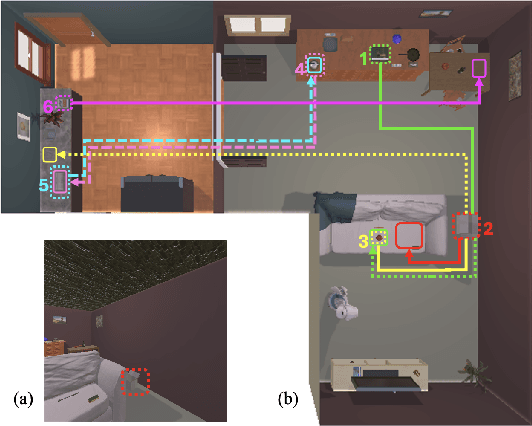
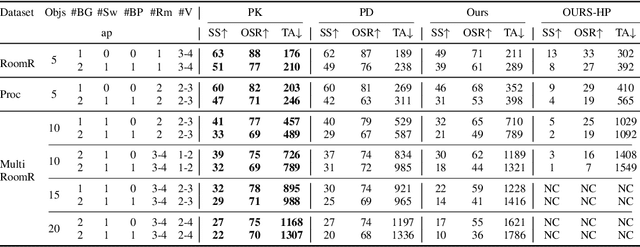
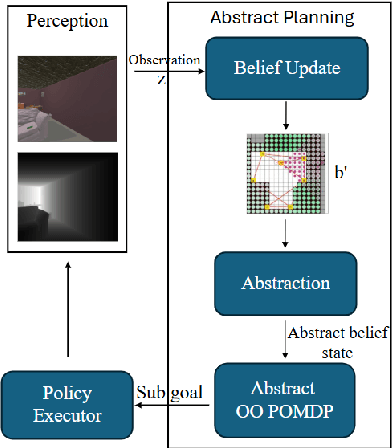
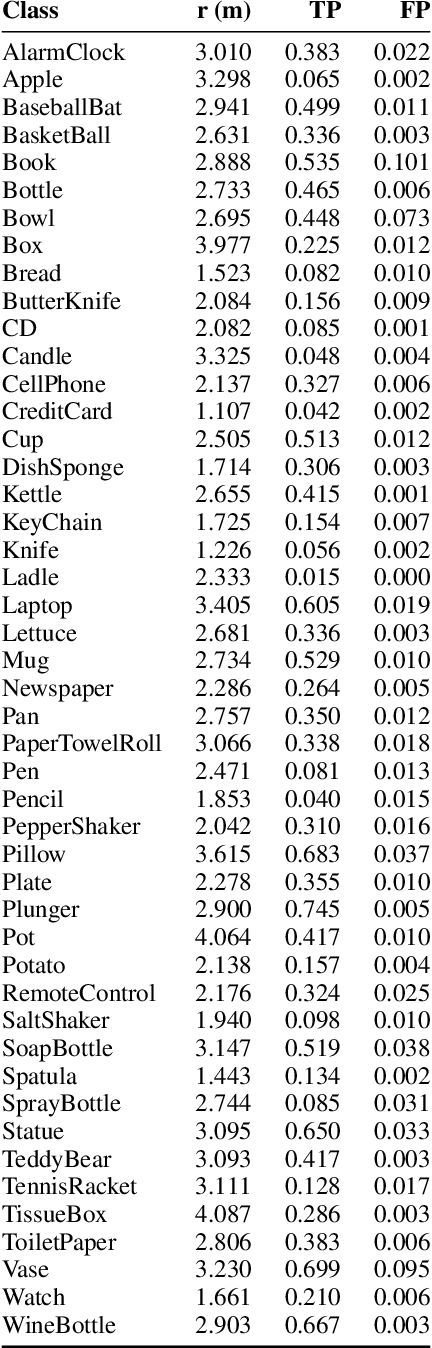
We present an online planning framework for solving multi-object rearrangement problems in partially observable, multi-room environments. Current object rearrangement solutions, primarily based on Reinforcement Learning or hand-coded planning methods, often lack adaptability to diverse challenges. To address this limitation, we introduce a novel Hierarchical Object-Oriented Partially Observed Markov Decision Process (HOO-POMDP) planning approach. This approach comprises of (a) an object-oriented POMDP planner generating sub-goals, (b) a set of low-level policies for sub-goal achievement, and (c) an abstraction system converting the continuous low-level world into a representation suitable for abstract planning. We evaluate our system on varying numbers of objects, rooms, and problem types in AI2-THOR simulated environments with promising results.
Learning Agents With Prioritization and Parameter Noise in Continuous State and Action Space
Oct 15, 2024Among the many variants of RL, an important class of problems is where the state and action spaces are continuous -- autonomous robots, autonomous vehicles, optimal control are all examples of such problems that can lend themselves naturally to reinforcement based algorithms, and have continuous state and action spaces. In this paper, we introduce a prioritized form of a combination of state-of-the-art approaches such as Deep Q-learning (DQN) and Deep Deterministic Policy Gradient (DDPG) to outperform the earlier results for continuous state and action space problems. Our experiments also involve the use of parameter noise during training resulting in more robust deep RL models outperforming the earlier results significantly. We believe these results are a valuable addition for continuous state and action space problems.
* 10 pages, 3 figures. Published in Advances in Neural Networks - ISNN 2019