 Add to Chrome
 Add to Firefox
 Add to Edge
ThAME: 3D Memory-Enabled Heterogeneous Accelerator for LLM Mixture of Experts
Jul 19, 2026
Mixture of Experts (MoE) architectures have emerged as a dominant paradigm for scaling Large Language Models (LLMs). However, MoE inference on conventional hardware is constrained by three fundamental bottlenecks. These encompass the massive memory bandwidth required to fetch non-contiguous expert weights, the non-deterministic scatter-gather traffic generated by input-dependent token routing, and the tail-latency dependency imposed by synchronous expert output aggregation. To address these challenges, we propose ThAME, a three-dimensional (3D) heterogeneous multi-chiplet architecture for MoE inference. ThAME employs Ferroelectric Field-Effect Transistor (FeFET)-based non-volatile and DRAM-based volatile memory chiplets with a co-designed compute mapping strategy that aligns the distinct computational profiles of attention mechanisms and expert routing. Furthermore, we design a specialized Network-on-Chip communication backbone optimized to mitigate the bottlenecks associated with non-deterministic token routing traffic across the combinatorial space of input-dependent MoE traffic patterns. Experimental results demonstrate that ThAME outperforms state-of-the-art counterparts by up to 15.7x in terms of speedup and improves energy efficiency by up to 9.8x.

ThRIve: Thermally Robust CNN Inference via Low-Rank Adaptation in Heterogeneous PIM Architectures
Jul 19, 2026Processing-In-Memory (PIM) has emerged as a promising technology for accelerating machine learning (ML) workloads. Specifically, non-volatile memory-based PIM architectures have enabled effective ML acceleration due to their ability to perform energy-efficient matrix-vector multiplication operations. However, these devices suffer from non-idealities such as thermal noise. This noise alters the stored values in the memory cells which correspond to actual model weights, compromising the inference accuracy. In this work, we introduce ThRIve, a noise-aware training methodology that leverages low-rank adaptation to enable thermally robust inference on heterogeneous PIM architectures. ThRIve selectively stores these low-rank noise-aware parameters on a hardware that is less susceptible to thermal noise, enabling robustness against temperature-induced noise variations. ThRIve mitigates the effects of thermal-noise and prevent the drop in inference accuracy across the entire operating temperature range. Experimental results demonstrate that ThRIve-enabled architectures maintain consistent inference accuracy, with the mean accuracy staying within 2% of the ideal (i.e., noise-free) accuracy, and the variation in accuracy across the entire operating temperature range remaining within 2% of the mean. The proposed methodology achieves accuracy and robustness comparable to thermally-resilient Static Random-Access Memory (SRAM)-based PIM systems, while delivering up to 5.4x reduction in energy-delay product (EDP) during CNN model inferencing.
* Published in ACM Transactions on Design Automation of Electronic Systems, Volume 31, Issue 2
SteinGate: Tail-Sensitive Safe Reinforcement Learning via Stein Discrepancy
Jul 14, 2026Safe reinforcement learning typically enforces safety by bounding expected cumulative costs, a criterion that often fails to detect rare but catastrophic tail events. To overcome these limitations, this paper introduces SteinGate, a boundary-aware distributional safety certificate that replaces fragile tail fitting with a robust consistency check using Kernelized Stein Discrepancy while accounting for boundary atoms induced by clipped costs. SteinGate evaluates whether observed policy rollout costs remain consistent with a safe reference distribution, providing a non-parametric safety certificate. This certificate is used to dynamically adapt the learning regime: favoring reward-improving policy updates when rollouts remain consistent with the safe reference and switching to recovery behavior when the cost tail deviates. Experiments on continuous-control benchmarks demonstrate that SteinGate significantly reduces both the frequency and severity of constraint violations during training while maintaining competitive returns relative to state-of-the-art baselines.
Conformal Margin Risk Minimization: An Envelope Framework for Robust Learning under Label Noise
Apr 07, 2026Most methods for learning with noisy labels require privileged knowledge such as noise transition matrices, clean subsets or pretrained feature extractors, resources typically unavailable when robustness is most needed. We propose Conformal Margin Risk Minimization (CMRM), a plug-and-play envelope framework that improves any classification loss under label noise by adding a single quantile-calibrated regularization term, with no privileged knowledge or training pipeline modification. CMRM measures the confidence margin between the observed label and competing labels, and thresholds it with a conformal quantile estimated per batch to focus training on high-margin samples while suppressing likely mislabeled ones. We derive a learning bound for CMRM under arbitrary label noise requiring only mild regularity of the margin distribution. Across five base methods and six benchmarks with synthetic and real-world noise, CMRM consistently improves accuracy (up to +3.39%), reduces conformal prediction set size (up to -20.44%) and does not hurt under 0% noise, showing that CMRM captures a method-agnostic uncertainty signal that existing mechanisms did not exploit.
Direct Prediction Set Minimization via Bilevel Conformal Classifier Training
Jun 07, 2025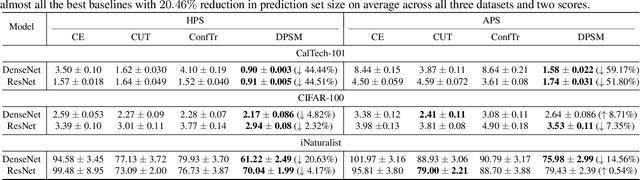
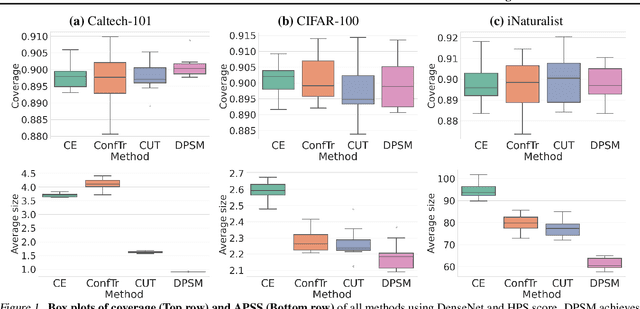
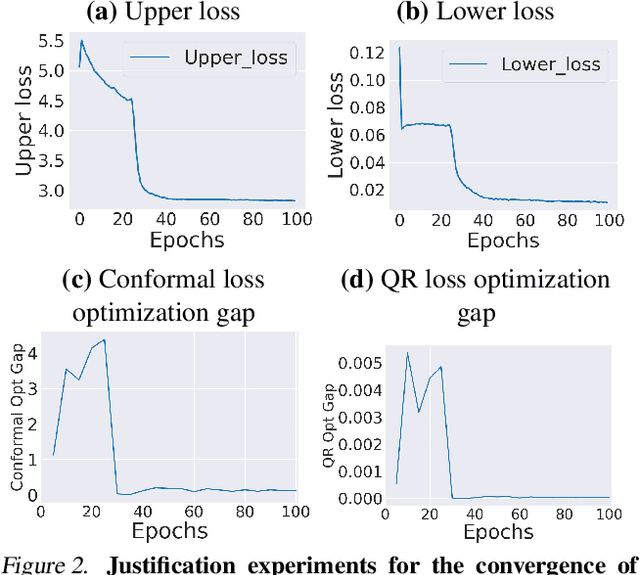
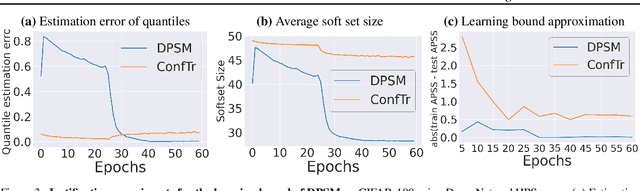
Conformal prediction (CP) is a promising uncertainty quantification framework which works as a wrapper around a black-box classifier to construct prediction sets (i.e., subset of candidate classes) with provable guarantees. However, standard calibration methods for CP tend to produce large prediction sets which makes them less useful in practice. This paper considers the problem of integrating conformal principles into the training process of deep classifiers to directly minimize the size of prediction sets. We formulate conformal training as a bilevel optimization problem and propose the {\em Direct Prediction Set Minimization (DPSM)} algorithm to solve it. The key insight behind DPSM is to minimize a measure of the prediction set size (upper level) that is conditioned on the learned quantile of conformity scores (lower level). We analyze that DPSM has a learning bound of $O(1/\sqrt{n})$ (with $n$ training samples), while prior conformal training methods based on stochastic approximation for the quantile has a bound of $\Omega(1/s)$ (with batch size $s$ and typically $s \ll \sqrt{n}$). Experiments on various benchmark datasets and deep models show that DPSM significantly outperforms the best prior conformal training baseline with $20.46\%\downarrow$ in the prediction set size and validates our theory.
Atleus: Accelerating Transformers on the Edge Enabled by 3D Heterogeneous Manycore Architectures
Jan 16, 2025Transformer architectures have become the standard neural network model for various machine learning applications including natural language processing and computer vision. However, the compute and memory requirements introduced by transformer models make them challenging to adopt for edge applications. Furthermore, fine-tuning pre-trained transformers (e.g., foundation models) is a common task to enhance the model's predictive performance on specific tasks/applications. Existing transformer accelerators are oblivious to complexities introduced by fine-tuning. In this paper, we propose the design of a three-dimensional (3D) heterogeneous architecture referred to as Atleus that incorporates heterogeneous computing resources specifically optimized to accelerate transformer models for the dual purposes of fine-tuning and inference. Specifically, Atleus utilizes non-volatile memory and systolic array for accelerating transformer computational kernels using an integrated 3D platform. Moreover, we design a suitable NoC to achieve high performance and energy efficiency. Finally, Atleus adopts an effective quantization scheme to support model compression. Experimental results demonstrate that Atleus outperforms existing state-of-the-art by up to 56x and 64.5x in terms of performance and energy efficiency respectively
Constraint-Adaptive Policy Switching for Offline Safe Reinforcement Learning
Dec 25, 2024Offline safe reinforcement learning (OSRL) involves learning a decision-making policy to maximize rewards from a fixed batch of training data to satisfy pre-defined safety constraints. However, adapting to varying safety constraints during deployment without retraining remains an under-explored challenge. To address this challenge, we introduce constraint-adaptive policy switching (CAPS), a wrapper framework around existing offline RL algorithms. During training, CAPS uses offline data to learn multiple policies with a shared representation that optimize different reward and cost trade-offs. During testing, CAPS switches between those policies by selecting at each state the policy that maximizes future rewards among those that satisfy the current cost constraint. Our experiments on 38 tasks from the DSRL benchmark demonstrate that CAPS consistently outperforms existing methods, establishing a strong wrapper-based baseline for OSRL. The code is publicly available at https://github.com/yassineCh/CAPS.
Non-Myopic Multi-Objective Bayesian Optimization
Dec 11, 2024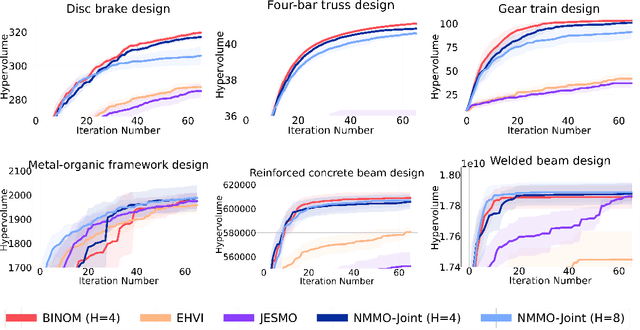
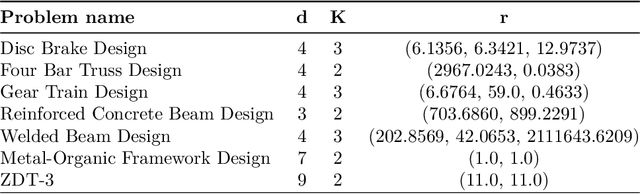
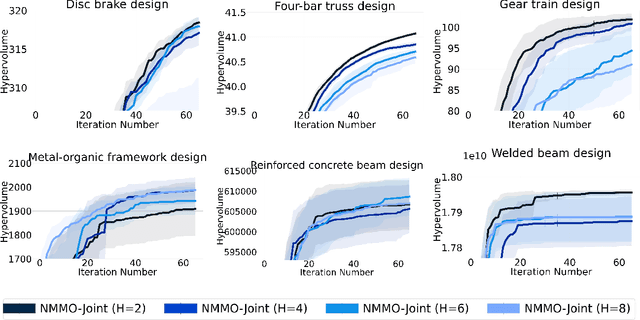
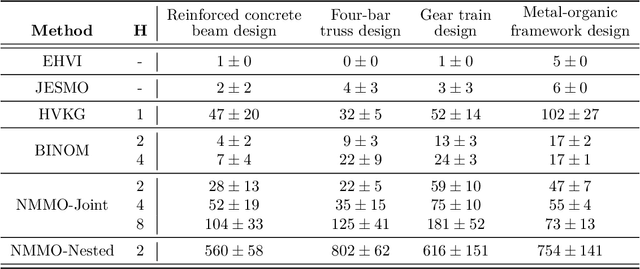
We consider the problem of finite-horizon sequential experimental design to solve multi-objective optimization (MOO) of expensive black-box objective functions. This problem arises in many real-world applications, including materials design, where we have a small resource budget to make and evaluate candidate materials in the lab. We solve this problem using the framework of Bayesian optimization (BO) and propose the first set of non-myopic methods for MOO problems. Prior work on non-myopic BO for single-objective problems relies on the Bellman optimality principle to handle the lookahead reasoning process. However, this principle does not hold for most MOO problems because the reward function needs to satisfy some conditions: scalar variable, monotonicity, and additivity. We address this challenge by using hypervolume improvement (HVI) as our scalarization approach, which allows us to use a lower-bound on the Bellman equation to approximate the finite-horizon using a batch expected hypervolume improvement (EHVI) acquisition function (AF) for MOO. Our formulation naturally allows us to use other improvement-based scalarizations and compare their efficacy to HVI. We derive three non-myopic AFs for MOBO: 1) the Nested AF, which is based on the exact computation of the lower bound, 2) the Joint AF, which is a lower bound on the nested AF, and 3) the BINOM AF, which is a fast and approximate variant based on batch multi-objective acquisition functions. Our experiments on multiple diverse real-world MO problems demonstrate that our non-myopic AFs substantially improve performance over the existing myopic AFs for MOBO.
HeTraX: Energy Efficient 3D Heterogeneous Manycore Architecture for Transformer Acceleration
Aug 06, 2024Transformers have revolutionized deep learning and generative modeling to enable unprecedented advancements in natural language processing tasks and beyond. However, designing hardware accelerators for executing transformer models is challenging due to the wide variety of computing kernels involved in the transformer architecture. Existing accelerators are either inadequate to accelerate end-to-end transformer models or suffer notable thermal limitations. In this paper, we propose the design of a three-dimensional heterogeneous architecture referred to as HeTraX specifically optimized to accelerate end-to-end transformer models. HeTraX employs hardware resources aligned with the computational kernels of transformers and optimizes both performance and energy. Experimental results show that HeTraX outperforms existing state-of-the-art by up to 5.6x in speedup and improves EDP by 14.5x while ensuring thermally feasibility.
Active Learning for Derivative-Based Global Sensitivity Analysis with Gaussian Processes
Jul 13, 2024
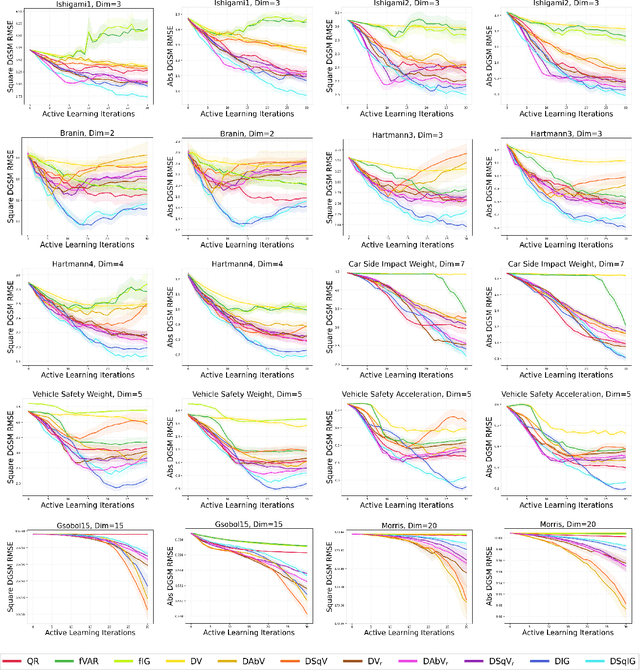
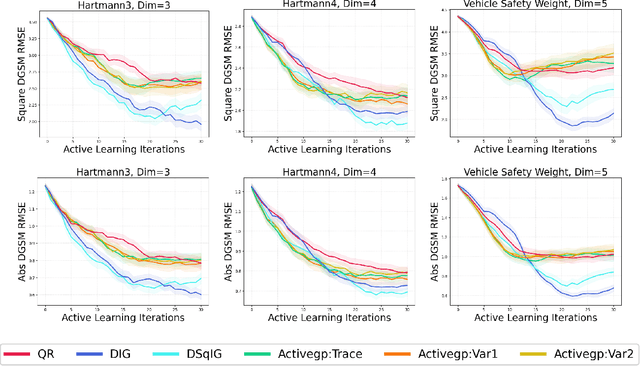
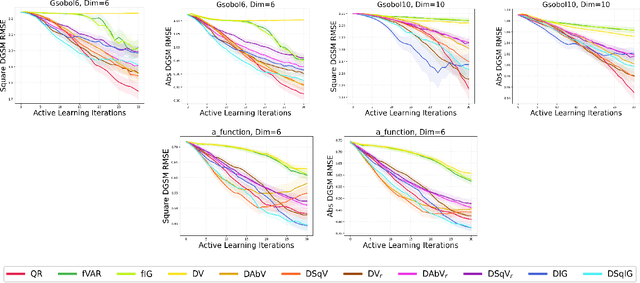
We consider the problem of active learning for global sensitivity analysis of expensive black-box functions. Our aim is to efficiently learn the importance of different input variables, e.g., in vehicle safety experimentation, we study the impact of the thickness of various components on safety objectives. Since function evaluations are expensive, we use active learning to prioritize experimental resources where they yield the most value. We propose novel active learning acquisition functions that directly target key quantities of derivative-based global sensitivity measures (DGSMs) under Gaussian process surrogate models. We showcase the first application of active learning directly to DGSMs, and develop tractable uncertainty reduction and information gain acquisition functions for these measures. Through comprehensive evaluation on synthetic and real-world problems, our study demonstrates how these active learning acquisition strategies substantially enhance the sample efficiency of DGSM estimation, particularly with limited evaluation budgets. Our work paves the way for more efficient and accurate sensitivity analysis in various scientific and engineering applications.