 Add to Chrome
 Add to Firefox
 Add to Edge
Training the Orchestrator: A Supervised Approach to End-to-End PDDL Planning with LLM Agents
Jun 19, 2026
Translating natural-language planning intent into verified plans is a longstanding challenge: people communicate goals in language, while classical planners require formal PDDL specifications. Recent agentic frameworks bridge this gap by orchestrating a pool of specialized repair agents inside a verifier-checked refinement loop, but the orchestrator at the centre is itself a prompted frontier LLM, paying a frontier-LLM API call at every refinement step. We present HALO (Hybrid Agent-Learned Orchestrator), which trains the orchestrator from refinement trajectories that an external verifier has certified as ending in valid plans, across 11 PDDL domains. HALO pairs a small QLoRA-tuned policy with three hardcoded rules for trivially decidable selections, and operates over an expanded 21-agent action space. Unlike approaches that prompt a frontier LLM at every step or learn an orchestrator from sparse end-of-episode rewards, our key observation is that the verifier already provides strong guidance: every accepted trajectory is a sequence of demonstrably correct (state, agent) decisions, directly usable as supervision. Across PlanBench, Natural Plan, and classical planning benchmarks, HALO matches or exceeds the GPT-5-mini prompted baseline on success rate, sits within three percentage points of the stronger Gemini-3-Flash prompted baseline, reduces orchestration cost by more than an order of magnitude (\$0.18 to \$0.004 per task against GPT-5-mini, roughly 45$\times$ cheaper; roughly 15$\times$ cheaper than Gemini-3-Flash), and cuts total LLM calls per episode by 40 to 50 percent.

Revisiting Reward Design and Evaluation for Robust Humanoid Standing and Walking
Apr 30, 2024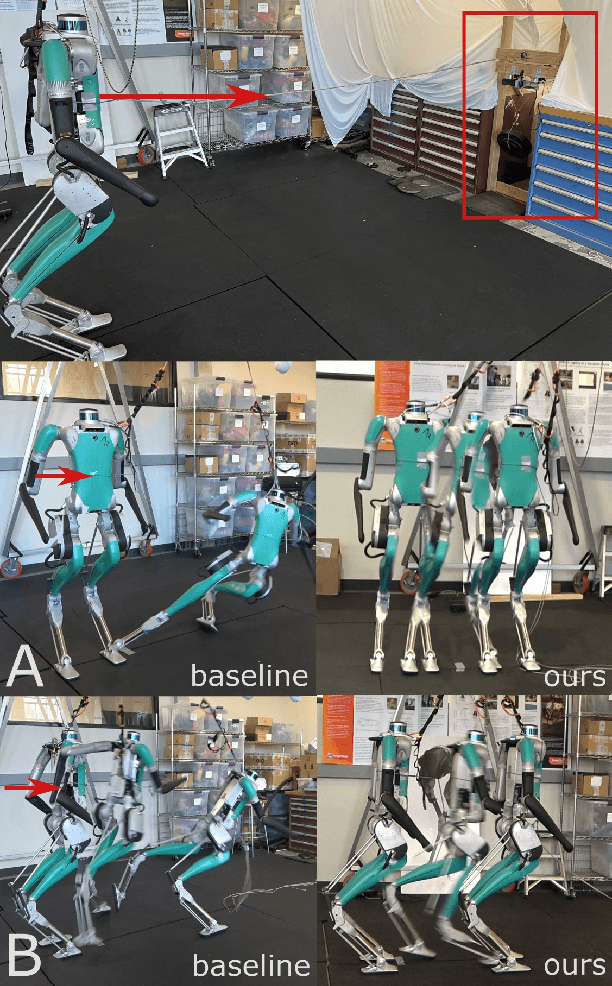
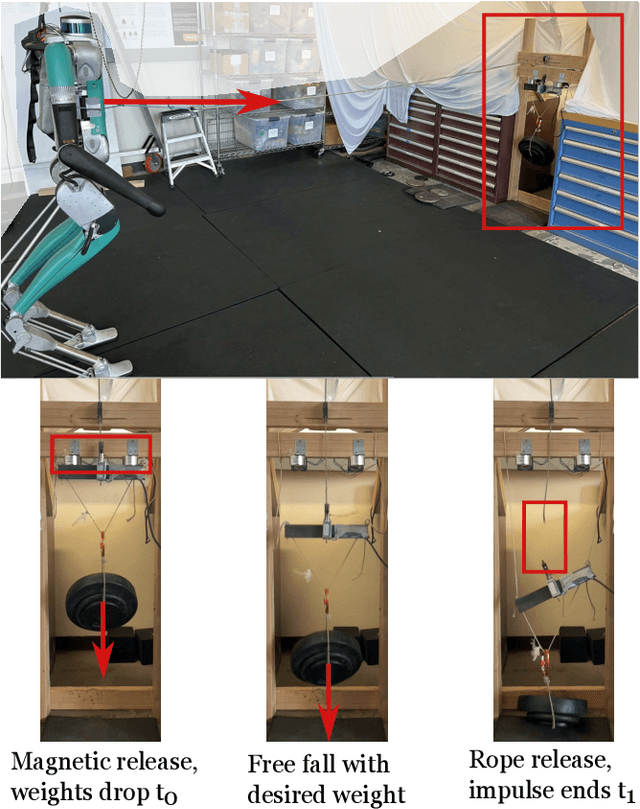
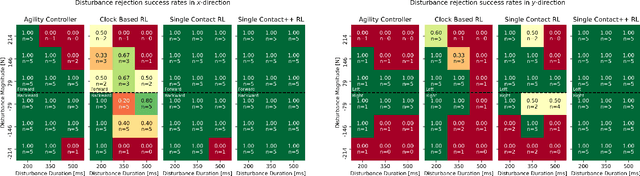
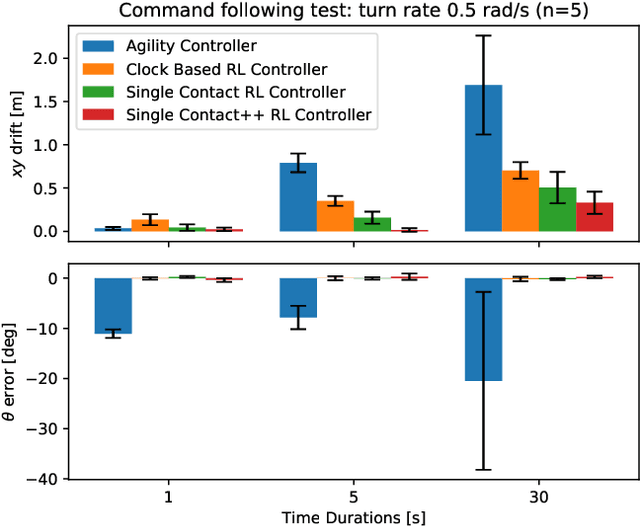
A necessary capability for humanoid robots is the ability to stand and walk while rejecting natural disturbances. Recent progress has been made using sim-to-real reinforcement learning (RL) to train such locomotion controllers, with approaches differing mainly in their reward functions. However, prior works lack a clear method to systematically test new reward functions and compare controller performance through repeatable experiments. This limits our understanding of the trade-offs between approaches and hinders progress. To address this, we propose a low-cost, quantitative benchmarking method to evaluate and compare the real-world performance of standing and walking (SaW) controllers on metrics like command following, disturbance recovery, and energy efficiency. We also revisit reward function design and construct a minimally constraining reward function to train SaW controllers. We experimentally verify that our benchmarking framework can identify areas for improvement, which can be systematically addressed to enhance the policies. We also compare our new controller to state-of-the-art controllers on the Digit humanoid robot. The results provide clear quantitative trade-offs among the controllers and suggest directions for future improvements to the reward functions and expansion of the benchmarks.
Semi-Bagging Based Deep Neural Architecture to Extract Text from High Entropy Images
Jul 02, 2019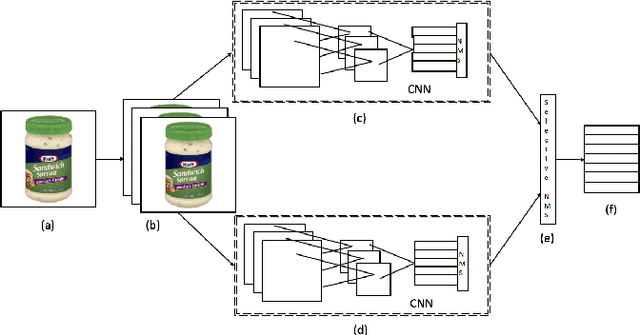
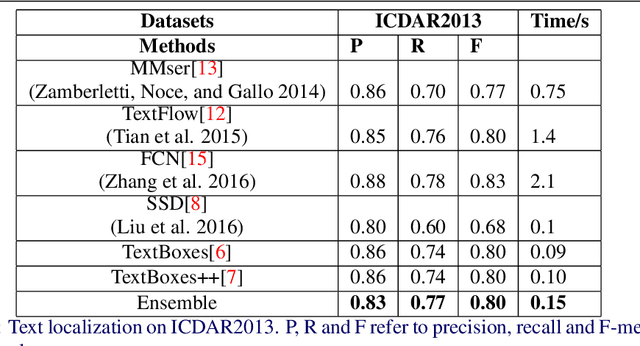
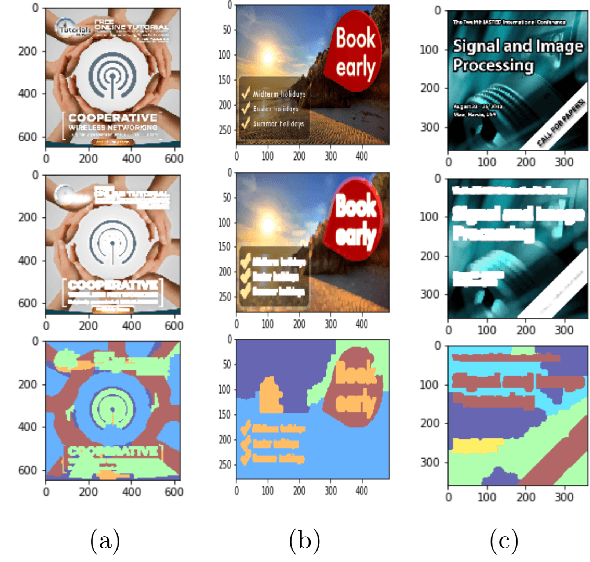
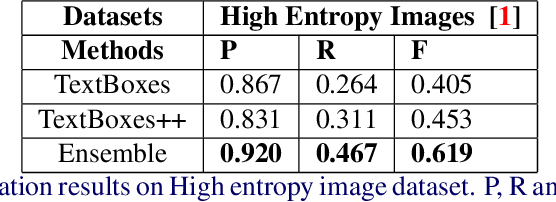
Extracting texts of various size and shape from images containing multiple objects is an important problem in many contexts, especially, in connection to e-commerce, augmented reality assistance system in natural scene, etc. The existing works (based on only CNN) often perform sub-optimally when the image contains regions of high entropy having multiple objects. This paper presents an end-to-end text detection strategy combining a segmentation algorithm and an ensemble of multiple text detectors of different types to detect text in every individual image segments independently. The proposed strategy involves a super-pixel based image segmenter which splits an image into multiple regions. A convolutional deep neural architecture is developed which works on each of the segments and detects texts of multiple shapes, sizes, and structures. It outperforms the competing methods in terms of coverage in detecting texts in images especially the ones where the text of various types and sizes are compacted in a small region along with various other objects. Furthermore, the proposed text detection method along with a text recognizer outperforms the existing state-of-the-art approaches in extracting text from high entropy images. We validate the results on a dataset consisting of product images on an e-commerce website.