 Add to Chrome
 Add to Firefox
 Add to Edge
LumaGuide: Distribution Shaping for Training-Free HDR Generation in Diffusion Models
Jul 28, 2026
Pretrained diffusion models generate realistic images but are constrained by the statistical biases of their training data, limiting their ability to produce high dynamic range (HDR) content. In this work, we introduce LumaGuide, a training-free framework for distribution shaping in diffusion models. Instead of modifying model parameters, LumaGuide steers the sampling process to match target feature distributions via differentiable energy-based guidance. We instantiate this framework for HDR generation by controlling luminance distributions in perceptually uniform PQ space. Our results show that aligning luminance histograms is sufficient to induce HDR-consistent behavior, including coherent highlights and preserved shadow detail, while maintaining semantic fidelity. Beyond HDR, LumaGuide enables flexible specification of target distributions through data-driven presets, reference images, or text-driven predictors, and extends naturally to video generation with temporal consistency constraints. More broadly, our work demonstrates that controllable generation can be achieved by directly shaping output distributions at sampling time, without retraining diffusion models.

CachedSearch: Training-Free Cached Exploration for Test-Time Search in Video Diffusion
Jul 25, 2026Test-time search lets small video diffusion models rival larger ones, but costs 2-10x more. All candidates are fully denoised, although most are discarded. Training-free caching makes each rollout 2-3x faster at near-lossless quality. Composition is safe only if lossy caching preserves verifier rankings. We present the first study of whether caching corrupts candidate ranking in video test-time search. On Wan2.1-T2V-1.3B with an adaptive caching wrapper (~2x per-candidate speedup), ImageReward scores seed-matched cached and full rollouts. Median per-prompt Spearman rank correlation is 0.905, with 72% top-1 agreement on the VBench suite. VBench-2.0 replicates this result on a harder suite. Recomputing the cached winner at full compute retains 90-94% of the full-search gain. Errors cluster among near-tied candidates, making corruption self-limiting. This finding leads to CachedSearch. It explores every candidate with aggressive caching, then re-generates only the winner at full compute. At N=8, it captures 94.7% of best-of-N's gain at 63% of the cost. Capture rises with width. At matched budget, it searches twice as wide for 38% more gain. The result holds from 1.3B-14B across six models and four families: Wan, LTX, CogVideoX, and Hunyuan. Wan2.1-14B matches the 1.3B model's fidelity. Mid-trajectory pruning multiplies the exploration saving to 3.11x at 88.6% capture. Ports to other model families require recalibrating a single parameter, showing that fidelity tracks architecture rather than parameter count. CachedSearch is training-free, verifier-agnostic, and orthogonal to the search algorithm, making it a plug-in multiplier for test-time scaling.
GenSP: Consistent Spherical Parameterization via Learning Shape Generative Models
Jul 01, 2026We introduce GenSP, a data-driven framework that learns consistent spherical parameterizations across a collection of genus-0 shapes. Instead of optimizing the parameterization of each shape independently, our method learns a neural generative model that predicts a continuous mapping from the unit sphere to shapes in a dataset. Under this formulation, spherical parameterizations are obtained through the inverse mappings of the learned generator, which encourages similar shapes to share consistent parameterizations. To make this formulation practical, we address several key challenges in learning such a generative model. First, we introduce a continuous neural deformation model that predicts surface points from sphere coordinates and latent shape codes, avoiding discretization artifacts common in mesh-based formulations. Second, we augment the training space with intermediate shapes that bridge the sphere and input shapes, allowing the model to learn meaningful deformations across a heterogeneous shape collection. Third, we compute reliable initial correspondences by propagating mappings along a spanning tree of training shapes in the latent space. Experiments on the ShapeNet dataset demonstrate that our approach significantly reduces geometric distortion and improves cross-shape consistency compared with state-of-the-art spherical parameterization methods.
Spatially Localized Image Degradation Embeddings for Image Quality Assessment
Jun 28, 2026Self-supervised learning (SSL) currently drives state-of-the-art performance in no-reference image quality assessment (NR-IQA). However, standard SSL pipelines uniformly apply synthetic distortions across the entire image field, which can limit their sensitivity to spatially localized and co-occurring degradations encountered in real-world content. In this work, we empirically expose this representational blind spot across existing state-of-the-art encoders, demonstrating their reduced sensitivity to spatially bounded image degradations. To bridge this gap, we introduce Spatial Localized Image Degradation Embeddings for Image Quality Assessment (SLIDE-IQA). SLIDE-IQA employs a dual-branch Vision Transformer framework that injects spatially bounded degradations into a contrastive pretraining objective. To handle the spatial complexity of these degradations, we introduce a Threshold-Bounded Exclusion Mechanism, a representational design choice that resolves structural conflicts arising from spatially localized distortions to ensure the latent space respects both degradation type and spatial scale. Finally, we show that SLIDE-IQA's synthetic-only pretraining significantly improves sensitivity to localized distortions, while achieving competitive performance on NR-IQA benchmarks against existing SSL NR-IQA models.
Subjective Portrait Region Cropping in Landscape Videos with Temporal Annotation Smoothing
Apr 27, 2026With the rise of mobile video consumption on diverse handheld display resolutions and orientation modes, altering videos to aspect ratios poses challenges. Static cropping and border padding often compromises visual quality, while warping may distort a video's intended meaning. Here we advocate for a more effective approach: cropping significant regions within video frames in a temporal manner, while minimizing distortion and preserving essential content. One barrier to solving this problem is the lack of sufficiently large-scale database devoted to informing these tasks. Towards filling this gap, we introduce the LIVE-YouTube Video Cropping (LIVE-YT VC) database, featuring 1800 videos, annotated by 90 human subjects. Using videos sourced from the YouTube-UGC and LSVQ Databases, this new resource is the largest publicly-available subjective video portrait region cropping database. We also introduce a post-processed version of the database, called LIVE-YT VC++, whereby a novel intra-frame temporal filter was deployed to smooth subjective annotations within each video. We demonstrate the usefulness of this new data resource using the SmartVidCrop algorithm and state-of-the-art video grounding models, in hopes of establishing our subjective dataset as a benchmark for future research. Our contributions offer a resource for advancing video aspect ratio transformation models towards ensuring that reshaped mobile-friendly video content retains its quality and meaning. Since our labels bear resemblances to video saliency annotations, we also conducted an additional analysis to explore the similarity between our labels and video saliency predictions. Finally, we repurposed state-of-the-art video grounding models for aspect ratio change tasks, and fine-tuned them on our dataset. As a service to the research community, we plan to open source the project.
LumaFlux: Lifting 8-Bit Worlds to HDR Reality with Physically-Guided Diffusion Transformers
Apr 03, 2026The rapid adoption of HDR-capable devices has created a pressing need to convert the 8-bit Standard Dynamic Range (SDR) content into perceptually and physically accurate 10-bit High Dynamic Range (HDR). Existing inverse tone-mapping (ITM) methods often rely on fixed tone-mapping operators that struggle to generalize to real-world degradations, stylistic variations, and camera pipelines, frequently producing clipped highlights, desaturated colors, or unstable tone reproduction. We introduce LumaFlux, a first physically and perceptually guided diffusion transformer (DiT) for SDR-to-HDR reconstruction by adapting a large pretrained DiT. Our LumaFlux introduces (1) a Physically-Guided Adaptation (PGA) module that injects luminance, spatial descriptors, and frequency cues into attention through low-rank residuals; (2) a Perceptual Cross-Modulation (PCM) layer that stabilizes chroma and texture via FiLM conditioning from vision encoder features; and (3) an HDR Residual Coupler that fuses physical and perceptual signals under a timestep- and layer-adaptive modulation schedule. Finally, a lightweight Rational-Quadratic Spline decoder reconstructs smooth, interpretable tone fields for highlight and exposure expansion, enhancing the output of the VAE decoder to generate HDR. To enable robust HDR learning, we curate the first large-scale SDR-HDR training corpus. For fair and reproducible comparison, we further establish a new evaluation benchmark, comprising HDR references and corresponding expert-graded SDR versions. Across benchmarks, LumaFlux outperforms state-of-the-art baselines, achieving superior luminance reconstruction and perceptual color fidelity with minimal additional parameters.
Seeing Beyond 8bits: Subjective and Objective Quality Assessment of HDR-UGC Videos
Mar 01, 2026High Dynamic Range (HDR) user-generated (UGC) videos are rapidly proliferating across social platforms, yet most perceptual video quality assessment (VQA) systems remain tailored to Standard Dynamic Range (SDR). HDR has a higher bit depth, wide color gamut, and elevated luminance range, exposing distortions such as near-black crushing, highlight clipping, banding, and exposure flicker that amplify UGC artifacts and challenge SDR models. To catalyze progress, we curate Beyond8Bits, a large-scale subjective dataset of 44K videos from 6.5K sources with over 1.5M crowd ratings, spanning diverse scenes, capture conditions, and compression settings. We further introduce HDR-Q, the first Multimodal Large Language Model (MLLM) for HDR-UGC VQA. We propose (i) a novel HDR-aware vision encoder to produce HDR-sensitive embeddings, and (ii) HDR-Aware Policy Optimization (HAPO), an RL finetuning framework that anchors reasoning to HDR cues. HAPO augments GRPO via an HDR-SDR contrastive KL that encourages token reliance on HDR inputs and a Gaussian weighted regression reward for fine-grained MOS calibration. Across Beyond8Bits and public HDR-VQA benchmarks, HDR-Q delivers state-of-the-art performance.
RegionRoute: Regional Style Transfer with Diffusion Model
Feb 22, 2026Precise spatial control in diffusion-based style transfer remains challenging. This challenge arises because diffusion models treat style as a global feature and lack explicit spatial grounding of style representations, making it difficult to restrict style application to specific objects or regions. To our knowledge, existing diffusion models are unable to perform true localized style transfer, typically relying on handcrafted masks or multi-stage post-processing that introduce boundary artifacts and limit generalization. To address this, we propose an attention-supervised diffusion framework that explicitly teaches the model where to apply a given style by aligning the attention scores of style tokens with object masks during training. Two complementary objectives, a Focus loss based on KL divergence and a Cover loss using binary cross-entropy, jointly encourage accurate localization and dense coverage. A modular LoRA-MoE design further enables efficient and scalable multi-style adaptation. To evaluate localized stylization, we introduce the Regional Style Editing Score, which measures Regional Style Matching through CLIP-based similarity within the target region and Identity Preservation via masked LPIPS and pixel-level consistency on unedited areas. Experiments show that our method achieves mask-free, single-object style transfer at inference, producing regionally accurate and visually coherent results that outperform existing diffusion-based editing approaches.
TABES: Trajectory-Aware Backward-on-Entropy Steering for Masked Diffusion Models
Jan 30, 2026Masked Diffusion Models (MDMs) have emerged as a promising non-autoregressive paradigm for generative tasks, offering parallel decoding and bidirectional context utilization. However, current sampling methods rely on simple confidence-based heuristics that ignore the long-term impact of local decisions, leading to trajectory lock-in where early hallucinations cascade into global incoherence. While search-based methods mitigate this, they incur prohibitive computational costs ($O(K)$ forward passes per step). In this work, we propose Backward-on-Entropy (BoE) Steering, a gradient-guided inference framework that approximates infinite-horizon lookahead via a single backward pass. We formally derive the Token Influence Score (TIS) from a first-order expansion of the trajectory cost functional, proving that the gradient of future entropy with respect to input embeddings serves as an optimal control signal for minimizing uncertainty. To ensure scalability, we introduce \texttt{ActiveQueryAttention}, a sparse adjoint primitive that exploits the structure of the masking objective to reduce backward pass complexity. BoE achieves a superior Pareto frontier for inference-time scaling compared to existing unmasking methods, demonstrating that gradient-guided steering offers a mathematically principled and efficient path to robust non-autoregressive generation. We will release the code.
Pro-Pose: Unpaired Full-Body Portrait Synthesis via Canonical UV Maps
Dec 19, 2025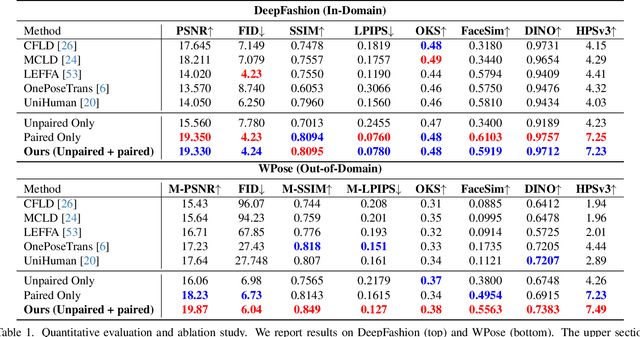
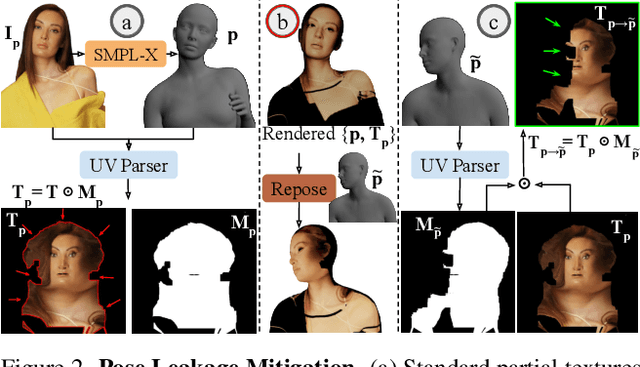
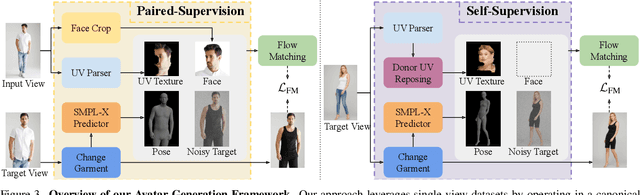

Photographs of people taken by professional photographers typically present the person in beautiful lighting, with an interesting pose, and flattering quality. This is unlike common photos people can take of themselves. In this paper, we explore how to create a ``professional'' version of a person's photograph, i.e., in a chosen pose, in a simple environment, with good lighting, and standard black top/bottom clothing. A key challenge is to preserve the person's unique identity, face and body features while transforming the photo. If there would exist a large paired dataset of the same person photographed both ``in the wild'' and by a professional photographer, the problem would potentially be easier to solve. However, such data does not exist, especially for a large variety of identities. To that end, we propose two key insights: 1) Our method transforms the input photo and person's face to a canonical UV space, which is further coupled with reposing methodology to model occlusions and novel view synthesis. Operating in UV space allows us to leverage existing unpaired datasets. 2) We personalize the output photo via multi image finetuning. Our approach yields high-quality, reposed portraits and achieves strong qualitative and quantitative performance on real-world imagery.