 Add to Chrome
 Add to Firefox
 Add to Edge
Spatially Localized Image Degradation Embeddings for Image Quality Assessment
Jun 28, 2026
Self-supervised learning (SSL) currently drives state-of-the-art performance in no-reference image quality assessment (NR-IQA). However, standard SSL pipelines uniformly apply synthetic distortions across the entire image field, which can limit their sensitivity to spatially localized and co-occurring degradations encountered in real-world content. In this work, we empirically expose this representational blind spot across existing state-of-the-art encoders, demonstrating their reduced sensitivity to spatially bounded image degradations. To bridge this gap, we introduce Spatial Localized Image Degradation Embeddings for Image Quality Assessment (SLIDE-IQA). SLIDE-IQA employs a dual-branch Vision Transformer framework that injects spatially bounded degradations into a contrastive pretraining objective. To handle the spatial complexity of these degradations, we introduce a Threshold-Bounded Exclusion Mechanism, a representational design choice that resolves structural conflicts arising from spatially localized distortions to ensure the latent space respects both degradation type and spatial scale. Finally, we show that SLIDE-IQA's synthetic-only pretraining significantly improves sensitivity to localized distortions, while achieving competitive performance on NR-IQA benchmarks against existing SSL NR-IQA models.

The Llama 4 Herd: Architecture, Training, Evaluation, and Deployment Notes
Jan 15, 2026This document consolidates publicly reported technical details about Metas Llama 4 model family. It summarizes (i) released variants (Scout and Maverick) and the broader herd context including the previewed Behemoth teacher model, (ii) architectural characteristics beyond a high-level MoE description covering routed/shared-expert structure, early-fusion multimodality, and long-context design elements reported for Scout (iRoPE and length generalization strategies), (iii) training disclosures spanning pre-training, mid-training for long-context extension, and post-training methodology (lightweight SFT, online RL, and lightweight DPO) as described in release materials, (iv) developer-reported benchmark results for both base and instruction-tuned checkpoints, and (v) practical deployment constraints observed across major serving environments, including provider-specific context limits and quantization packaging. The manuscript also summarizes licensing obligations relevant to redistribution and derivative naming, and reviews publicly described safeguards and evaluation practices. The goal is to provide a compact technical reference for researchers and practitioners who need precise, source-backed facts about Llama 4.
Leveraging Compression to Construct Transferable Bitrate Ladders
Dec 15, 2025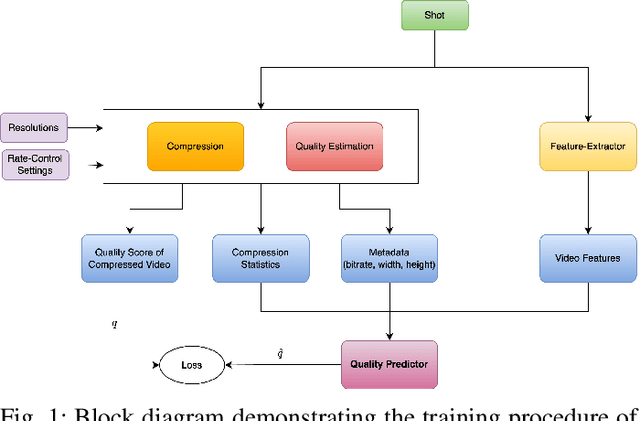
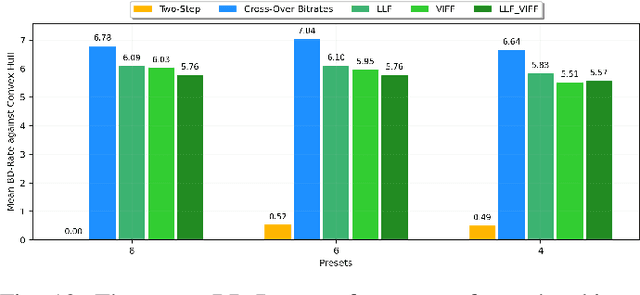
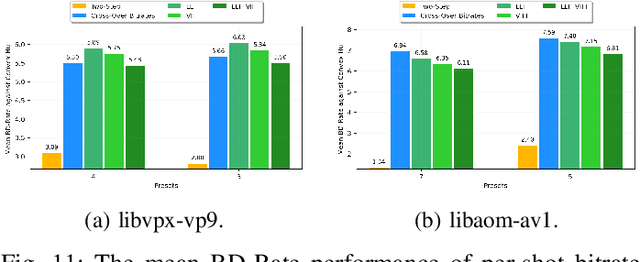
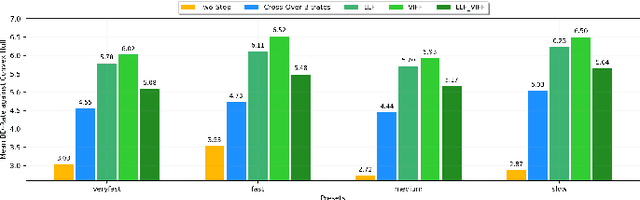
Over the past few years, per-title and per-shot video encoding techniques have demonstrated significant gains as compared to conventional techniques such as constant CRF encoding and the fixed bitrate ladder. These techniques have demonstrated that constructing content-gnostic per-shot bitrate ladders can provide significant bitrate gains and improved Quality of Experience (QoE) for viewers under various network conditions. However, constructing a convex hull for every video incurs a significant computational overhead. Recently, machine learning-based bitrate ladder construction techniques have emerged as a substitute for convex hull construction. These methods operate by extracting features from source videos to train machine learning (ML) models to construct content-adaptive bitrate ladders. Here, we present a new ML-based bitrate ladder construction technique that accurately predicts the VMAF scores of compressed videos, by analyzing the compression procedure and by making perceptually relevant measurements on the source videos prior to compression. We evaluate the performance of our proposed framework against leading prior methods on a large corpus of videos. Since training ML models on every encoder setting is time-consuming, we also investigate how per-shot bitrate ladders perform under different encoding settings. We evaluate the performance of all models against the fixed bitrate ladder and the best possible convex hull constructed using exhaustive encoding with Bjontegaard-delta metrics.