 Add to Chrome
 Add to Firefox
 Add to Edge
Leveraging Compression to Construct Transferable Bitrate Ladders
Dec 15, 2025
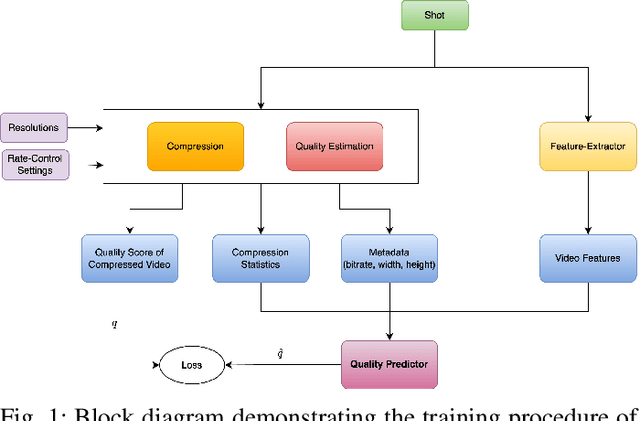
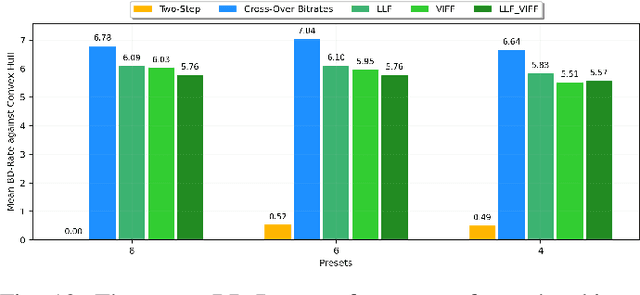
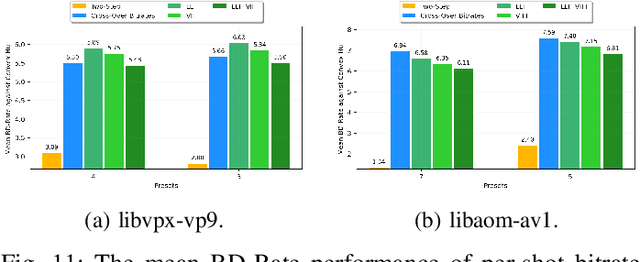
Over the past few years, per-title and per-shot video encoding techniques have demonstrated significant gains as compared to conventional techniques such as constant CRF encoding and the fixed bitrate ladder. These techniques have demonstrated that constructing content-gnostic per-shot bitrate ladders can provide significant bitrate gains and improved Quality of Experience (QoE) for viewers under various network conditions. However, constructing a convex hull for every video incurs a significant computational overhead. Recently, machine learning-based bitrate ladder construction techniques have emerged as a substitute for convex hull construction. These methods operate by extracting features from source videos to train machine learning (ML) models to construct content-adaptive bitrate ladders. Here, we present a new ML-based bitrate ladder construction technique that accurately predicts the VMAF scores of compressed videos, by analyzing the compression procedure and by making perceptually relevant measurements on the source videos prior to compression. We evaluate the performance of our proposed framework against leading prior methods on a large corpus of videos. Since training ML models on every encoder setting is time-consuming, we also investigate how per-shot bitrate ladders perform under different encoding settings. We evaluate the performance of all models against the fixed bitrate ladder and the best possible convex hull constructed using exhaustive encoding with Bjontegaard-delta metrics.

Perceptual Classifiers: Detecting Generative Images using Perceptual Features
Jul 23, 2025Image Quality Assessment (IQA) models are employed in many practical image and video processing pipelines to reduce storage, minimize transmission costs, and improve the Quality of Experience (QoE) of millions of viewers. These models are sensitive to a diverse range of image distortions and can accurately predict image quality as judged by human viewers. Recent advancements in generative models have resulted in a significant influx of "GenAI" content on the internet. Existing methods for detecting GenAI content have progressed significantly with improved generalization performance on images from unseen generative models. Here, we leverage the capabilities of existing IQA models, which effectively capture the manifold of real images within a bandpass statistical space, to distinguish between real and AI-generated images. We investigate the generalization ability of these perceptual classifiers to the task of GenAI image detection and evaluate their robustness against various image degradations. Our results show that a two-layer network trained on the feature space of IQA models demonstrates state-of-the-art performance in detecting fake images across generative models, while maintaining significant robustness against image degradations.
Constructing Per-Shot Bitrate Ladders using Visual Information Fidelity
Aug 04, 2024
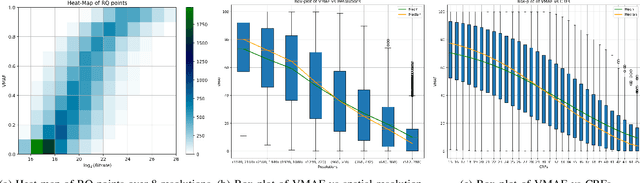
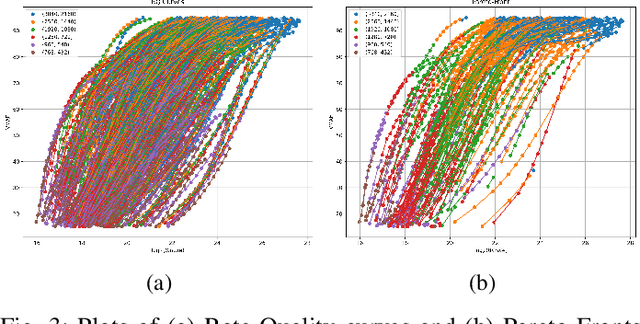
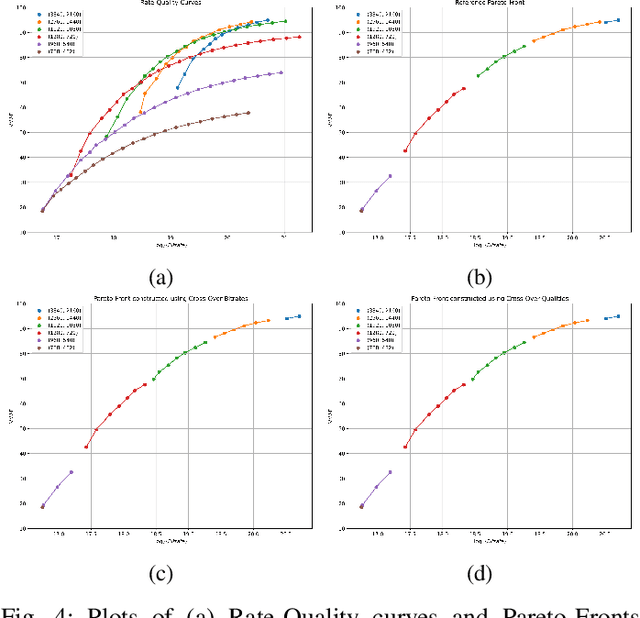
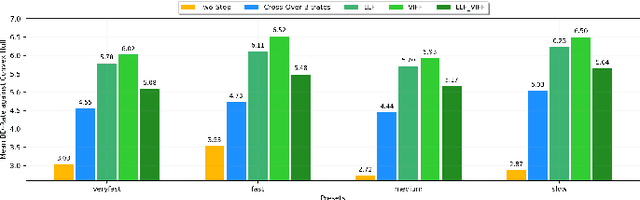
Adaptive video streaming allows for the construction of bitrate ladders that deliver perceptually optimized visual quality to viewers under bandwidth constraints. Two common approaches to adaptation are per-title encoding and per-shot encoding. The former involves encoding each program, movie, or other content in a manner that is perceptually- and bandwidth-optimized for that content but is otherwise fixed. The latter is a more granular approach that optimizes the encoding parameters for each scene or shot (however defined) of a video content. Per-shot video encoding, as pioneered by Netflix, encodes on a per-shot basis using the Dynamic Optimizer (DO). Under the control of the VMAF perceptual video quality prediction engine, the DO delivers high-quality videos to millions of viewers at considerably reduced bitrates than per-title or fixed bitrate ladder encoding. A variety of per-title and per-shot encoding techniques have been recently proposed that seek to reduce computational overhead and to construct optimal bitrate ladders more efficiently using low-level features extracted from source videos. Here we develop a perceptually optimized method of constructing optimal per-shot bitrate and quality ladders, using an ensemble of low-level features and Visual Information Fidelity (VIF) features extracted from different scales and subbands. We compare the performance of our model, which we call VIF-ladder, against other content-adaptive bitrate ladder prediction methods, counterparts of them that we designed to construct quality ladders, a fixed bitrate ladder, and bitrate ladders constructed via exhaustive encoding using Bjontegaard delta metrics.
Bitrate Ladder Construction using Visual Information Fidelity
Dec 12, 2023

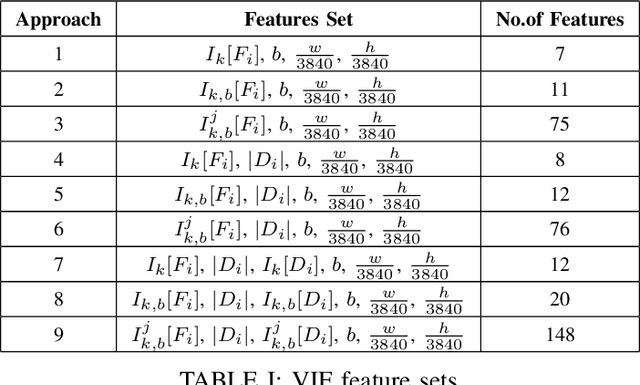
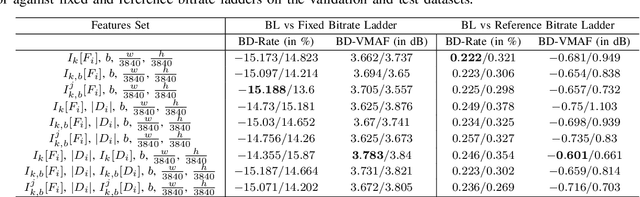
Recently proposed perceptually optimized per-title video encoding methods provide better BD-rate savings than fixed bitrate-ladder approaches that have been employed in the past. However, a disadvantage of per-title encoding is that it requires significant time and energy to compute bitrate ladders. Over the past few years, a variety of methods have been proposed to construct optimal bitrate ladders including using low-level features to predict cross-over bitrates, optimal resolutions for each bitrate, predicting visual quality, etc. Here, we deploy features drawn from Visual Information Fidelity (VIF) (VIF features) extracted from uncompressed videos to predict the visual quality (VMAF) of compressed videos. We present multiple VIF feature sets extracted from different scales and subbands of a video to tackle the problem of bitrate ladder construction. Comparisons are made against a fixed bitrate ladder and a bitrate ladder obtained from exhaustive encoding using Bjontegaard delta metrics.