 Add to Chrome
 Add to Firefox
 Add to Edge
Pro-Pose: Unpaired Full-Body Portrait Synthesis via Canonical UV Maps
Dec 19, 2025
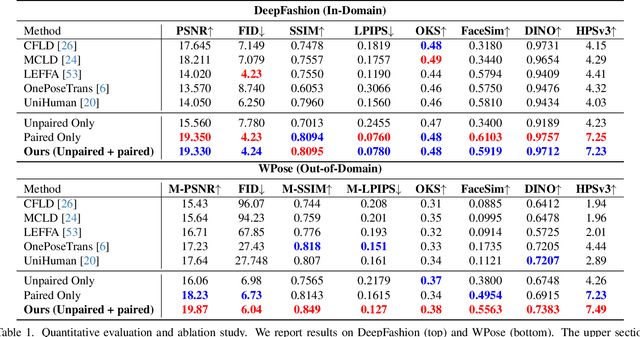
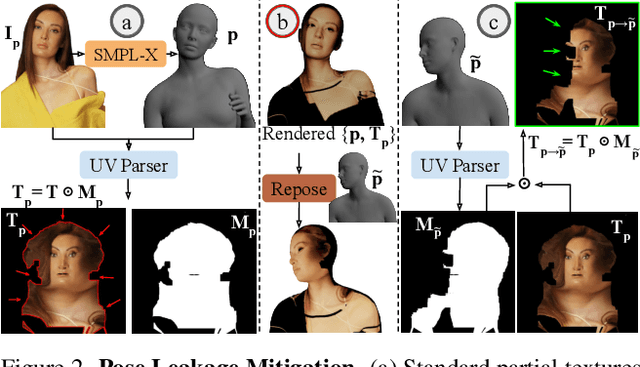
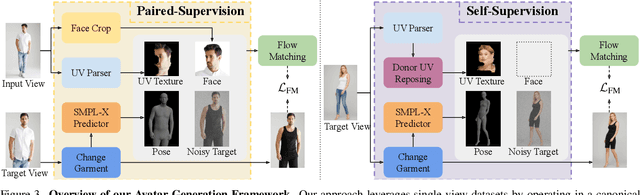

Photographs of people taken by professional photographers typically present the person in beautiful lighting, with an interesting pose, and flattering quality. This is unlike common photos people can take of themselves. In this paper, we explore how to create a ``professional'' version of a person's photograph, i.e., in a chosen pose, in a simple environment, with good lighting, and standard black top/bottom clothing. A key challenge is to preserve the person's unique identity, face and body features while transforming the photo. If there would exist a large paired dataset of the same person photographed both ``in the wild'' and by a professional photographer, the problem would potentially be easier to solve. However, such data does not exist, especially for a large variety of identities. To that end, we propose two key insights: 1) Our method transforms the input photo and person's face to a canonical UV space, which is further coupled with reposing methodology to model occlusions and novel view synthesis. Operating in UV space allows us to leverage existing unpaired datasets. 2) We personalize the output photo via multi image finetuning. Our approach yields high-quality, reposed portraits and achieves strong qualitative and quantitative performance on real-world imagery.

Transfer Learning for Estimating Causal Effects using Neural Networks
Aug 23, 2018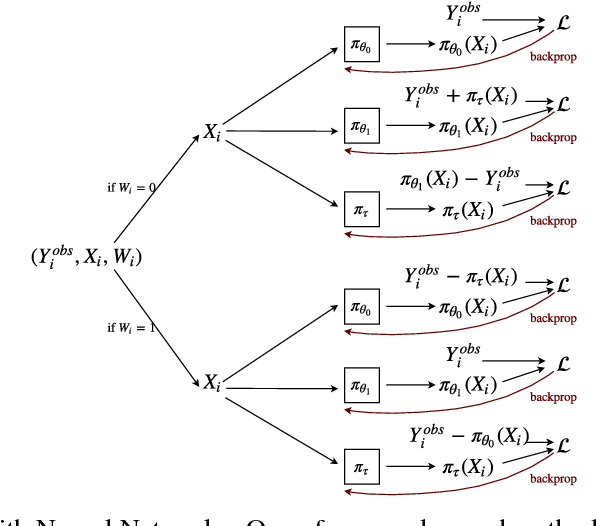
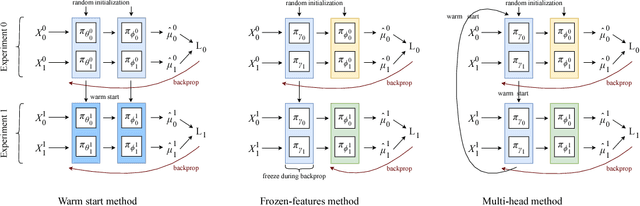
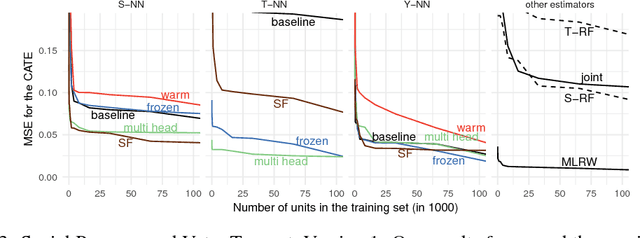
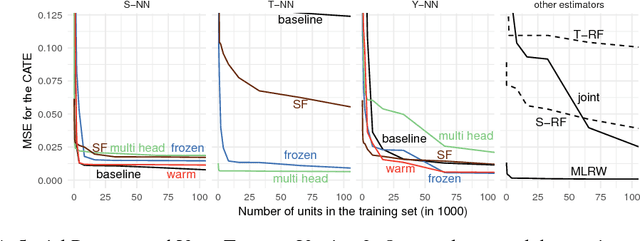
We develop new algorithms for estimating heterogeneous treatment effects, combining recent developments in transfer learning for neural networks with insights from the causal inference literature. By taking advantage of transfer learning, we are able to efficiently use different data sources that are related to the same underlying causal mechanisms. We compare our algorithms with those in the extant literature using extensive simulation studies based on large-scale voter persuasion experiments and the MNIST database. Our methods can perform an order of magnitude better than existing benchmarks while using a fraction of the data.