 Add to Chrome
 Add to Firefox
 Add to Edge
Dual Alignment Between Language Model Layers and Human Sentence Processing
Apr 20, 2026
A recent study (Kuribayashi et al., 2025) has shown that human sentence processing behavior, typically measured on syntactically unchallenging constructions, can be effectively modeled using surprisal from early layers of large language models (LLMs). This raises the question of whether such advantages of internal layers extend to more syntactically challenging constructions, where surprisal has been reported to underestimate human cognitive effort. In this paper, we begin by exploring internal layers that better estimate human cognitive effort observed in syntactic ambiguity processing in English. Our experiments show that, in contrast to naturalistic reading, later layers better estimate such a cognitive effort, but still underestimate the human data. This dual alignment sheds light on different modes of sentence processing in humans and LMs: naturalistic reading employs a somewhat weak prediction akin to earlier layers of LMs, while syntactically challenging processing requires more fully-contextualized representations, better modeled by later layers of LMs. Motivated by these findings, we also explore several probability-update measures using shallow and deep layers of LMs, showing a complementary advantage to single-layer's surprisal in reading time modeling.

BabyLM Turns 4 and Goes Multilingual: Call for Papers for the 2026 BabyLM Workshop
Feb 24, 2026The goal of the BabyLM is to stimulate new research connections between cognitive modeling and language model pretraining. We invite contributions in this vein to the BabyLM Workshop, which will also include the 4th iteration of the BabyLM Challenge. As in previous years, the challenge features two ``standard'' tracks (Strict and Strict-Small), in which participants must train language models on under 100M or 10M words of data, respectively. This year, we move beyond our previous English-only pretraining datasets with a new Multilingual track, focusing on English, Dutch, and Chinese. For the workshop, we call for papers related to the overall theme of BabyLM, which includes training efficiency, small-scale training datasets, cognitive modeling, model evaluation, and architecture innovation.
A Unified Assessment of the Poverty of the Stimulus Argument for Neural Language Models
Feb 10, 2026How can children acquire native-level syntax from limited input? According to the Poverty of the Stimulus Hypothesis (PoSH), the linguistic input children receive is insufficient to explain certain generalizations that are robustly learned; innate linguistic constraints, many have argued, are thus necessary to explain language learning. Neural language models, which lack such language-specific constraints in their design, offer a computational test of this longstanding (but controversial) claim. We introduce \poshbench, a training-and-evaluation suite targeting question formation, islands to movement, and other English phenomena at the center of the PoSH arguments. Training Transformer models on 10--50M words of developmentally plausible text, we find indications of generalization on all phenomena even without direct positive evidence -- yet neural models remain less data-efficient and their generalizations are weaker than those of children. We further enhance our models with three recently proposed cognitively motivated inductive biases. We find these biases improve general syntactic competence but not \poshbench performance. Our findings challenge the claim that innate syntax is the only possible route to generalization, while suggesting that human-like data efficiency requires inductive biases beyond those tested here.
From Linear Input to Hierarchical Structure: Function Words as Statistical Cues for Language Learning
Jan 29, 2026What statistical conditions support learning hierarchical structure from linear input? In this paper, we address this question by focusing on the statistical distribution of function words. Function words have long been argued to play a crucial role in language acquisition due to their distinctive distributional properties, including high frequency, reliable association with syntactic structure, and alignment with phrase boundaries. We use cross-linguistic corpus analysis to first establish that all three properties are present across 186 studied languages. Next, we use a combination of counterfactual language modeling and ablation experiments to show that language variants preserving all three properties are more easily acquired by neural learners, with frequency and structural association contributing more strongly than boundary alignment. Follow-up probing and ablation analyses further reveal that different learning conditions lead to systematically different reliance on function words, indicating that similar performance can arise from distinct internal mechanisms.
Using Information Theory to Characterize Prosodic Typology: The Case of Tone, Pitch-Accent and Stress-Accent
May 12, 2025This paper argues that the relationship between lexical identity and prosody -- one well-studied parameter of linguistic variation -- can be characterized using information theory. We predict that languages that use prosody to make lexical distinctions should exhibit a higher mutual information between word identity and prosody, compared to languages that don't. We test this hypothesis in the domain of pitch, which is used to make lexical distinctions in tonal languages, like Cantonese. We use a dataset of speakers reading sentences aloud in ten languages across five language families to estimate the mutual information between the text and their pitch curves. We find that, across languages, pitch curves display similar amounts of entropy. However, these curves are easier to predict given their associated text in the tonal languages, compared to pitch- and stress-accent languages, and thus the mutual information is higher in these languages, supporting our hypothesis. Our results support perspectives that view linguistic typology as gradient, rather than categorical.
Looking forward: Linguistic theory and methods
Feb 25, 2025This chapter examines current developments in linguistic theory and methods, focusing on the increasing integration of computational, cognitive, and evolutionary perspectives. We highlight four major themes shaping contemporary linguistics: (1) the explicit testing of hypotheses about symbolic representation, such as efficiency, locality, and conceptual semantic grounding; (2) the impact of artificial neural networks on theoretical debates and linguistic analysis; (3) the importance of intersubjectivity in linguistic theory; and (4) the growth of evolutionary linguistics. By connecting linguistics with computer science, psychology, neuroscience, and biology, we provide a forward-looking perspective on the changing landscape of linguistic research.
Findings of the Second BabyLM Challenge: Sample-Efficient Pretraining on Developmentally Plausible Corpora
Dec 06, 2024The BabyLM Challenge is a community effort to close the data-efficiency gap between human and computational language learners. Participants compete to optimize language model training on a fixed language data budget of 100 million words or less. This year, we released improved text corpora, as well as a vision-and-language corpus to facilitate research into cognitively plausible vision language models. Submissions were compared on evaluation tasks targeting grammatical ability, (visual) question answering, pragmatic abilities, and grounding, among other abilities. Participants could submit to a 10M-word text-only track, a 100M-word text-only track, and/or a 100M-word and image multimodal track. From 31 submissions employing diverse methods, a hybrid causal-masked language model architecture outperformed other approaches. No submissions outperformed the baselines in the multimodal track. In follow-up analyses, we found a strong relationship between training FLOPs and average performance across tasks, and that the best-performing submissions proposed changes to the training data, training objective, and model architecture. This year's BabyLM Challenge shows that there is still significant room for innovation in this setting, in particular for image-text modeling, but community-driven research can yield actionable insights about effective strategies for small-scale language modeling.
Reverse-Engineering the Reader
Oct 16, 2024Numerous previous studies have sought to determine to what extent language models, pretrained on natural language text, can serve as useful models of human cognition. In this paper, we are interested in the opposite question: whether we can directly optimize a language model to be a useful cognitive model by aligning it to human psychometric data. To achieve this, we introduce a novel alignment technique in which we fine-tune a language model to implicitly optimize the parameters of a linear regressor that directly predicts humans' reading times of in-context linguistic units, e.g., phonemes, morphemes, or words, using surprisal estimates derived from the language model. Using words as a test case, we evaluate our technique across multiple model sizes and datasets and find that it improves language models' psychometric predictive power. However, we find an inverse relationship between psychometric power and a model's performance on downstream NLP tasks as well as its perplexity on held-out test data. While this latter trend has been observed before (Oh et al., 2022; Shain et al., 2024), we are the first to induce it by manipulating a model's alignment to psychometric data.
On the Role of Context in Reading Time Prediction
Sep 12, 2024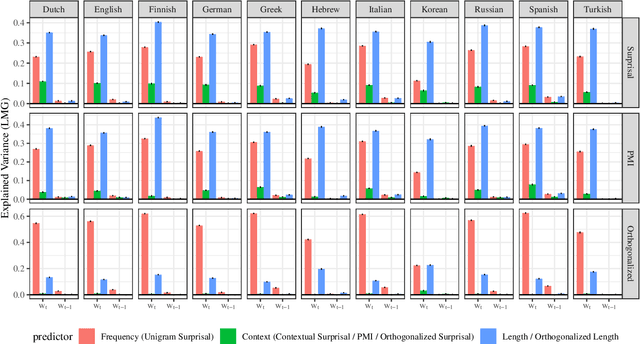
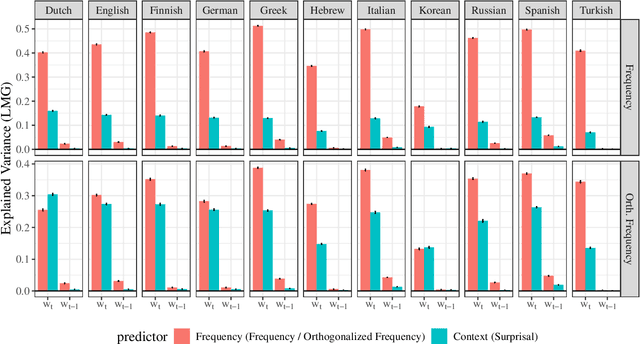
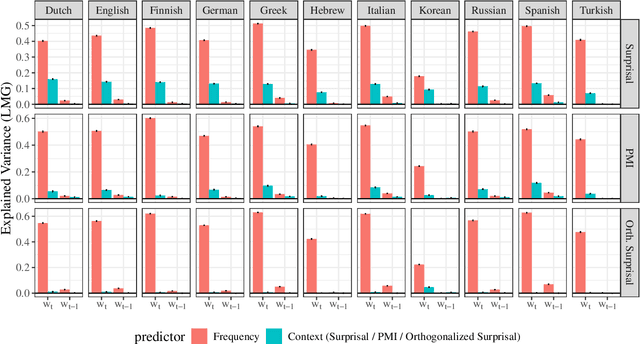
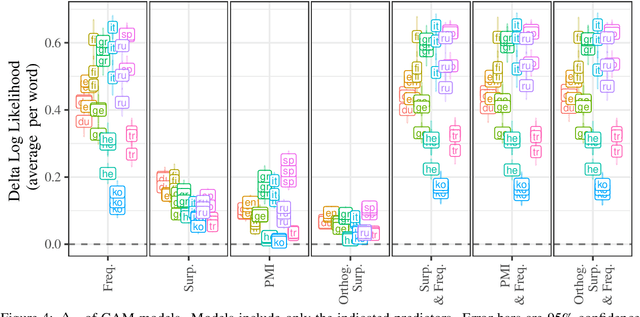
We present a new perspective on how readers integrate context during real-time language comprehension. Our proposals build on surprisal theory, which posits that the processing effort of a linguistic unit (e.g., a word) is an affine function of its in-context information content. We first observe that surprisal is only one out of many potential ways that a contextual predictor can be derived from a language model. Another one is the pointwise mutual information (PMI) between a unit and its context, which turns out to yield the same predictive power as surprisal when controlling for unigram frequency. Moreover, both PMI and surprisal are correlated with frequency. This means that neither PMI nor surprisal contains information about context alone. In response to this, we propose a technique where we project surprisal onto the orthogonal complement of frequency, yielding a new contextual predictor that is uncorrelated with frequency. Our experiments show that the proportion of variance in reading times explained by context is a lot smaller when context is represented by the orthogonalized predictor. From an interpretability standpoint, this indicates that previous studies may have overstated the role that context has in predicting reading times.
Revisiting the Optimality of Word Lengths
Dec 06, 2023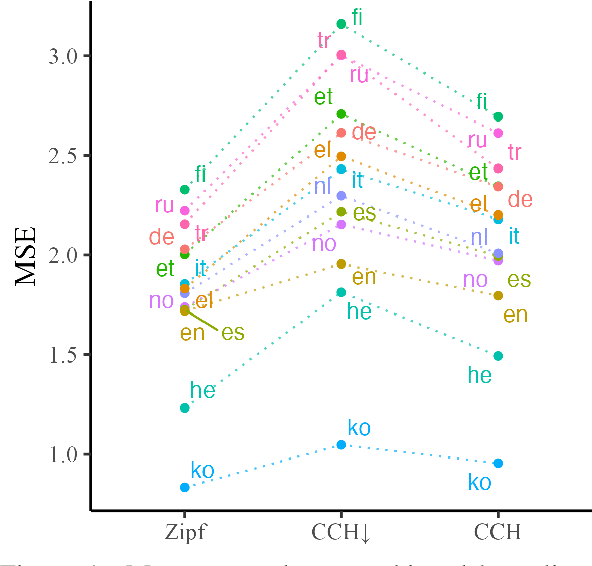
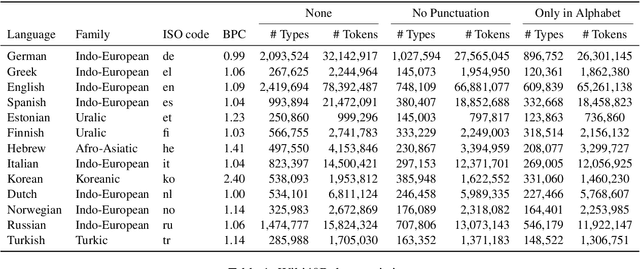
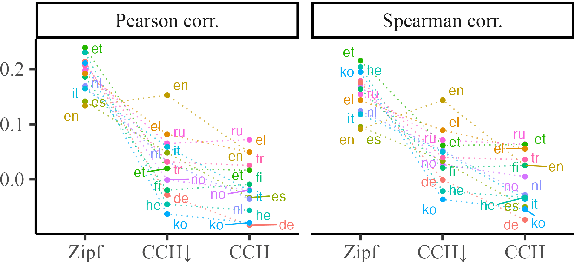
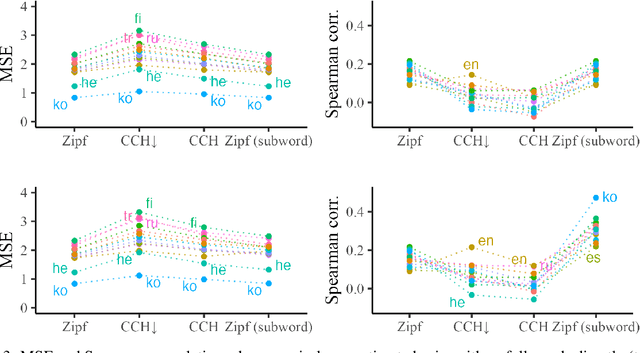
Zipf (1935) posited that wordforms are optimized to minimize utterances' communicative costs. Under the assumption that cost is given by an utterance's length, he supported this claim by showing that words' lengths are inversely correlated with their frequencies. Communicative cost, however, can be operationalized in different ways. Piantadosi et al. (2011) claim that cost should be measured as the distance between an utterance's information rate and channel capacity, which we dub the channel capacity hypothesis (CCH) here. Following this logic, they then proposed that a word's length should be proportional to the expected value of its surprisal (negative log-probability in context). In this work, we show that Piantadosi et al.'s derivation does not minimize CCH's cost, but rather a lower bound, which we term CCH-lower. We propose a novel derivation, suggesting an improved way to minimize CCH's cost. Under this method, we find that a language's word lengths should instead be proportional to the surprisal's expectation plus its variance-to-mean ratio. Experimentally, we compare these three communicative cost functions: Zipf's, CCH-lower , and CCH. Across 13 languages and several experimental settings, we find that length is better predicted by frequency than either of the other hypotheses. In fact, when surprisal's expectation, or expectation plus variance-to-mean ratio, is estimated using better language models, it leads to worse word length predictions. We take these results as evidence that Zipf's longstanding hypothesis holds.