 Add to Chrome
 Add to Firefox
 Add to Edge
Wlasl
Papers and Code
Sign Language Recognition using Parallel Bidirectional Reservoir Computing
Dec 22, 2025
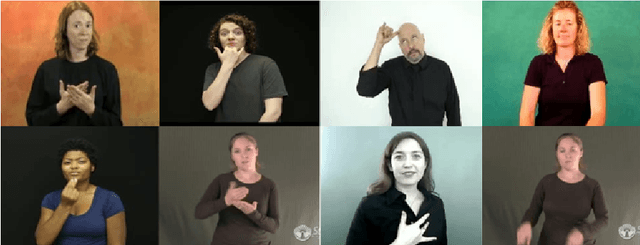
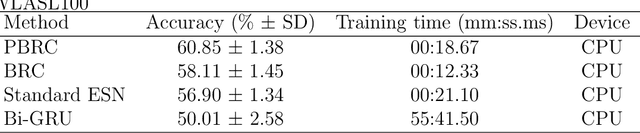
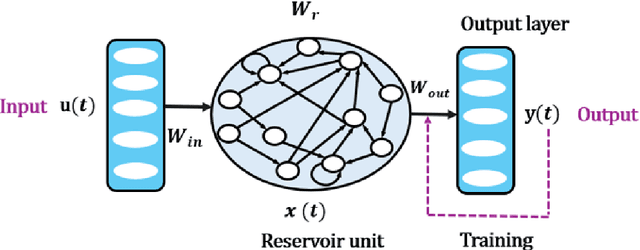
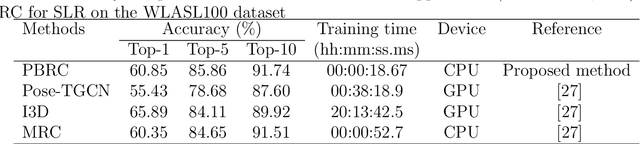
Sign language recognition (SLR) facilitates communication between deaf and hearing communities. Deep learning based SLR models are commonly used but require extensive computational resources, making them unsuitable for deployment on edge devices. To address these limitations, we propose a lightweight SLR system that combines parallel bidirectional reservoir computing (PBRC) with MediaPipe. MediaPipe enables real-time hand tracking and precise extraction of hand joint coordinates, which serve as input features for the PBRC architecture. The proposed PBRC architecture consists of two echo state network (ESN) based bidirectional reservoir computing (BRC) modules arranged in parallel to capture temporal dependencies, thereby creating a rich feature representation for classification. We trained our PBRC-based SLR system on the Word-Level American Sign Language (WLASL) video dataset, achieving top-1, top-5, and top-10 accuracies of 60.85%, 85.86%, and 91.74%, respectively. Training time was significantly reduced to 18.67 seconds due to the intrinsic properties of reservoir computing, compared to over 55 minutes for deep learning based methods such as Bi-GRU. This approach offers a lightweight, cost-effective solution for real-time SLR on edge devices.

Real-Time American Sign Language Recognition Using 3D Convolutional Neural Networks and LSTM: Architecture, Training, and Deployment
Dec 19, 2025This paper presents a real-time American Sign Language (ASL) recognition system utilizing a hybrid deep learning architecture combining 3D Convolutional Neural Networks (3D CNN) with Long Short-Term Memory (LSTM) networks. The system processes webcam video streams to recognize word-level ASL signs, addressing communication barriers for over 70 million deaf and hard-of-hearing individuals worldwide. Our architecture leverages 3D convolutions to capture spatial-temporal features from video frames, followed by LSTM layers that model sequential dependencies inherent in sign language gestures. Trained on the WLASL dataset (2,000 common words), ASL-LEX lexical database (~2,700 signs), and a curated set of 100 expert-annotated ASL signs, the system achieves F1-scores ranging from 0.71 to 0.99 across sign classes. The model is deployed on AWS infrastructure with edge deployment capability on OAK-D cameras for real-time inference. We discuss the architecture design, training methodology, evaluation metrics, and deployment considerations for practical accessibility applications.
Data-Efficient American Sign Language Recognition via Few-Shot Prototypical Networks
Dec 11, 2025Isolated Sign Language Recognition (ISLR) is critical for bridging the communication gap between the Deaf and Hard-of-Hearing (DHH) community and the hearing world. However, robust ISLR is fundamentally constrained by data scarcity and the long-tail distribution of sign vocabulary, where gathering sufficient examples for thousands of unique signs is prohibitively expensive. Standard classification approaches struggle under these conditions, often overfitting to frequent classes while failing to generalize to rare ones. To address this bottleneck, we propose a Few-Shot Prototypical Network framework adapted for a skeleton based encoder. Unlike traditional classifiers that learn fixed decision boundaries, our approach utilizes episodic training to learn a semantic metric space where signs are classified based on their proximity to dynamic class prototypes. We integrate a Spatiotemporal Graph Convolutional Network (ST-GCN) with a novel Multi-Scale Temporal Aggregation (MSTA) module to capture both rapid and fluid motion dynamics. Experimental results on the WLASL dataset demonstrate the superiority of this metric learning paradigm: our model achieves 43.75% Top-1 and 77.10% Top-5 accuracy on the test set. Crucially, this outperforms a standard classification baseline sharing the identical backbone architecture by over 13%, proving that the prototypical training strategy effectively outperforms in a data scarce situation where standard classification fails. Furthermore, the model exhibits strong zero-shot generalization, achieving nearly 30% accuracy on the unseen SignASL dataset without fine-tuning, offering a scalable pathway for recognizing extensive sign vocabularies with limited data.
A Comparative Analysis of Recurrent and Attention Architectures for Isolated Sign Language Recognition
Nov 17, 2025This study presents a systematic comparative analysis of recurrent and attention-based neural architectures for isolated sign language recognition. We implement and evaluate two representative models-ConvLSTM and Vanilla Transformer-on the Azerbaijani Sign Language Dataset (AzSLD) and the Word-Level American Sign Language (WLASL) dataset. Our results demonstrate that the attention-based Vanilla Transformer consistently outperforms the recurrent ConvLSTM in both Top-1 and Top-5 accuracy across datasets, achieving up to 76.8% Top-1 accuracy on AzSLD and 88.3% on WLASL. The ConvLSTM, while more computationally efficient, lags in recognition accuracy, particularly on smaller datasets. These findings highlight the complementary strengths of each paradigm: the Transformer excels in overall accuracy and signer independence, whereas the ConvLSTM offers advantages in computational efficiency and temporal modeling. The study provides a nuanced analysis of these trade-offs, offering guidance for architecture selection in sign language recognition systems depending on application requirements and resource constraints.
IsoSignVid2Aud: Sign Language Video to Audio Conversion without Text Intermediaries
Oct 09, 2025Sign language to spoken language audio translation is important to connect the hearing- and speech-challenged humans with others. We consider sign language videos with isolated sign sequences rather than continuous grammatical signing. Such videos are useful in educational applications and sign prompt interfaces. Towards this, we propose IsoSignVid2Aud, a novel end-to-end framework that translates sign language videos with a sequence of possibly non-grammatic continuous signs to speech without requiring intermediate text representation, providing immediate communication benefits while avoiding the latency and cascading errors inherent in multi-stage translation systems. Our approach combines an I3D-based feature extraction module with a specialized feature transformation network and an audio generation pipeline, utilizing a novel Non-Maximal Suppression (NMS) algorithm for the temporal detection of signs in non-grammatic continuous sequences. Experimental results demonstrate competitive performance on ASL-Citizen-1500 and WLASL-100 datasets with Top-1 accuracies of 72.01\% and 78.67\%, respectively, and audio quality metrics (PESQ: 2.67, STOI: 0.73) indicating intelligible speech output. Code is available at: https://github.com/BheeshmSharma/IsoSignVid2Aud_AIMLsystems-2025.
Skeleton-based sign language recognition using a dual-stream spatio-temporal dynamic graph convolutional network
Sep 10, 2025Isolated Sign Language Recognition (ISLR) is challenged by gestures that are morphologically similar yet semantically distinct, a problem rooted in the complex interplay between hand shape and motion trajectory. Existing methods, often relying on a single reference frame, struggle to resolve this geometric ambiguity. This paper introduces Dual-SignLanguageNet (DSLNet), a dual-reference, dual-stream architecture that decouples and models gesture morphology and trajectory in separate, complementary coordinate systems. Our approach utilizes a wrist-centric frame for view-invariant shape analysis and a facial-centric frame for context-aware trajectory modeling. These streams are processed by specialized networks-a topology-aware graph convolution for shape and a Finsler geometry-based encoder for trajectory-and are integrated via a geometry-driven optimal transport fusion mechanism. DSLNet sets a new state-of-the-art, achieving 93.70%, 89.97% and 99.79% accuracy on the challenging WLASL-100, WLASL-300 and LSA64 datasets, respectively, with significantly fewer parameters than competing models.
Speak2Sign3D: A Multi-modal Pipeline for English Speech to American Sign Language Animation
Jul 09, 2025Helping deaf and hard-of-hearing people communicate more easily is the main goal of Automatic Sign Language Translation. Although most past research has focused on turning sign language into text, doing the reverse, turning spoken English into sign language animations, has been largely overlooked. That's because it involves multiple steps, such as understanding speech, translating it into sign-friendly grammar, and generating natural human motion. In this work, we introduce a complete pipeline that converts English speech into smooth, realistic 3D sign language animations. Our system starts with Whisper to translate spoken English into text. Then, we use a MarianMT machine translation model to translate that text into American Sign Language (ASL) gloss, a simplified version of sign language that captures meaning without grammar. This model performs well, reaching BLEU scores of 0.7714 and 0.8923. To make the gloss translation more accurate, we also use word embeddings such as Word2Vec and FastText to understand word meanings. Finally, we animate the translated gloss using a 3D keypoint-based motion system trained on Sign3D-WLASL, a dataset we created by extracting body, hand, and face key points from real ASL videos in the WLASL dataset. To support the gloss translation stage, we also built a new dataset called BookGlossCorpus-CG, which turns everyday English sentences from the BookCorpus dataset into ASL gloss using grammar rules. Our system stitches everything together by smoothly interpolating between signs to create natural, continuous animations. Unlike previous works like How2Sign and Phoenix-2014T that focus on recognition or use only one type of data, our pipeline brings together audio, text, and motion in a single framework that goes all the way from spoken English to lifelike 3D sign language animation.
Fine-Tuning Video Transformers for Word-Level Bangla Sign Language: A Comparative Analysis for Classification Tasks
Jun 04, 2025Sign Language Recognition (SLR) involves the automatic identification and classification of sign gestures from images or video, converting them into text or speech to improve accessibility for the hearing-impaired community. In Bangladesh, Bangla Sign Language (BdSL) serves as the primary mode of communication for many individuals with hearing impairments. This study fine-tunes state-of-the-art video transformer architectures -- VideoMAE, ViViT, and TimeSformer -- on BdSLW60 (arXiv:2402.08635), a small-scale BdSL dataset with 60 frequent signs. We standardized the videos to 30 FPS, resulting in 9,307 user trial clips. To evaluate scalability and robustness, the models were also fine-tuned on BdSLW401 (arXiv:2503.02360), a large-scale dataset with 401 sign classes. Additionally, we benchmark performance against public datasets, including LSA64 and WLASL. Data augmentation techniques such as random cropping, horizontal flipping, and short-side scaling were applied to improve model robustness. To ensure balanced evaluation across folds during model selection, we employed 10-fold stratified cross-validation on the training set, while signer-independent evaluation was carried out using held-out test data from unseen users U4 and U8. Results show that video transformer models significantly outperform traditional machine learning and deep learning approaches. Performance is influenced by factors such as dataset size, video quality, frame distribution, frame rate, and model architecture. Among the models, the VideoMAE variant (MCG-NJU/videomae-base-finetuned-kinetics) achieved the highest accuracies of 95.5% on the frame rate corrected BdSLW60 dataset and 81.04% on the front-facing signs of BdSLW401 -- demonstrating strong potential for scalable and accurate BdSL recognition.
Logos as a Well-Tempered Pre-train for Sign Language Recognition
May 15, 2025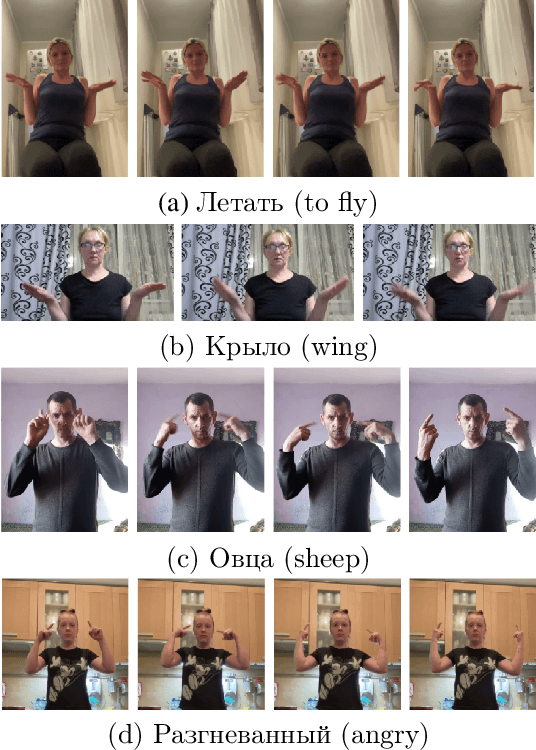
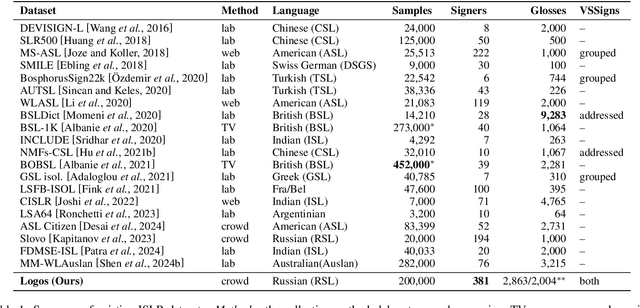
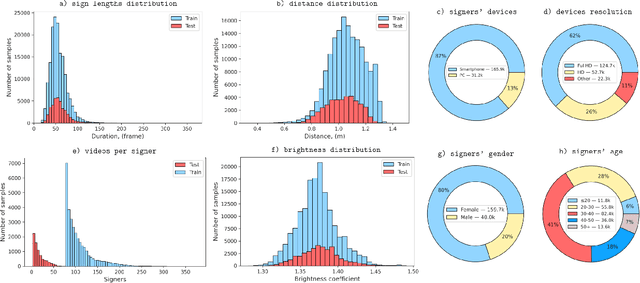
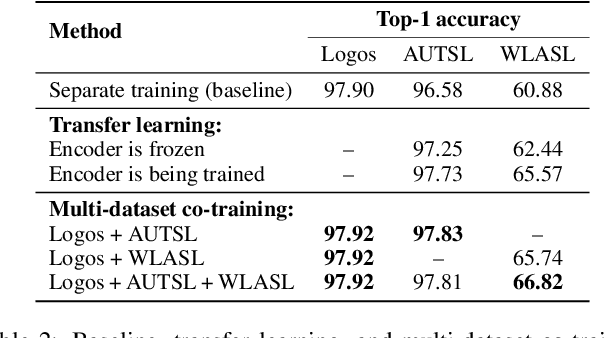
This paper examines two aspects of the isolated sign language recognition (ISLR) task. First, despite the availability of a number of datasets, the amount of data for most individual sign languages is limited. It poses the challenge of cross-language ISLR model training, including transfer learning. Second, similar signs can have different semantic meanings. It leads to ambiguity in dataset labeling and raises the question of the best policy for annotating such signs. To address these issues, this study presents Logos, a novel Russian Sign Language (RSL) dataset, the most extensive ISLR dataset by the number of signers and one of the largest available datasets while also the largest RSL dataset in size and vocabulary. It is shown that a model, pre-trained on the Logos dataset can be used as a universal encoder for other language SLR tasks, including few-shot learning. We explore cross-language transfer learning approaches and find that joint training using multiple classification heads benefits accuracy for the target lowresource datasets the most. The key feature of the Logos dataset is explicitly annotated visually similar sign groups. We show that explicitly labeling visually similar signs improves trained model quality as a visual encoder for downstream tasks. Based on the proposed contributions, we outperform current state-of-the-art results for the WLASL dataset and get competitive results for the AUTSL dataset, with a single stream model processing solely RGB video. The source code, dataset, and pre-trained models are publicly available.
SSLR: A Semi-Supervised Learning Method for Isolated Sign Language Recognition
Apr 23, 2025Sign language is the primary communication language for people with disabling hearing loss. Sign language recognition (SLR) systems aim to recognize sign gestures and translate them into spoken language. One of the main challenges in SLR is the scarcity of annotated datasets. To address this issue, we propose a semi-supervised learning (SSL) approach for SLR (SSLR), employing a pseudo-label method to annotate unlabeled samples. The sign gestures are represented using pose information that encodes the signer's skeletal joint points. This information is used as input for the Transformer backbone model utilized in the proposed approach. To demonstrate the learning capabilities of SSL across various labeled data sizes, several experiments were conducted using different percentages of labeled data with varying numbers of classes. The performance of the SSL approach was compared with a fully supervised learning-based model on the WLASL-100 dataset. The obtained results of the SSL model outperformed the supervised learning-based model with less labeled data in many cases.