 Add to Chrome
 Add to Firefox
 Add to Edge
Software Code Smell
Papers and Code
Specification and Detection of LLM Code Smells
Dec 19, 2025
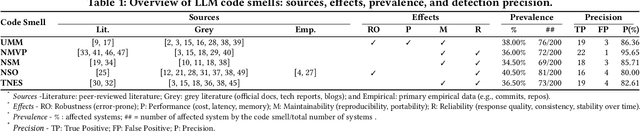
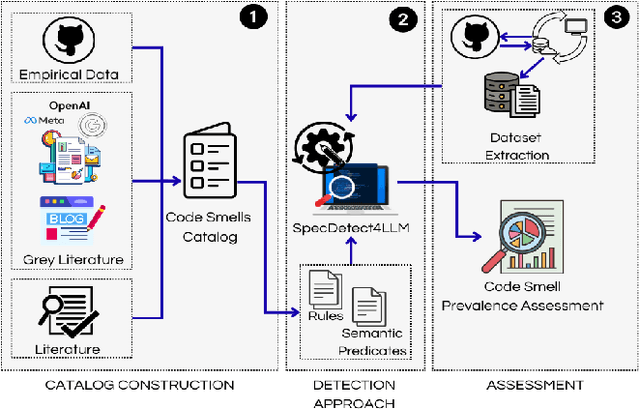
Large Language Models (LLMs) have gained massive popularity in recent years and are increasingly integrated into software systems for diverse purposes. However, poorly integrating them in source code may undermine software system quality. Yet, to our knowledge, there is no formal catalog of code smells specific to coding practices for LLM inference. In this paper, we introduce the concept of LLM code smells and formalize five recurrent problematic coding practices related to LLM inference in software systems, based on relevant literature. We extend the detection tool SpecDetect4AI to cover the newly defined LLM code smells and use it to validate their prevalence in a dataset of 200 open-source LLM systems. Our results show that LLM code smells affect 60.50% of the analyzed systems, with a detection precision of 86.06%.

SQuaD: The Software Quality Dataset
Nov 14, 2025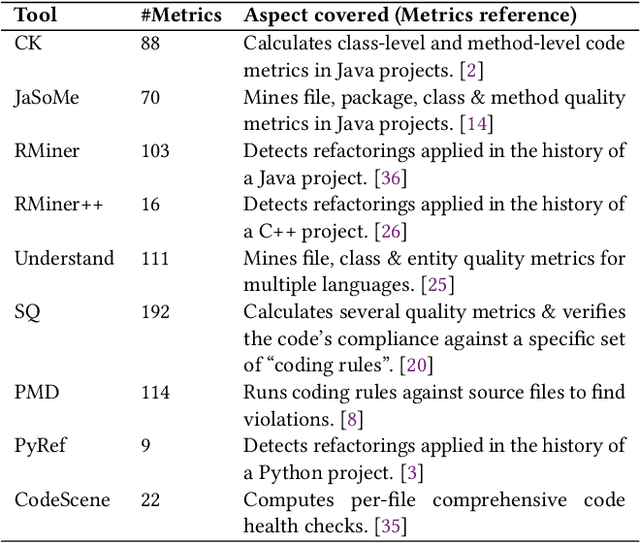
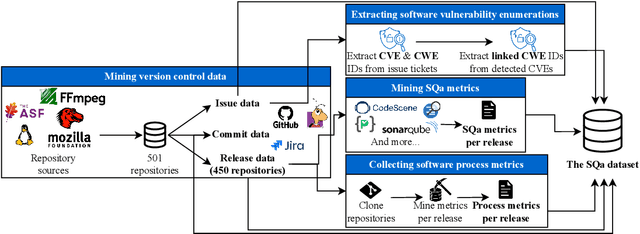
Software quality research increasingly relies on large-scale datasets that measure both the product and process aspects of software systems. However, existing resources often focus on limited dimensions, such as code smells, technical debt, or refactoring activity, thereby restricting comprehensive analyses across time and quality dimensions. To address this gap, we present the Software Quality Dataset (SQuaD), a multi-dimensional, time-aware collection of software quality metrics extracted from 450 mature open-source projects across diverse ecosystems, including Apache, Mozilla, FFmpeg, and the Linux kernel. By integrating nine state-of-the-art static analysis tools, i.e., SonarQube, CodeScene, PMD, Understand, CK, JaSoMe, RefactoringMiner, RefactoringMiner++, and PyRef, our dataset unifies over 700 unique metrics at method, class, file, and project levels. Covering a total of 63,586 analyzed project releases, SQuaD also provides version control and issue-tracking histories, software vulnerability data (CVE/CWE), and process metrics proven to enhance Just-In-Time (JIT) defect prediction. The SQuaD enables empirical research on maintainability, technical debt, software evolution, and quality assessment at unprecedented scale. We also outline emerging research directions, including automated dataset updates and cross-project quality modeling to support the continuous evolution of software analytics. The dataset is publicly available on ZENODO (DOI: 10.5281/zenodo.17566690).
Assessing the Quality and Security of AI-Generated Code: A Quantitative Analysis
Aug 20, 2025This study presents a quantitative evaluation of the code quality and security of five prominent Large Language Models (LLMs): Claude Sonnet 4, Claude 3.7 Sonnet, GPT-4o, Llama 3.2 90B, and OpenCoder 8B. While prior research has assessed the functional performance of LLM-generated code, this research tested LLM output from 4,442 Java coding assignments through comprehensive static analysis using SonarQube. The findings suggest that although LLMs can generate functional code, they also introduce a range of software defects, including bugs, security vulnerabilities, and code smells. These defects do not appear to be isolated; rather, they may represent shared weaknesses stemming from systemic limitations within current LLM code generation methods. In particular, critically severe issues, such as hard-coded passwords and path traversal vulnerabilities, were observed across multiple models. These results indicate that LLM-generated code requires verification in order to be considered production-ready. This study found no direct correlation between a model's functional performance (measured by Pass@1 rate of unit tests) and the overall quality and security of its generated code, measured by the number of SonarQube issues in benchmark solutions that passed the functional tests. This suggests that functional benchmark performance score is not a good indicator of overall code quality and security. The goal of this study is not to rank LLM performance but to highlight that all evaluated models appear to share certain weaknesses. Consequently, these findings support the view that static analysis can be a valuable instrument for detecting latent defects and an important safeguard for organizations that deploy AI in software development.
Augmenting Large Language Models with Static Code Analysis for Automated Code Quality Improvements
Jun 12, 2025This study examined code issue detection and revision automation by integrating Large Language Models (LLMs) such as OpenAI's GPT-3.5 Turbo and GPT-4o into software development workflows. A static code analysis framework detects issues such as bugs, vulnerabilities, and code smells within a large-scale software project. Detailed information on each issue was extracted and organized to facilitate automated code revision using LLMs. An iterative prompt engineering process is applied to ensure that prompts are structured to produce accurate and organized outputs aligned with the project requirements. Retrieval-augmented generation (RAG) is implemented to enhance the relevance and precision of the revisions, enabling LLM to access and integrate real-time external knowledge. The issue of LLM hallucinations - where the model generates plausible but incorrect outputs - is addressed by a custom-built "Code Comparison App," which identifies and corrects erroneous changes before applying them to the codebase. Subsequent scans using the static code analysis framework revealed a significant reduction in code issues, demonstrating the effectiveness of combining LLMs, static analysis, and RAG to improve code quality, streamline the software development process, and reduce time and resource expenditure.
AST-Enhanced or AST-Overloaded? The Surprising Impact of Hybrid Graph Representations on Code Clone Detection
Jun 17, 2025As one of the most detrimental code smells, code clones significantly increase software maintenance costs and heighten vulnerability risks, making their detection a critical challenge in software engineering. Abstract Syntax Trees (ASTs) dominate deep learning-based code clone detection due to their precise syntactic structure representation, but they inherently lack semantic depth. Recent studies address this by enriching AST-based representations with semantic graphs, such as Control Flow Graphs (CFGs) and Data Flow Graphs (DFGs). However, the effectiveness of various enriched AST-based representations and their compatibility with different graph-based machine learning techniques remains an open question, warranting further investigation to unlock their full potential in addressing the complexities of code clone detection. In this paper, we present a comprehensive empirical study to rigorously evaluate the effectiveness of AST-based hybrid graph representations in Graph Neural Network (GNN)-based code clone detection. We systematically compare various hybrid representations ((CFG, DFG, Flow-Augmented ASTs (FA-AST)) across multiple GNN architectures. Our experiments reveal that hybrid representations impact GNNs differently: while AST+CFG+DFG consistently enhances accuracy for convolution- and attention-based models (Graph Convolutional Networks (GCN), Graph Attention Networks (GAT)), FA-AST frequently introduces structural complexity that harms performance. Notably, GMN outperforms others even with standard AST representations, highlighting its superior cross-code similarity detection and reducing the need for enriched structures.
How Propense Are Large Language Models at Producing Code Smells? A Benchmarking Study
Dec 25, 2024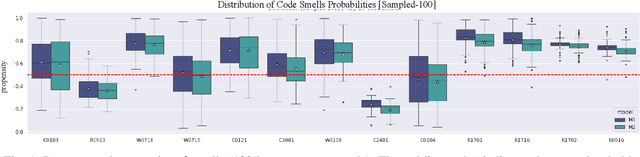

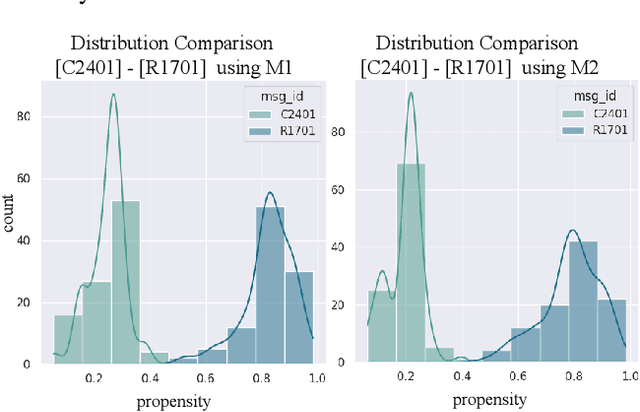

Large Language Models (LLMs) have shown significant potential in automating software engineering tasks, particularly in code generation. However, current evaluation benchmarks, which primarily focus on accuracy, fall short in assessing the quality of the code generated by these models, specifically their tendency to produce code smells. To address this limitation, we introduce CodeSmellEval, a benchmark designed to evaluate the propensity of LLMs for generating code smells. Our benchmark includes a novel metric: Propensity Smelly Score (PSC), and a curated dataset of method-level code smells: CodeSmellData. To demonstrate the use of CodeSmellEval, we conducted a case study with two state-of-the-art LLMs, CodeLlama and Mistral. The results reveal that both models tend to generate code smells, such as simplifiable-condition and consider-merging-isinstance. These findings highlight the effectiveness of our benchmark in evaluating LLMs, providing valuable insights into their reliability and their propensity to introduce code smells in code generation tasks.
Helping LLMs Improve Code Generation Using Feedback from Testing and Static Analysis
Dec 19, 2024
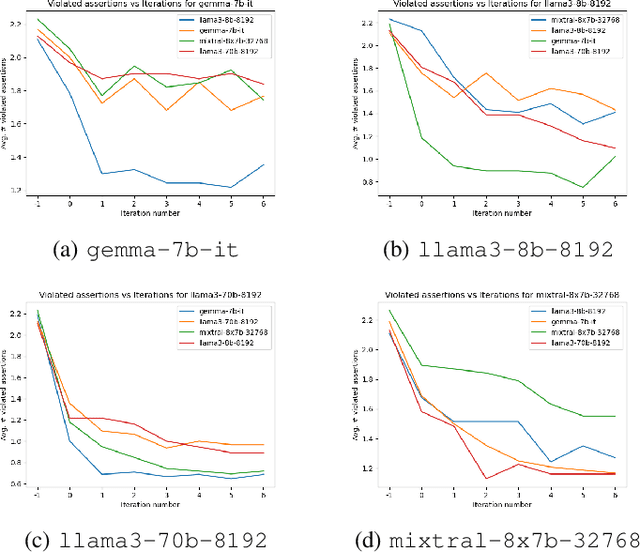


Large Language Models (LLMs) are one of the most promising developments in the field of artificial intelligence, and the software engineering community has readily noticed their potential role in the software development life-cycle. Developers routinely ask LLMs to generate code snippets, increasing productivity but also potentially introducing ownership, privacy, correctness, and security issues. Previous work highlighted how code generated by mainstream commercial LLMs is often not safe, containing vulnerabilities, bugs, and code smells. In this paper, we present a framework that leverages testing and static analysis to assess the quality, and guide the self-improvement, of code generated by general-purpose, open-source LLMs. First, we ask LLMs to generate C code to solve a number of programming tasks. Then we employ ground-truth tests to assess the (in)correctness of the generated code, and a static analysis tool to detect potential safety vulnerabilities. Next, we assess the models ability to evaluate the generated code, by asking them to detect errors and vulnerabilities. Finally, we test the models ability to fix the generated code, providing the reports produced during the static analysis and incorrectness evaluation phases as feedback. Our results show that models often produce incorrect code, and that the generated code can include safety issues. Moreover, they perform very poorly at detecting either issue. On the positive side, we observe a substantial ability to fix flawed code when provided with information about failed tests or potential vulnerabilities, indicating a promising avenue for improving the safety of LLM-based code generation tools.
Benefits and Risks of Using ChatGPT4 as a Teaching Assistant for Computer Science Students
Nov 08, 2024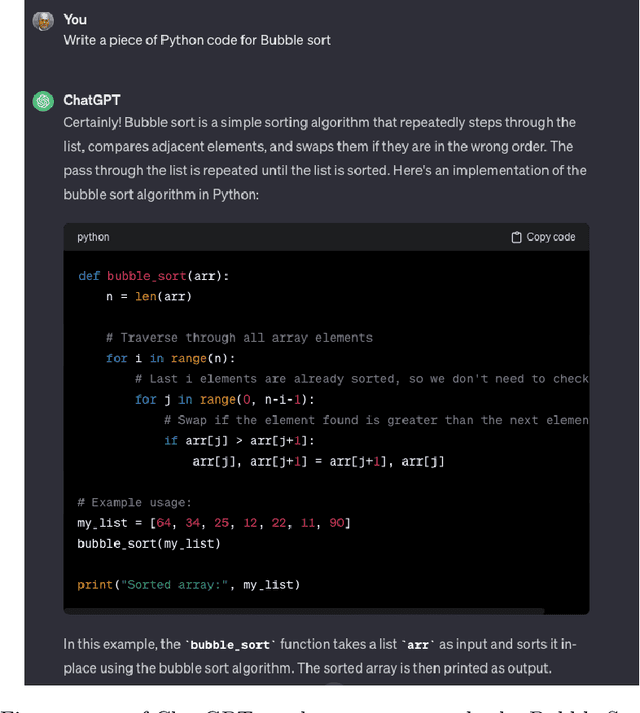
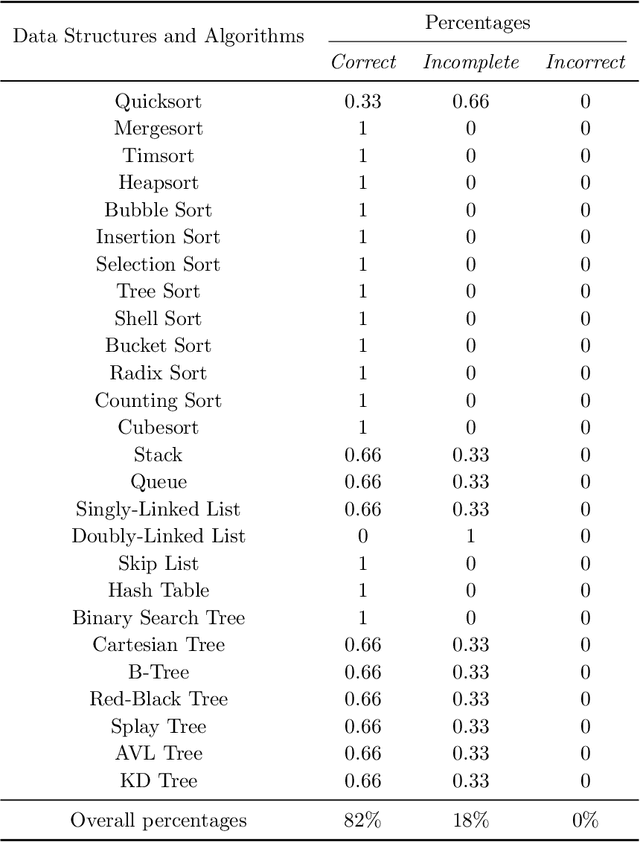
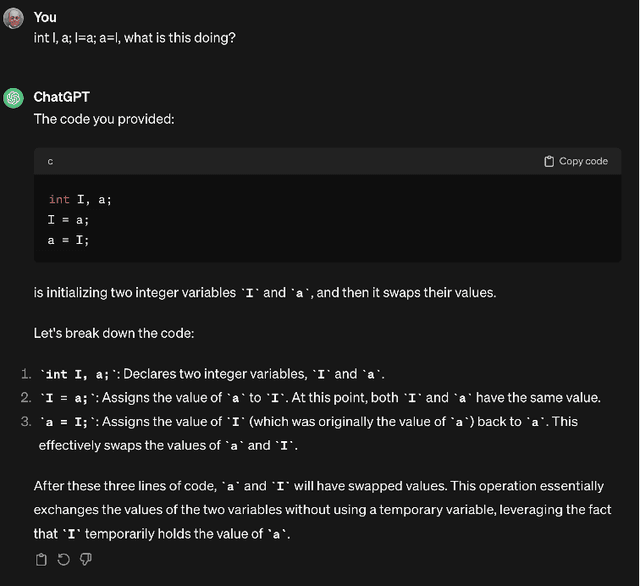
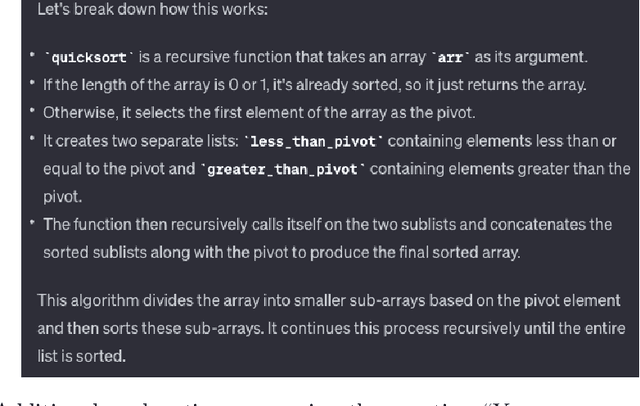
Upon release, ChatGPT3.5 shocked the software engineering community by its ability to generate answers to specialized questions about coding. Immediately, many educators wondered if it was possible to use the chatbot as a support tool that helps students answer their programming questions. This article evaluates this possibility at three levels: fundamental Computer Science knowledge (basic algorithms and data structures), core competency (design patterns), and advanced knowledge (quantum computing). In each case, we ask normalized questions several times to ChatGPT3.5, then look at the correctness of answers, and finally check if this creates issues. The main result is that the performances of ChatGPT3.5 degrades drastically as the specialization of the domain increases: for basic algorithms it returns answers that are almost always correct, for design patterns the generated code contains many code smells and is generally of low quality, but it is still sometimes able to fix it (if asked), and for quantum computing it is often blatantly wrong.
Evaluating Software Development Agents: Patch Patterns, Code Quality, and Issue Complexity in Real-World GitHub Scenarios
Oct 16, 2024In recent years, AI-based software engineering has progressed from pre-trained models to advanced agentic workflows, with Software Development Agents representing the next major leap. These agents, capable of reasoning, planning, and interacting with external environments, offer promising solutions to complex software engineering tasks. However, while much research has evaluated code generated by large language models (LLMs), comprehensive studies on agent-generated patches, particularly in real-world settings, are lacking. This study addresses that gap by evaluating 4,892 patches from 10 top-ranked agents on 500 real-world GitHub issues from SWE-Bench Verified, focusing on their impact on code quality. Our analysis shows no single agent dominated, with 170 issues unresolved, indicating room for improvement. Even for patches that passed unit tests and resolved issues, agents made different file and function modifications compared to the gold patches from repository developers, revealing limitations in the benchmark's test case coverage. Most agents maintained code reliability and security, avoiding new bugs or vulnerabilities; while some agents increased code complexity, many reduced code duplication and minimized code smells. Finally, agents performed better on simpler codebases, suggesting that breaking complex tasks into smaller sub-tasks could improve effectiveness. This study provides the first comprehensive evaluation of agent-generated patches on real-world GitHub issues, offering insights to advance AI-driven software development.
On the Workflows and Smells of Leaderboard Operations (LBOps): An Exploratory Study of Foundation Model Leaderboards
Jul 04, 2024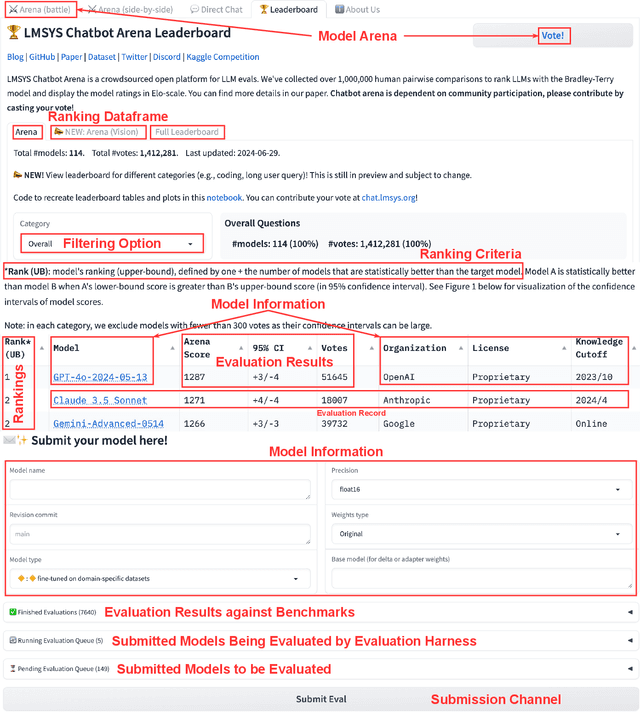
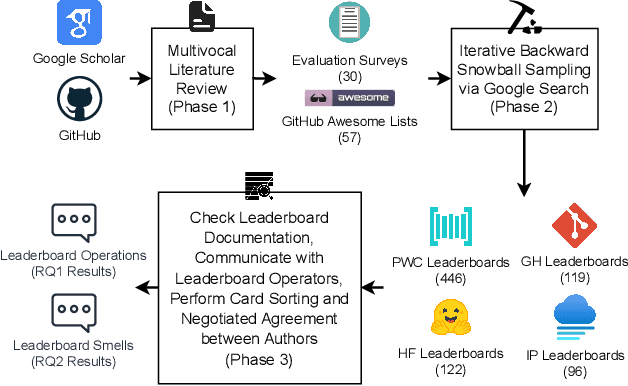
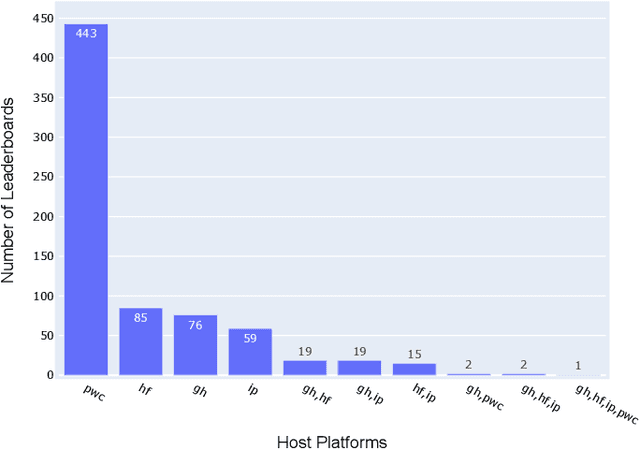
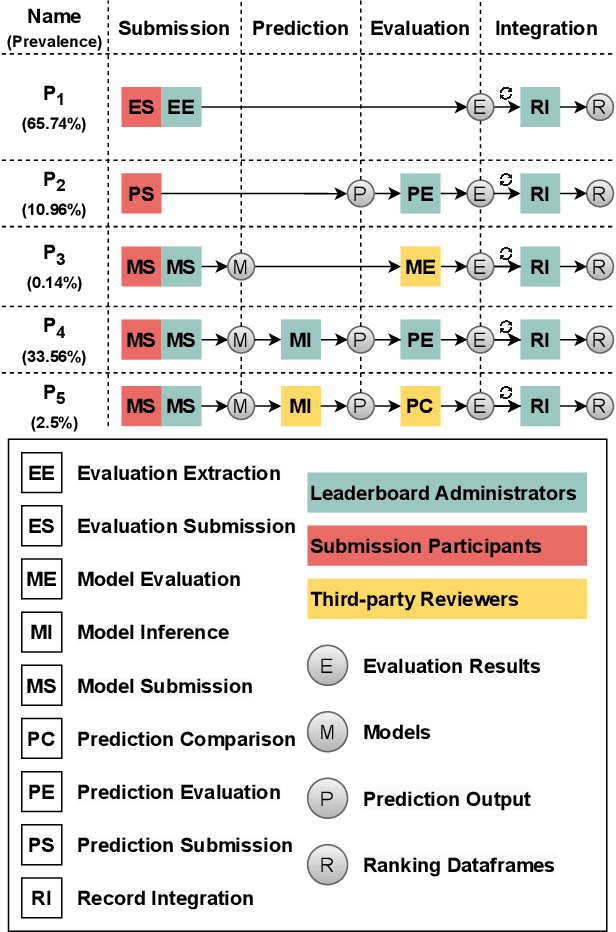
Foundation models (FM), such as large language models (LLMs), which are large-scale machine learning (ML) models, have demonstrated remarkable adaptability in various downstream software engineering (SE) tasks, such as code completion, code understanding, and software development. As a result, FM leaderboards, especially those hosted on cloud platforms, have become essential tools for SE teams to compare and select the best third-party FMs for their specific products and purposes. However, the lack of standardized guidelines for FM evaluation and comparison threatens the transparency of FM leaderboards and limits stakeholders' ability to perform effective FM selection. As a first step towards addressing this challenge, our research focuses on understanding how these FM leaderboards operate in real-world scenarios ("leaderboard operations") and identifying potential leaderboard pitfalls and areas for improvement ("leaderboard smells"). In this regard, we perform a multivocal literature review to collect up to 721 FM leaderboards, after which we examine their documentation and engage in direct communication with leaderboard operators to understand their workflow patterns. Using card sorting and negotiated agreement, we identify 5 unique workflow patterns and develop a domain model that outlines the essential components and their interaction within FM leaderboards. We then identify 8 unique types of leaderboard smells in LBOps. By mitigating these smells, SE teams can improve transparency, accountability, and collaboration in current LBOps practices, fostering a more robust and responsible ecosystem for FM comparison and selection.