 Add to Chrome
 Add to Firefox
 Add to Edge
Are Performance-Optimization Benchmarks Reliably Measuring Coding Agents?
Jul 01, 2026
Repository-level performance-optimization benchmarks such as GSO, SWE-Perf and SWE-fficiency evaluate coding agents by applying patches to real repositories and comparing runtime against unoptimized baselines and official reference patches. Their leaderboard scores are increasingly used as evidence of coding-agent progress, but those scores can conflate runtime instability, benchmark-specific scoring rules, and how many tasks are already solved by at least one public submission. We audit these issues across the three benchmarks. First, we replay the official reference patches for 740 code optimization tasks across four common types of Google Cloud machines. Most benchmark tasks can be replayed, but their reference patches satisfy the original benchmark validity rules in every cross-machine replay for only 39/102 GSO tasks, 11/140 SWE-Perf tasks, and 411/498 SWE-fficiency tasks; SWE-Perf is especially fragile because many reference patches produce close-to-zero runtime changes. Second, we show that public submission rankings depend strongly on the benchmark scoring rule. Among eight public submissions shared by GSO and SWE-fficiency, the official rankings disagree on 9 of 28 pairwise submission comparisons, and SWE-fficiency's leaderboard scoring rule assigns the worst ten tasks overly high score weights of 58.5%-82.8%. Third, looking across 10 public submissions for each task, we find that at least one submission matches or beats the reference patch on 85.3% (384/450) of replay-valid GSO and SWE-fficiency tasks, and beats the unoptimized base code on 99.8% (449/450). Our study complements leaderboard scores by identifying tasks with more reliable performance signals, quantifying per-task score contributions, and exposing the remaining performance gaps that are hidden by aggregate rankings.

Exploration Structure in LLM Agents for Multi-File Change Localization
Jun 10, 2026Software engineering tools increasingly rely on LLM based agents to localize files to change to resolve a software issue. Most AI agents explore repositories linearly, that is, visiting one directory or file per step. We postulate that this is a structural mismatch for changes that span several subsystems. We compare linear sequential exploration against non-linear, domain-scoped parallel agentic exploration. Using SWE Bench Pro as initial benchmark, we focus on ansible as an exemplar. We construct an approach for persistent-session evaluation of GitHub issues anchored at a single base commit. We compare our non-linear domain-agent file traversal system against a base LLM without direct repository access, a single agent Recursive Language Model (RLM) baseline with a persistent Python REPL and an external CLI baseline using Codex 5.5 High. Domain scoped parallel agent spawning with a small Haiku-class model achieves the highest micro F1 among Haiku class models by a large margin. Domain-agents is the second highest behind only the much larger Codex 5.5 High on our own expanded benchmark including over more recent PRs from 2025 and 2026. On the original, curated, 2020 SWE-bench Pro benchmark, a larger Sonnet plain LLM baseline attains higher micro F1 by predicting few files, leading to higher precision, but at significantly lower all gold recall. We also present three additional findings. First, documentation evolution is a latent dependency unresolved by any approach. Second, naive file system access can degrade localization driven by test-file over prediction. Lastly, forced multi-agent consultation does not measurably help and raises token cost substantially.
Same Signal, Different Semantics: A Cross-Framework Behavioral Analysis of Software Engineering Agents
May 18, 2026Behavioral studies of LLM-based software engineering agents extract operational rules about which trajectory shapes correlate with higher resolution rates: that a test step follows a code modification, that error cascades are short, or that trajectories are compact. Each rule is typically derived from a single framework, and whether it transfers, in sign as well as magnitude, to structurally different agent designs has not been directly tested. We address this at ecosystem scale: 64,380 SWE-bench runs from 126 agent configurations spanning 43 frameworks, where each configuration pairs an LLM with a framework (e.g., SWE-Agent, OpenHands) that supplies its tools and workflow. We separate framework effects from LLM effects by holding each layer fixed in turn, then measure one behavior-outcome effect per configuration and examine how those effects agree or disagree. Swapping the framework while the LLM is held fixed produces large behavioral differences in every action feature. On most signals, configurations disagree not merely in magnitude but in direction. Error rate is the cleanest case: 47 configurations resolve more issues when their error rate is lower, while 48 resolve more when it is higher. Five other continuous features and three of seven binary patterns from prior SE literature show similar directional disagreement. Framework identity accounts for more of this variation than LLM family: for mean turns, framework explains 64% of the between-configuration variance against the LLM's 10%. The implication is that the same observable behavioral signal can carry opposite meaning for different agent configurations. Behavioral findings from any single framework therefore warrant cross-configuration validation before being claimed as general.
Rethinking the Value of Agent-Generated Tests for LLM-Based Software Engineering Agents
Feb 08, 2026Large Language Model (LLM) code agents increasingly resolve repository-level issues by iteratively editing code, invoking tools, and validating candidate patches. In these workflows, agents often write tests on the fly, a paradigm adopted by many high-ranking agents on the SWE-bench leaderboard. However, we observe that GPT-5.2, which writes almost no new tests, can even achieve performance comparable to top-ranking agents. This raises the critical question: whether such tests meaningfully improve issue resolution or merely mimic human testing practices while consuming a substantial interaction budget. To reveal the impact of agent-written tests, we present an empirical study that analyzes agent trajectories across six state-of-the-art LLMs on SWE-bench Verified. Our results show that while test writing is commonly adopted, but resolved and unresolved tasks within the same model exhibit similar test-writing frequencies Furthermore, these tests typically serve as observational feedback channels, where agents prefer value-revealing print statements significantly more than formal assertion-based checks. Based on these insights, we perform a controlled experiment by revising the prompts of four agents to either increase or reduce test writing. The results suggest that changes in the volume of agent-written tests do not significantly change final outcomes. Taken together, our study reveals that current test-writing practices may provide marginal utility in autonomous software engineering tasks.
Runtime Anomaly Detection for Drones: An Integrated Rule-Mining and Unsupervised-Learning Approach
May 03, 2025UAVs, commonly referred to as drones, have witnessed a remarkable surge in popularity due to their versatile applications. These cyber-physical systems depend on multiple sensor inputs, such as cameras, GPS receivers, accelerometers, and gyroscopes, with faults potentially leading to physical instability and serious safety concerns. To mitigate such risks, anomaly detection has emerged as a crucial safeguarding mechanism, capable of identifying the physical manifestations of emerging issues and allowing operators to take preemptive action at runtime. Recent anomaly detection methods based on LSTM neural networks have shown promising results, but three challenges persist: the need for models that can generalise across the diverse mission profiles of drones; the need for interpretability, enabling operators to understand the nature of detected problems; and the need for capturing domain knowledge that is difficult to infer solely from log data. Motivated by these challenges, this paper introduces RADD, an integrated approach to anomaly detection in drones that combines rule mining and unsupervised learning. In particular, we leverage rules (or invariants) to capture expected relationships between sensors and actuators during missions, and utilise unsupervised learning techniques to cover more subtle relationships that the rules may have missed. We implement this approach using the ArduPilot drone software in the Gazebo simulator, utilising 44 rules derived across the main phases of drone missions, in conjunction with an ensemble of five unsupervised learning models. We find that our integrated approach successfully detects 93.84% of anomalies over six types of faults with a low false positive rate (2.33%), and can be deployed effectively at runtime. Furthermore, RADD outperforms a state-of-the-art LSTM-based method in detecting the different types of faults evaluated in our study.
Unveiling Pitfalls: Understanding Why AI-driven Code Agents Fail at GitHub Issue Resolution
Mar 16, 2025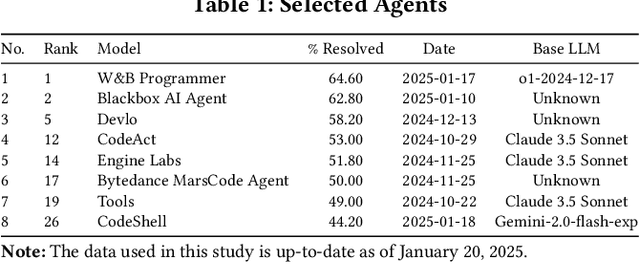
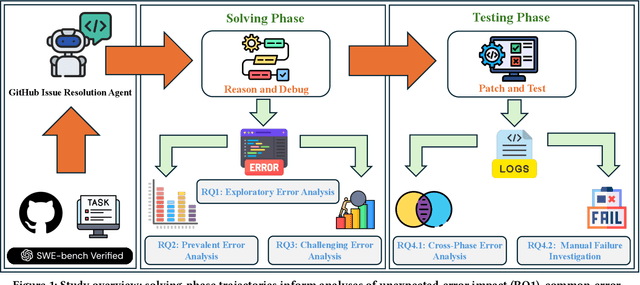
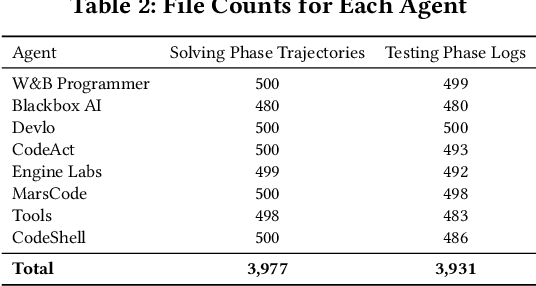
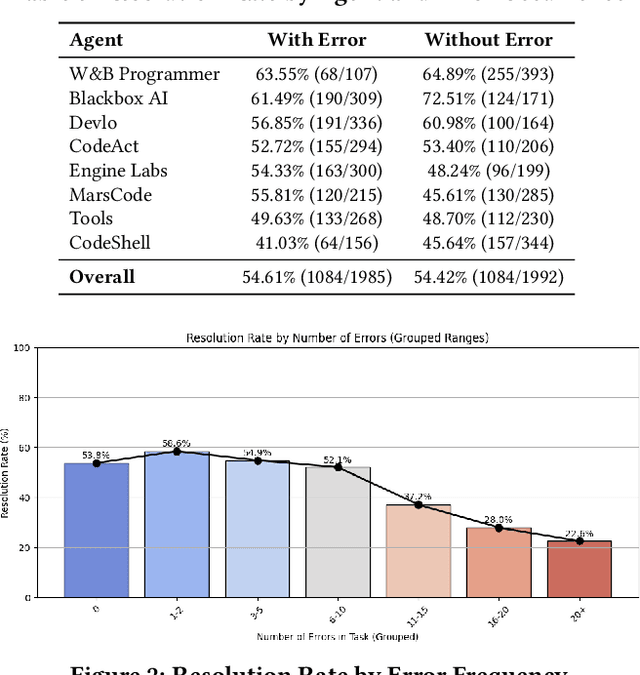
AI-driven software development has rapidly advanced with the emergence of software development agents that leverage large language models (LLMs) to tackle complex, repository-level software engineering tasks. These agents go beyond just generation of final code; they engage in multi-step reasoning, utilize various tools for code modification and debugging, and interact with execution environments to diagnose and iteratively resolve issues. However, most existing evaluations focus primarily on static analyses of final code outputs, yielding limited insights into the agents' dynamic problem-solving processes. To fill this gap, we conduct an in-depth empirical study on 3,977 solving-phase trajectories and 3,931 testing-phase logs from 8 top-ranked agents evaluated on 500 GitHub issues in the SWE-Bench benchmark. Our exploratory analysis shows that Python execution errors during the issue resolution phase correlate with lower resolution rates and increased reasoning overheads. We have identified the most prevalent errors -- such as ModuleNotFoundError and TypeError -- and highlighted particularly challenging errors like OSError and database-related issues (e.g., IntegrityError) that demand significantly more debugging effort. Furthermore, we have discovered 3 bugs in the SWE-Bench platform that affect benchmark fairness and accuracy; these issues have been reported to and confirmed by the maintainers. To promote transparency and foster future research, we publicly share our datasets and analysis scripts.
Transducer Tuning: Efficient Model Adaptation for Software Tasks Using Code Property Graphs
Dec 18, 2024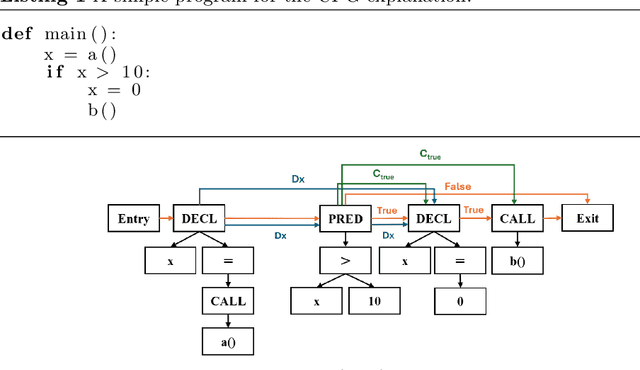
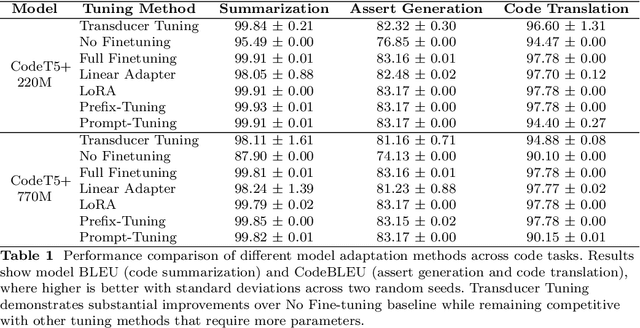
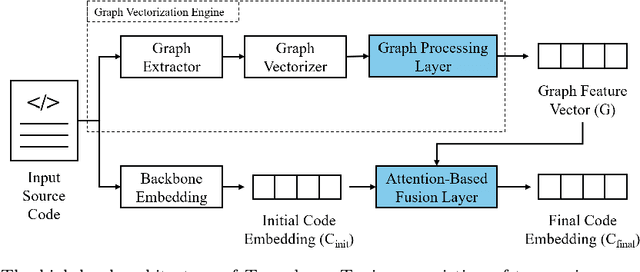
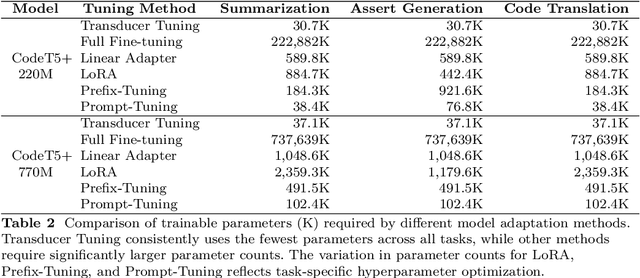
Large language models have demonstrated promising performance across various software engineering tasks. While fine-tuning is a common practice to adapt these models for downstream tasks, it becomes challenging in resource-constrained environments due to increased memory requirements from growing trainable parameters in increasingly large language models. We introduce \approach, a technique to adapt large models for downstream code tasks using Code Property Graphs (CPGs). Our approach introduces a modular component called \transducer that enriches code embeddings with structural and dependency information from CPGs. The Transducer comprises two key components: Graph Vectorization Engine (GVE) and Attention-Based Fusion Layer (ABFL). GVE extracts CPGs from input source code and transforms them into graph feature vectors. ABFL then fuses those graphs feature vectors with initial code embeddings from a large language model. By optimizing these transducers for different downstream tasks, our approach enhances the models without the need to fine-tune them for specific tasks. We have evaluated \approach on three downstream tasks: code summarization, assert generation, and code translation. Our results demonstrate competitive performance compared to full parameter fine-tuning while reducing up to 99\% trainable parameters to save memory. \approach also remains competitive against other fine-tuning approaches (e.g., LoRA, Prompt-Tuning, Prefix-Tuning) while using only 1.5\%-80\% of their trainable parameters. Our findings show that integrating structural and dependency information through Transducer Tuning enables more efficient model adaptation, making it easier for users to adapt large models in resource-constrained settings.
Evaluating Software Development Agents: Patch Patterns, Code Quality, and Issue Complexity in Real-World GitHub Scenarios
Oct 16, 2024In recent years, AI-based software engineering has progressed from pre-trained models to advanced agentic workflows, with Software Development Agents representing the next major leap. These agents, capable of reasoning, planning, and interacting with external environments, offer promising solutions to complex software engineering tasks. However, while much research has evaluated code generated by large language models (LLMs), comprehensive studies on agent-generated patches, particularly in real-world settings, are lacking. This study addresses that gap by evaluating 4,892 patches from 10 top-ranked agents on 500 real-world GitHub issues from SWE-Bench Verified, focusing on their impact on code quality. Our analysis shows no single agent dominated, with 170 issues unresolved, indicating room for improvement. Even for patches that passed unit tests and resolved issues, agents made different file and function modifications compared to the gold patches from repository developers, revealing limitations in the benchmark's test case coverage. Most agents maintained code reliability and security, avoiding new bugs or vulnerabilities; while some agents increased code complexity, many reduced code duplication and minimized code smells. Finally, agents performed better on simpler codebases, suggesting that breaking complex tasks into smaller sub-tasks could improve effectiveness. This study provides the first comprehensive evaluation of agent-generated patches on real-world GitHub issues, offering insights to advance AI-driven software development.
Promise and Peril of Collaborative Code Generation Models: Balancing Effectiveness and Memorization
Sep 18, 2024In the rapidly evolving field of machine learning, training models with datasets from various locations and organizations presents significant challenges due to privacy and legal concerns. The exploration of effective collaborative training settings capable of leveraging valuable knowledge from distributed and isolated datasets is increasingly crucial. This study investigates key factors that impact the effectiveness of collaborative training methods in code next-token prediction, as well as the correctness and utility of the generated code, demonstrating the promise of such methods. Additionally, we evaluate the memorization of different participant training data across various collaborative training settings, including centralized, federated, and incremental training, highlighting their potential risks in leaking data. Our findings indicate that the size and diversity of code datasets are pivotal factors influencing the success of collaboratively trained code models. We show that federated learning achieves competitive performance compared to centralized training while offering better data protection, as evidenced by lower memorization ratios in the generated code. However, federated learning can still produce verbatim code snippets from hidden training data, potentially violating privacy or copyright. Our study further explores effectiveness and memorization patterns in incremental learning, emphasizing the sequence in which individual participant datasets are introduced. We also identify cross-organizational clones as a prevalent challenge in both centralized and federated learning scenarios. Our findings highlight the persistent risk of data leakage during inference, even when training data remains unseen. We conclude with recommendations for practitioners and researchers to optimize multisource datasets, propelling cross-organizational collaboration forward.
Your Instructions Are Not Always Helpful: Assessing the Efficacy of Instruction Fine-tuning for Software Vulnerability Detection
Jan 15, 2024Software, while beneficial, poses potential cybersecurity risks due to inherent vulnerabilities. Detecting these vulnerabilities is crucial, and deep learning has shown promise as an effective tool for this task due to its ability to perform well without extensive feature engineering. However, a challenge in deploying deep learning for vulnerability detection is the limited availability of training data. Recent research highlights the deep learning efficacy in diverse tasks. This success is attributed to instruction fine-tuning, a technique that remains under-explored in the context of vulnerability detection. This paper investigates the capability of models, specifically a recent language model, to generalize beyond the programming languages used in their training data. It also examines the role of natural language instructions in enhancing this generalization. Our study evaluates the model performance on a real-world dataset to predict vulnerable code. We present key insights and lessons learned, contributing to understanding the deep learning application in software vulnerability detection.