 Add to Chrome
 Add to Firefox
 Add to Edge
Towards Evaluation Engineering: An Empirical Study of ML Evaluation Harnesses in the Wild
May 22, 2026
Evaluation harnesses are software systems that orchestrate model evaluation by managing model invocation, data loading, metric computation, and result reporting. Despite their critical role in machine learning infrastructure, their operational challenges and engineering concerns have received limited attention so far. We present an empirical study of 57 evaluation harnesses, deriving a five-stage harness model and classifying 16,560 issues by workflow stage and root cause. Most harness operational challenges concentrate in the Specification stage (41.4% of issues), where harnesses integrate external models, datasets, and scoring judges. The three most frequent root causes of operational challenges are unimplemented features (24.3%), documentation gaps (20.3%), and missing input validation (17.2%), which together account for 61.7% of classified issues, spanning both defects in existing functionality and capability gaps that block intended workflows. Root causes also vary by workflow stage: environment incompatibility and external dependency breakage account for 36.2% of provisioning issues, whereas algorithmic error (25.9%) and validation gap (22.5%) dominate assessment issues. Together, these contributions establish an empirical foundation for treating evaluation engineering as a distinct software engineering concern.

Gradual Cognitive Externalization: From Modeling Cognition to Constituting It
Apr 07, 2026Developers are publishing AI agent skills that replicate a colleague's communication style, encode a supervisor's mentoring heuristics, or preserve a person's behavioral repertoire beyond biological death. To explain why, we propose Gradual Cognitive Externalization (GCE), a framework arguing that ambient AI systems, through sustained causal coupling with users, transition from modeling cognitive functions to constituting part of users' cognitive architectures. GCE adopts an explicit functionalist commitment: cognitive functions are individuated by their causal-functional roles, not by substrate. The framework rests on the behavioral manifold hypothesis and a central falsifiable assumption, the no behaviorally invisible residual (NBIR) hypothesis: for any cognitive function whose behavioral output lies on a learnable manifold, no behaviorally invisible component is necessary for that function's operation. We document evidence from deployed AI systems showing that externalization preconditions are already observable, formalize three criteria separating cognitive integration from tool use (bidirectional adaptation, functional equivalence, causal coupling), and derive five testable predictions with theory-constrained thresholds.
Why Code, Why Now: Learnability, Computability, and the Real Limits of Machine Learning
Feb 15, 2026Code generation has progressed more reliably than reinforcement learning, largely because code has an information structure that makes it learnable. Code provides dense, local, verifiable feedback at every token, whereas most reinforcement learning problems do not. This difference in feedback quality is not binary but graded. We propose a five-level hierarchy of learnability based on information structure and argue that the ceiling on ML progress depends less on model size than on whether a task is learnable at all. The hierarchy rests on a formal distinction among three properties of computational problems (expressibility, computability, and learnability). We establish their pairwise relationships, including where implications hold and where they fail, and present a unified template that makes the structural differences explicit. The analysis suggests why supervised learning on code scales predictably while reinforcement learning does not, and why the common assumption that scaling alone will solve remaining ML challenges warrants scrutiny.
SE Arena: Benchmarking Software Engineering Chatbots with Iterative Interactions
Feb 03, 2025
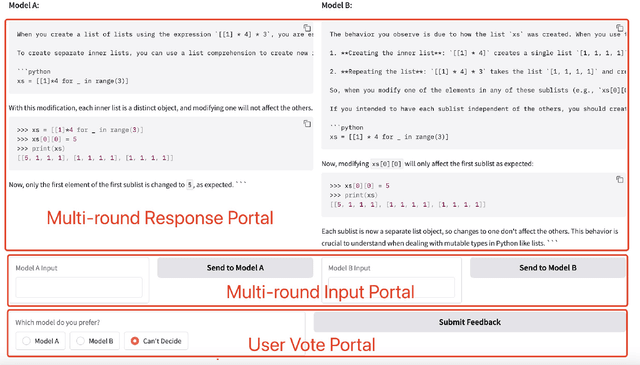
Foundation models (FMs), particularly large language models (LLMs), have shown significant promise in various software engineering (SE) tasks, including code generation, debugging, and requirement refinement. Despite these advances, existing evaluation frameworks are insufficient for assessing model performance in iterative, context-rich workflows characteristic of SE activities. To address this limitation, we introduce SE Arena, an interactive platform designed to evaluate SE-focused chatbots. SE Arena provides a transparent, open-source leaderboard, supports multi-round conversational workflows, and enables end-to-end model comparisons. Moreover, SE Arena incorporates a new feature called RepoChat, which automatically injects repository-related context (e.g., issues, commits, pull requests) into the conversation, further aligning evaluations with real-world development processes. This paper outlines the design and capabilities of SE Arena, emphasizing its potential to advance the evaluation and practical application of FMs in software engineering.
On the Workflows and Smells of Leaderboard Operations (LBOps): An Exploratory Study of Foundation Model Leaderboards
Jul 04, 2024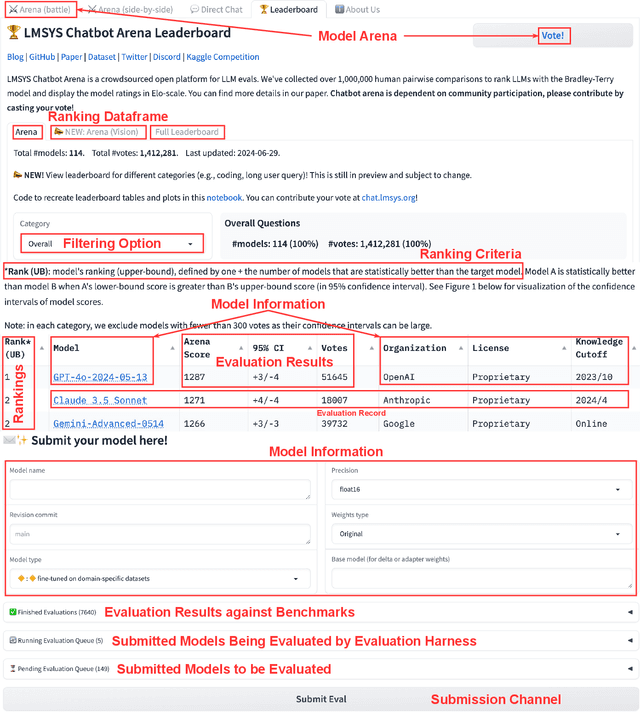
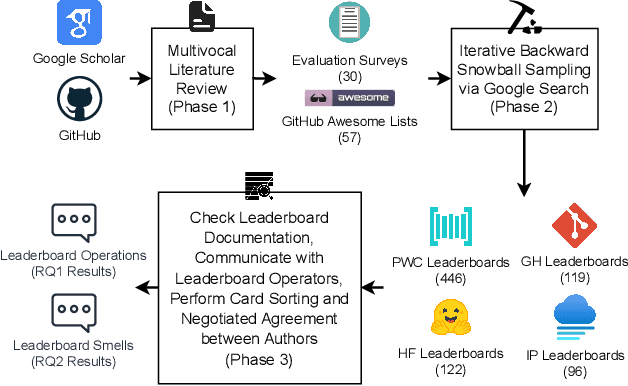
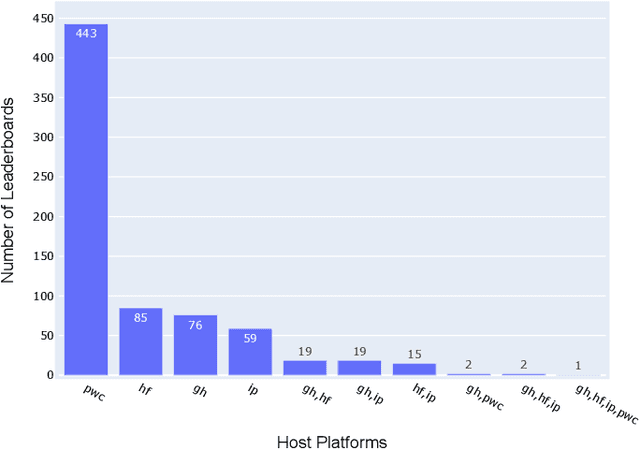
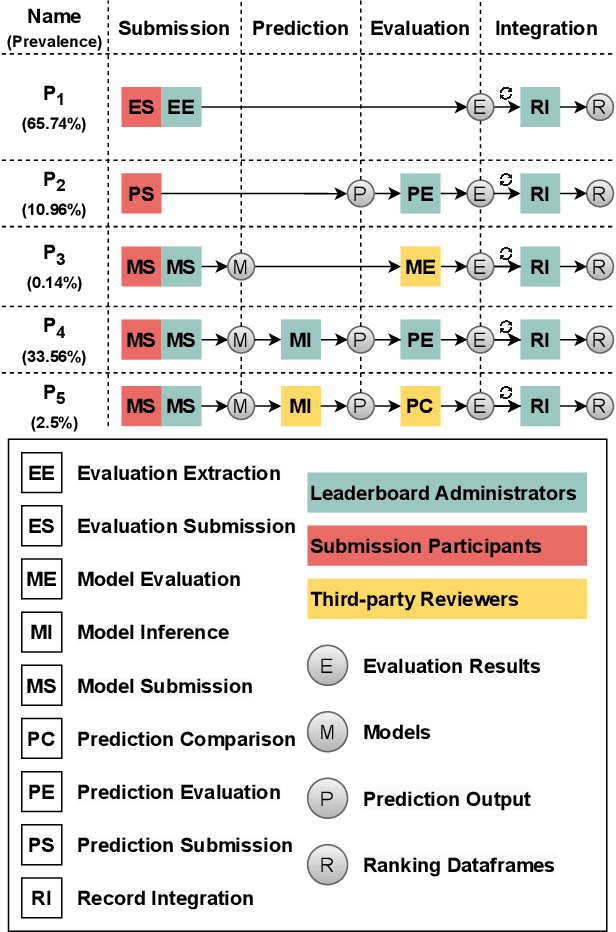
Foundation models (FM), such as large language models (LLMs), which are large-scale machine learning (ML) models, have demonstrated remarkable adaptability in various downstream software engineering (SE) tasks, such as code completion, code understanding, and software development. As a result, FM leaderboards, especially those hosted on cloud platforms, have become essential tools for SE teams to compare and select the best third-party FMs for their specific products and purposes. However, the lack of standardized guidelines for FM evaluation and comparison threatens the transparency of FM leaderboards and limits stakeholders' ability to perform effective FM selection. As a first step towards addressing this challenge, our research focuses on understanding how these FM leaderboards operate in real-world scenarios ("leaderboard operations") and identifying potential leaderboard pitfalls and areas for improvement ("leaderboard smells"). In this regard, we perform a multivocal literature review to collect up to 721 FM leaderboards, after which we examine their documentation and engage in direct communication with leaderboard operators to understand their workflow patterns. Using card sorting and negotiated agreement, we identify 5 unique workflow patterns and develop a domain model that outlines the essential components and their interaction within FM leaderboards. We then identify 8 unique types of leaderboard smells in LBOps. By mitigating these smells, SE teams can improve transparency, accountability, and collaboration in current LBOps practices, fostering a more robust and responsible ecosystem for FM comparison and selection.
An Empirical Study of Challenges in Machine Learning Asset Management
Feb 28, 2024In machine learning (ML), efficient asset management, including ML models, datasets, algorithms, and tools, is vital for resource optimization, consistent performance, and a streamlined development lifecycle. This enables quicker iterations, adaptability, reduced development-to-deployment time, and reliable outputs. Despite existing research, a significant knowledge gap remains in operational challenges like model versioning, data traceability, and collaboration, which are crucial for the success of ML projects. Our study aims to address this gap by analyzing 15,065 posts from developer forums and platforms, employing a mixed-method approach to classify inquiries, extract challenges using BERTopic, and identify solutions through open card sorting and BERTopic clustering. We uncover 133 topics related to asset management challenges, grouped into 16 macro-topics, with software dependency, model deployment, and model training being the most discussed. We also find 79 solution topics, categorized under 18 macro-topics, highlighting software dependency, feature development, and file management as key solutions. This research underscores the need for further exploration of identified pain points and the importance of collaborative efforts across academia, industry, and the research community.