 Add to Chrome
 Add to Firefox
 Add to Edge
LLM Code Smells: A Taxonomy and Detection Approach
May 21, 2026
Large Language Models (LLMs) are increasingly integrated into software systems for diverse purposes, due to their versatility, flexibility, and ability to simulate human reasoning to some extent. However, poor integration of LLM inference in source code can undermine software system quality. Therefore, inadequate LLM integration coding practices must be documented to help developers mitigate such issues. Following our earlier work on LLM code smells, this paper consolidates and refines the concept by presenting a self-contained taxonomy and a catalog of nine LLM code smells. We also create SpecDetect4LLM, a static source code analysis tool for their detection, and conduct extensive empirical evaluations of its detection effectiveness (precision and recall) as well as the prevalence of LLM code smells across 692 open-source software projects (171,194 source files). Our results show that LLM code smells affect 73.5% of the analyzed systems, with a detection precision of 91.3% and a recall of 71.8%.

Specification and Detection of LLM Code Smells
Dec 19, 2025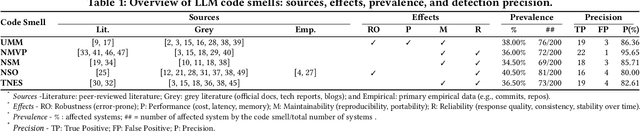
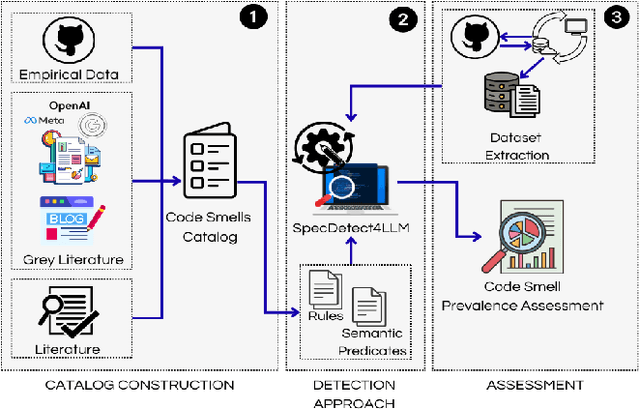
Large Language Models (LLMs) have gained massive popularity in recent years and are increasingly integrated into software systems for diverse purposes. However, poorly integrating them in source code may undermine software system quality. Yet, to our knowledge, there is no formal catalog of code smells specific to coding practices for LLM inference. In this paper, we introduce the concept of LLM code smells and formalize five recurrent problematic coding practices related to LLM inference in software systems, based on relevant literature. We extend the detection tool SpecDetect4AI to cover the newly defined LLM code smells and use it to validate their prevalence in a dataset of 200 open-source LLM systems. Our results show that LLM code smells affect 60.50% of the analyzed systems, with a detection precision of 86.06%.