 Add to Chrome
 Add to Firefox
 Add to Edge
Pcb
Papers and Code
PCBSchemaGen: Constraint-Guided Schematic Design via LLM for Printed Circuit Boards (PCB)
Jan 31, 2026
Printed Circuit Board (PCB) schematic design plays an essential role in all areas of electronic industries. Unlike prior works that focus on digital or analog circuits alone, PCB design must handle heterogeneous digital, analog, and power signals while adhering to real-world IC packages and pin constraints. Automated PCB schematic design remains unexplored due to the scarcity of open-source data and the absence of simulation-based verification. We introduce PCBSchemaGen, the first training-free framework for PCB schematic design that comprises LLM agent and Constraint-guided synthesis. Our approach makes three contributions: 1. an LLM-based code generation paradigm with iterative feedback with domain-specific prompts. 2. a verification framework leveraging a real-world IC datasheet derived Knowledge Graph (KG) and Subgraph Isomorphism encoding pin-role semantics and topological constraints. 3. an extensive experiment on 23 PCB schematic tasks spanning digital, analog, and power domains. Results demonstrate that PCBSchemaGen significantly improves design accuracy and computational efficiency.

UniPCB: A Unified Vision-Language Benchmark for Open-Ended PCB Quality Inspection
Jan 27, 2026Multimodal Large Language Models (MLLMs) show promise for general industrial quality inspection, but fall short in complex scenarios, such as Printed Circuit Board (PCB) inspection. PCB inspection poses unique challenges due to densely packed components, complex wiring structures, and subtle defect patterns that require specialized domain expertise. However, a high-quality, unified vision-language benchmark for quantitatively evaluating MLLMs across PCB inspection tasks remains absent, stemming not only from limited data availability but also from fragmented datasets and inconsistent standardization. To fill this gap, we propose UniPCB, the first unified vision-language benchmark for open-ended PCB quality inspection. UniPCB is built via a systematic pipeline that curates and standardizes data from disparate sources across three annotated scenarios. Furthermore, we introduce PCB-GPT, an MLLM trained on a new instruction dataset generated by this pipeline, utilizing a novel progressive curriculum that mimics the learning process of human experts. Evaluations on the UniPCB benchmark show that while existing MLLMs falter on domain-specific tasks, PCB-GPT establishes a new baseline. Notably, it more than doubles the performance on fine-grained defect localization compared to the strongest competitors, with significant advantages in localization and analysis. We will release the instruction data, benchmark, and model to facilitate future research.
SME-YOLO: A Real-Time Detector for Tiny Defect Detection on PCB Surfaces
Jan 16, 2026Surface defects on Printed Circuit Boards (PCBs) directly compromise product reliability and safety. However, achieving high-precision detection is challenging because PCB defects are typically characterized by tiny sizes, high texture similarity, and uneven scale distributions. To address these challenges, this paper proposes a novel framework based on YOLOv11n, named SME-YOLO (Small-target Multi-scale Enhanced YOLO). First, we employ the Normalized Wasserstein Distance Loss (NWDLoss). This metric effectively mitigates the sensitivity of Intersection over Union (IoU) to positional deviations in tiny objects. Second, the original upsampling module is replaced by the Efficient Upsampling Convolution Block (EUCB). By utilizing multi-scale convolutions, the EUCB gradually recovers spatial resolution and enhances the preservation of edge and texture details for tiny defects. Finally, this paper proposes the Multi-Scale Focused Attention (MSFA) module. Tailored to the specific spatial distribution of PCB defects, this module adaptively strengthens perception within key scale intervals, achieving efficient fusion of local fine-grained features and global context information. Experimental results on the PKU-PCB dataset demonstrate that SME-YOLO achieves state-of-the-art performance. Specifically, compared to the baseline YOLOv11n, SME-YOLO improves mAP by 2.2% and Precision by 4%, validating the effectiveness of the proposed method.
LaminoDiff: Artifact-Free Computed Laminography in Non-Destructive Testing via Diffusion Model
Jan 12, 2026Computed Laminography (CL) is a key non-destructive testing technology for the visualization of internal structures in large planar objects. The inherent scanning geometry of CL inevitably results in inter-layer aliasing artifacts, limiting its practical application, particularly in electronic component inspection. While deep learning (DL) provides a powerful paradigm for artifact removal, its effectiveness is often limited by the domain gap between synthetic data and real-world data. In this work, we present LaminoDiff, a framework to integrate a diffusion model with a high-fidelity prior representation to bridge the domain gap in CL imaging. This prior, generated via a dual-modal CT-CL fusion strategy, is integrated into the proposed network as a conditional constraint. This integration ensures high-precision preservation of circuit structures and geometric fidelity while suppressing artifacts. Extensive experiments on both simulated and real PCB datasets demonstrate that LaminoDiff achieves high-fidelity reconstruction with competitive performance in artifact suppression and detail recovery. More importantly, the results facilitate reliable automated defect recognition.
Low-Complexity Planar Beyond-Diagonal RIS Architecture Design Using Graph Theory
Jan 07, 2026Reconfigurable intelligent surfaces (RISs) enable programmable control of the wireless propagation environment and are key enablers for future networks. Beyond-diagonal RIS (BD-RIS) architectures enhance conventional RIS by interconnecting elements through tunable impedance components, offering greater flexibility with higher circuit complexity. However, excessive interconnections between BD-RIS elements require multi-layer printed circuit board (PCB) designs, increasing fabrication difficulty. In this letter, we use graph theory to characterize the BD-RIS architectures that can be realized on double-layer PCBs, denoted as planar-connected RISs. Among the possible planar-connected RISs, we identify the ones with the most degrees of freedom, expected to achieve the best performance under practical constraints.
Application Research of a Deep Learning Model Integrating CycleGAN and YOLO in PCB Infrared Defect Detection
Jan 01, 2026This paper addresses the critical bottleneck of infrared (IR) data scarcity in Printed Circuit Board (PCB) defect detection by proposing a cross-modal data augmentation framework integrating CycleGAN and YOLOv8. Unlike conventional methods relying on paired supervision, we leverage CycleGAN to perform unpaired image-to-image translation, mapping abundant visible-light PCB images into the infrared domain. This generative process synthesizes high-fidelity pseudo-IR samples that preserve the structural semantics of defects while accurately simulating thermal distribution patterns. Subsequently, we construct a heterogeneous training strategy that fuses generated pseudo-IR data with limited real IR samples to train a lightweight YOLOv8 detector. Experimental results demonstrate that this method effectively enhances feature learning under low-data conditions. The augmented detector significantly outperforms models trained on limited real data alone and approaches the performance benchmarks of fully supervised training, proving the efficacy of pseudo-IR synthesis as a robust augmentation strategy for industrial inspection.
Wireless sEMG-IMU Wearable for Real-Time Squat Kinematics and Muscle Activation
Dec 22, 2025This work presents the design and implementation of a wireless, wearable system that combines surface electromyography (sEMG) and inertial measurement units (IMUs) to analyze a single lower-limb functional task: the free bodyweight squat in a healthy adult. The system records bipolar EMG from one agonist and one antagonist muscle of the dominant leg (vastus lateralis and semitendinosus) while simultaneously estimating knee joint angle, angular velocity, and angular acceleration using two MPU6050 IMUs. A custom dual-channel EMG front end with differential instrumentation preamplification, analog filtering (5-500 Hz band-pass and 60 Hz notch), high final gain, and rectified-integrated output was implemented on a compact 10 cm x 12 cm PCB. Data are digitized by an ESP32 microcontroller and transmitted wirelessly via ESP-NOW to a second ESP32 connected to a PC. A Python-based graphical user interface (GUI) displays EMG and kinematic signals in real time, manages subject metadata, and exports a summary of each session to Excel. The complete system is battery-powered to reduce electrical risk during human use. The resulting prototype demonstrates the feasibility of low-cost, portable EMG-IMU instrumentation for integrated analysis of muscle activation and squat kinematics and provides a platform for future biomechanical applications in sports performance and rehabilitation.
An Open Toolkit for Underwater Field Robotics
Dec 17, 2025Underwater robotics is becoming increasingly important for marine science, environmental monitoring, and subsea industrial operations, yet the development of underwater manipulation and actuation systems remains restricted by high costs, proprietary designs, and limited access to modular, research-oriented hardware. While open-source initiatives have democratized vehicle construction and control software, a substantial gap persists for joint-actuated systems-particularly those requiring waterproof, feedback-enabled actuation suitable for manipulators, grippers, and bioinspired devices. As a result, many research groups face lengthy development cycles, limited reproducibility, and difficulty transitioning laboratory prototypes to field-ready platforms. To address this gap, we introduce an open, cost-effective hardware and software toolkit for underwater manipulation research. The toolkit includes a depth-rated Underwater Robotic Joint (URJ) with early leakage detection, compact control and power management electronics, and a ROS2-based software stack for sensing and multi-mode actuation. All CAD models, fabrication files, PCB sources, firmware, and ROS2 packages are openly released, enabling local manufacturing, modification, and community-driven improvement. The toolkit has undergone extensive laboratory testing and multiple field deployments, demonstrating reliable operation up to 40 m depth across diverse applications, including a 3-DoF underwater manipulator, a tendon-driven soft gripper, and an underactuated sediment sampler. These results validate the robustness, versatility, and reusability of the toolkit for real marine environments. By providing a fully open, field-tested platform, this work aims to lower the barrier to entry for underwater manipulation research, improve reproducibility, and accelerate innovation in underwater field robotics.
Unified Smart Factory Model: A model-based Approach for Integrating Industry 4.0 and Sustainability for Manufacturing Systems
Dec 12, 2025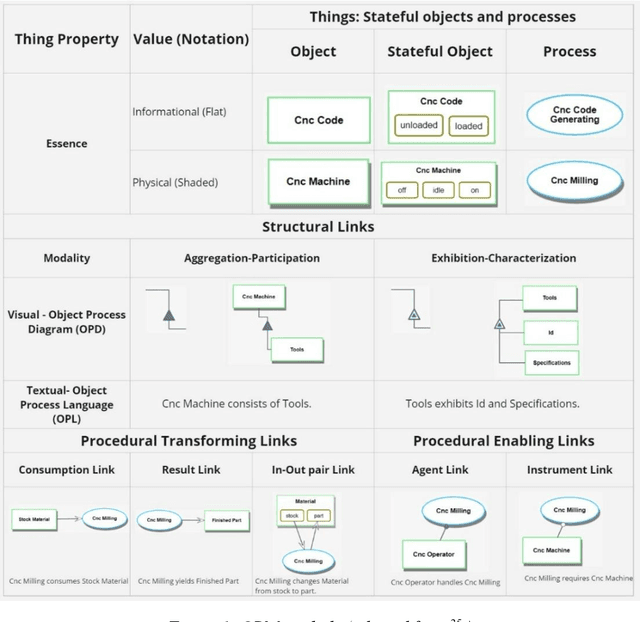
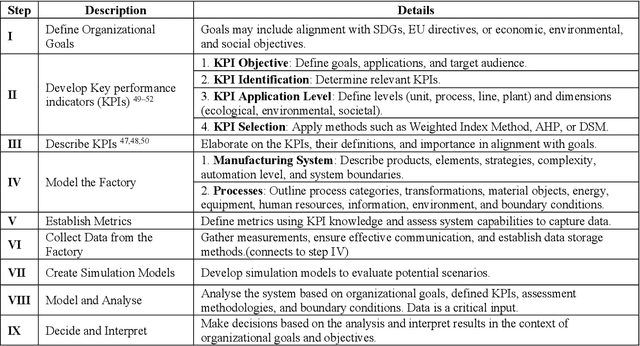
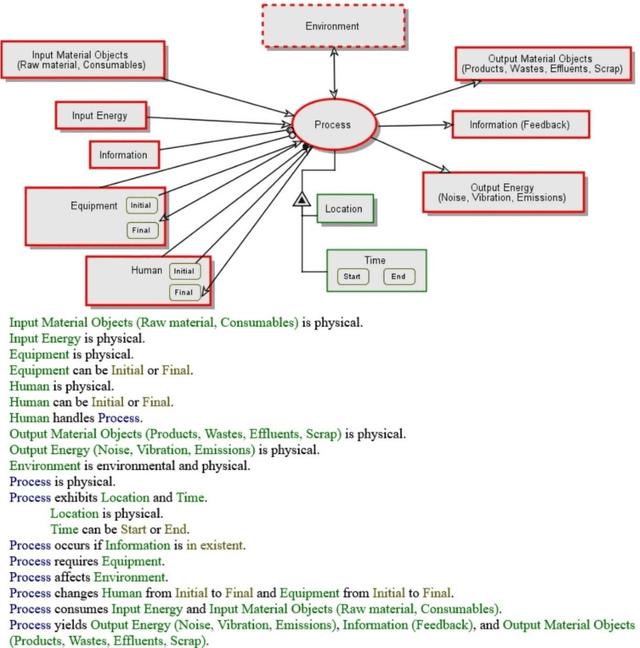

This paper presents the Unified Smart Factory Model (USFM), a comprehensive framework designed to translate high-level sustainability goals into measurable factory-level indicators with a systematic information map of manufacturing activities. The manufacturing activities were modelled as set of manufacturing, assembly and auxiliary processes using Object Process Methodology, a Model Based Systems Engineering (MBSE) language. USFM integrates Manufacturing Process and System, Data Process, and Key Performance Indicator (KPI) Selection and Assessment in a single framework. Through a detailed case study of Printed Circuit Board (PCB) assembly factory, the paper demonstrates how environmental sustainability KPIs can be selected, modelled, and mapped to the necessary data, highlighting energy consumption and environmental impact metrics. The model's systematic approach can reduce redundancy, minimize the risk of missing critical information, and enhance data collection. The paper concluded that the USFM bridges the gap between sustainability goals and practical implementation, providing significant benefits for industries specifically SMEs aiming to achieve sustainability targets.
BoardVision: Deployment-ready and Robust Motherboard Defect Detection with YOLO+Faster-RCNN Ensemble
Oct 16, 2025Motherboard defect detection is critical for ensuring reliability in high-volume electronics manufacturing. While prior research in PCB inspection has largely targeted bare-board or trace-level defects, assembly-level inspection of full motherboards inspection remains underexplored. In this work, we present BoardVision, a reproducible framework for detecting assembly-level defects such as missing screws, loose fan wiring, and surface scratches. We benchmark two representative detectors - YOLOv7 and Faster R-CNN, under controlled conditions on the MiracleFactory motherboard dataset, providing the first systematic comparison in this domain. To mitigate the limitations of single models, where YOLO excels in precision but underperforms in recall and Faster R-CNN shows the reverse, we propose a lightweight ensemble, Confidence-Temporal Voting (CTV Voter), that balances precision and recall through interpretable rules. We further evaluate robustness under realistic perturbations including sharpness, brightness, and orientation changes, highlighting stability challenges often overlooked in motherboard defect detection. Finally, we release a deployable GUI-driven inspection tool that bridges research evaluation with operator usability. Together, these contributions demonstrate how computer vision techniques can transition from benchmark results to practical quality assurance for assembly-level motherboard manufacturing.