 Add to Chrome
 Add to Firefox
 Add to Edge
Opinion Mining
Papers and Code
Generate Then Correct: Single Shot Global Correction for Aspect Sentiment Quad Prediction
Mar 14, 2026
Aspect-based sentiment analysis (ABSA) extracts aspect-level sentiment signals from user-generated text, supports product analytics, experience monitoring, and public-opinion tracking, and is central to fine-grained opinion mining. A key challenge in ABSA is aspect sentiment quad prediction (ASQP), which requires identifying four elements: the aspect term, the aspect category, the opinion term, and the sentiment polarity. However, existing studies usually linearize the unordered quad set into a fixed-order template and decode it left-to-right. With teacher forcing training, the resulting training-inference mismatch (exposure bias) lets early prefix errors propagate to later elements. The linearization order determines which elements appear earlier in the prefix, so this propagation becomes order-sensitive and is hard to repair in a single pass. To address this, we propose a method, Generate-then-Correct (G2C): a generator drafts quads and a corrector performs a single-shot, sequence-level global correction trained on LLM-synthesized drafts with common error patterns. On the Rest15 and Rest16 datasets, G2C outperforms strong baseline models.

Privacy Preserving Topic-wise Sentiment Analysis of the Iran Israel USA Conflict Using Federated Transformer Models
Mar 13, 2026The recent escalation of the Iran Israel USA conflict in 2026 has triggered widespread global discussions across social media platforms. As people increasingly use these platforms for expressing opinions, analyzing public sentiment from these discussions can provide valuable insights into global public perception. This study aims to analyze global public sentiment regarding the Iran Israel USA conflict by mining user-generated comments from YouTube news channels. The work contributes to public opinion analysis by introducing a privacy preserving framework that combines topic wise sentiment analysis with modern deep learning techniques and Federated Learning. To achieve this, approximately 19,000 YouTube comments were collected from major international news channels and preprocessed to remove noise and normalize text. Sentiment labels were initially generated using the VADER sentiment analyzer and later validated through manual inspection to improve reliability. Latent Dirichlet Allocation (LDA) was applied to identify key discussion topics related to the conflict. Several transformer-based models, including BERT, RoBERTa, XLNet, DistilBERT, ModernBERT, and ELECTRA, were fine tuned for sentiment classification. The best-performing model was further integrated into a federated learning environment to enable distributed training by preserving user data privacy. Additionally, Explainable Artificial Intelligence (XAI) techniques using SHAP were applied to interpret model predictions and identify influential words affecting sentiment classification. Experimental results demonstrate that transformer models perform effectively, and among them, ELECTRA achieved the best performance with 91.32% accuracy. The federated learning also maintained strong performance while preserving privacy, achieving 89.59% accuracy in a two client configuration.
XAI-enhanced Comparative Opinion Mining via Aspect-based Scoring and Semantic Reasoning
Mar 01, 2026Comparative opinion mining involves comparing products from different reviews. However, transformer-based models designed for this task often lack transparency, which can adversely hinder the development of trust in users. In this paper, we propose XCom, an enhanced transformer-based model separated into two principal modules, i.e., (i) aspect-based rating prediction and (ii) semantic analysis for comparative opinion mining. XCom also incorporates a Shapley additive explanations module to provide interpretable insights into the model's deliberative decisions. Empirically, XCom achieves leading performances compared to other baselines, which demonstrates its effectiveness in providing meaningful explanations, making it a more reliable tool for comparative opinion mining. Source code is available at: https://anonymous.4open.science/r/XCom.
Prototype-Based Knowledge Guidance for Fine-Grained Structured Radiology Reporting
Mar 12, 2026Structured radiology reporting promises faster, more consistent communication than free text, but automation remains difficult as models must make many fine-grained, discrete decisions about rare findings and attributes from limited structured supervision. In contrast, free-text reports are produced at scale in routine care and implicitly encode fine-grained, image-linked information through detailed descriptions. To leverage this unstructured knowledge, we propose ProtoSR, an approach for injecting free-text information into structured report population. First, we introduce an automatic extraction pipeline that uses an instruction-tuned LLM to mine 80k+ MIMIC-CXR studies and build a multimodal knowledge base aligned with a structured reporting template, representing each answer option with a visual prototype. Using this knowledge base, ProtoSR is trained to retrieve prototypes relevant for the current image-question pair and augment the model predictions through a prototype-conditioned residual, providing a data-driven second opinion that selectively corrects predictions. On the Rad-ReStruct benchmark, ProtoSR achieves state-of-the-art results, with the largest improvements on detailed attribute questions, demonstrating the value of integrating free-text derived signal for fine-grained image understanding.
LAMUS: A Large-Scale Corpus for Legal Argument Mining from U.S. Caselaw using LLMs
Mar 09, 2026Legal argument mining aims to identify and classify the functional components of judicial reasoning, such as facts, issues, rules, analysis, and conclusions. Progress in this area is limited by the lack of large-scale, high-quality annotated datasets for U.S. caselaw, particularly at the state level. This paper introduces LAMUS, a sentence-level legal argument mining corpus constructed from U.S. Supreme Court decisions and Texas criminal appellate opinions. The dataset is created using a data-centric pipeline that combines large-scale case collection, LLM-based automatic annotation, and targeted human-in-the-loop quality refinement. We formulate legal argument mining as a six-class sentence classification task and evaluate multiple general-purpose and legal-domain language models under zero-shot, few-shot, and chain-of-thought prompting strategies, with LegalBERT as a supervised baseline. Results show that chain-of-thought prompting substantially improves LLM performance, while domain-specific models exhibit more stable zero-shot behavior. LLM-assisted verification corrects nearly 20% of annotation errors, improving label consistency. Human verification achieves Cohen's Kappa of 0.85, confirming annotation quality. LAMUS provides a scalable resource and empirical insights for future legal NLP research. All code and datasets can be accessed for reproducibility on GitHub at: https://github.com/LavanyaPobbathi/LAMUS/tree/main
Towards Expectation Detection in Language: A Case Study on Treatment Expectations in Reddit
Feb 17, 2026Patients' expectations towards their treatment have a substantial effect on the treatments' success. While primarily studied in clinical settings, online patient platforms like medical subreddits may hold complementary insights: treatment expectations that patients feel unnecessary or uncomfortable to share elsewhere. Despite this, no studies examine what type of expectations users discuss online and how they express them. Presumably this is because expectations have not been studied in natural language processing (NLP) before. Therefore, we introduce the task of Expectation Detection, arguing that expectations are relevant for many applications, including opinion mining and product design. Subsequently, we present a case study for the medical domain, where expectations are particularly crucial to extract. We contribute RedHOTExpect, a corpus of Reddit posts (4.5K posts) to study expectations in this context. We use a large language model (LLM) to silver-label the data and validate its quality manually (label accuracy ~78%). Based on this, we analyze which linguistic patterns characterize expectations and explore what patients expect and why. We find that optimism and proactive framing are more pronounced in posts about physical or treatment-related illnesses compared to mental-health contexts, and that in our dataset, patients mostly discuss benefits rather than negative outcomes. The RedHOTExpect corpus can be obtained from https://www.ims.uni-stuttgart.de/data/RedHOTExpect
TruthStance: An Annotated Dataset of Conversations on Truth Social
Feb 16, 2026Argument mining and stance detection are central to understanding how opinions are formed and contested in online discourse. However, most publicly available resources focus on mainstream platforms such as Twitter and Reddit, leaving conversational structure on alt-tech platforms comparatively under-studied. We introduce TruthStance, a large-scale dataset of Truth Social conversation threads spanning 2023-2025, consisting of 24,378 posts and 523,360 comments with reply-tree structure preserved. We provide a human-annotated benchmark of 1,500 instances across argument mining and claim-based stance detection, including inter-annotator agreement, and use it to evaluate large language model (LLM) prompting strategies. Using the best-performing configuration, we release additional LLM-generated labels for 24,352 posts (argument presence) and 107,873 comments (stance to parent), enabling analysis of stance and argumentation patterns across depth, topics, and users. All code and data are released publicly.
Comparing Without Saying: A Dataset and Benchmark for Implicit Comparative Opinion Mining from Same-User Reviews
Jan 20, 2026Existing studies on comparative opinion mining have mainly focused on explicit comparative expressions, which are uncommon in real-world reviews. This leaves implicit comparisons - here users express preferences across separate reviews - largely underexplored. We introduce SUDO, a novel dataset for implicit comparative opinion mining from same-user reviews, allowing reliable inference of user preferences even without explicit comparative cues. SUDO comprises 4,150 annotated review pairs (15,191 sentences) with a bi-level structure capturing aspect-level mentions and review-level preferences. We benchmark this task using two baseline architectures: traditional machine learning- and language model-based baselines. Experimental results show that while the latter outperforms the former, overall performance remains moderate, revealing the inherent difficulty of the task and establishing SUDO as a challenging and valuable benchmark for future research.
Opinion Mining and Analysis Using Hybrid Deep Neural Networks
Nov 16, 2025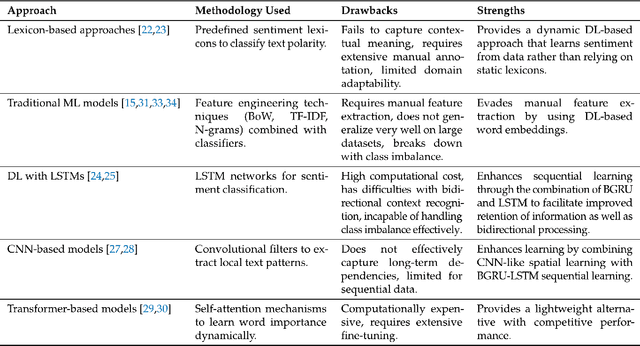
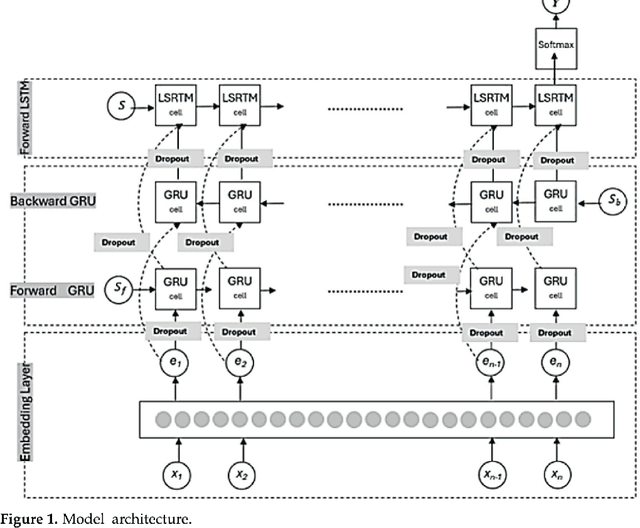

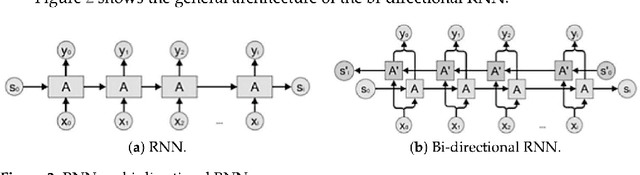
Understanding customer attitudes has become a critical component of decision-making due to the growing influence of social media and e-commerce. Text-based opinions are the most structured, hence playing an important role in sentiment analysis. Most of the existing methods, which include lexicon-based approaches and traditional machine learning techniques, are insufficient for handling contextual nuances and scalability. While the latter has limitations in model performance and generalization, deep learning (DL) has achieved improvement, especially on semantic relationship capturing with recurrent neural networks (RNNs) and convolutional neural networks (CNNs). The aim of the study is to enhance opinion mining by introducing a hybrid deep neural network model that combines a bidirectional gated recurrent unit (BGRU) and long short-term memory (LSTM) layers to improve sentiment analysis, particularly addressing challenges such as contextual nuance, scalability, and class imbalance. To substantiate the efficacy of the proposed model, we conducted comprehensive experiments utilizing benchmark datasets, encompassing IMDB movie critiques and Amazon product evaluations. The introduced hybrid BGRULSTM (HBGRU-LSTM) architecture attained a testing accuracy of 95%, exceeding the performance of traditional DL frameworks such as LSTM (93.06%), CNN+LSTM (93.31%), and GRU+LSTM (92.20%). Moreover, our model exhibited a noteworthy enhancement in recall for negative sentiments, escalating from 86% (unbalanced dataset) to 96% (balanced dataset), thereby ensuring a more equitable and just sentiment classification. Furthermore, the model diminished misclassification loss from 20.24% for unbalanced to 13.3% for balanced dataset, signifying enhanced generalization and resilience.
* 22 pages, 4 figures, 11 tables
From Semantic Roles to Opinion Roles: SRL Data Extraction for Multi-Task and Transfer Learning in Low-Resource ORL
Nov 11, 2025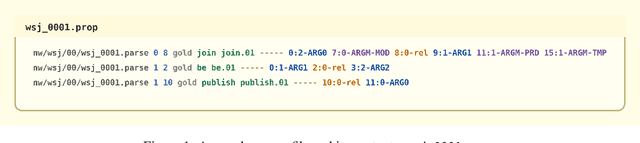
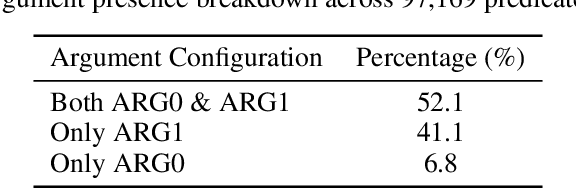
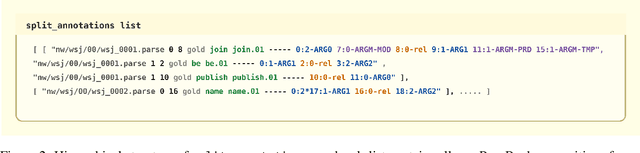
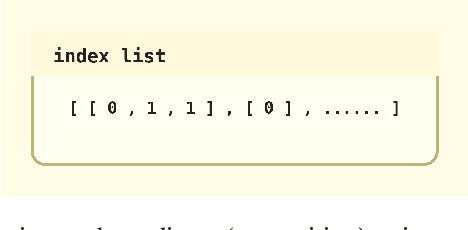
This report presents a detailed methodology for constructing a high-quality Semantic Role Labeling (SRL) dataset from the Wall Street Journal (WSJ) portion of the OntoNotes 5.0 corpus and adapting it for Opinion Role Labeling (ORL) tasks. Leveraging the PropBank annotation framework, we implement a reproducible extraction pipeline that aligns predicate-argument structures with surface text, converts syntactic tree pointers to coherent spans, and applies rigorous cleaning to ensure semantic fidelity. The resulting dataset comprises 97,169 predicate-argument instances with clearly defined Agent (ARG0), Predicate (REL), and Patient (ARG1) roles, mapped to ORL's Holder, Expression, and Target schema. We provide a detailed account of our extraction algorithms, discontinuous argument handling, annotation corrections, and statistical analysis of the resulting dataset. This work offers a reusable resource for researchers aiming to leverage SRL for enhancing ORL, especially in low-resource opinion mining scenarios.