 Add to Chrome
 Add to Firefox
 Add to Edge
LAMUS: A Large-Scale Corpus for Legal Argument Mining from U.S. Caselaw using LLMs
Mar 09, 2026
Legal argument mining aims to identify and classify the functional components of judicial reasoning, such as facts, issues, rules, analysis, and conclusions. Progress in this area is limited by the lack of large-scale, high-quality annotated datasets for U.S. caselaw, particularly at the state level. This paper introduces LAMUS, a sentence-level legal argument mining corpus constructed from U.S. Supreme Court decisions and Texas criminal appellate opinions. The dataset is created using a data-centric pipeline that combines large-scale case collection, LLM-based automatic annotation, and targeted human-in-the-loop quality refinement. We formulate legal argument mining as a six-class sentence classification task and evaluate multiple general-purpose and legal-domain language models under zero-shot, few-shot, and chain-of-thought prompting strategies, with LegalBERT as a supervised baseline. Results show that chain-of-thought prompting substantially improves LLM performance, while domain-specific models exhibit more stable zero-shot behavior. LLM-assisted verification corrects nearly 20% of annotation errors, improving label consistency. Human verification achieves Cohen's Kappa of 0.85, confirming annotation quality. LAMUS provides a scalable resource and empirical insights for future legal NLP research. All code and datasets can be accessed for reproducibility on GitHub at: https://github.com/LavanyaPobbathi/LAMUS/tree/main

A Comparative Study of Quality Evaluation Methods for Text Summarization
Jun 30, 2024
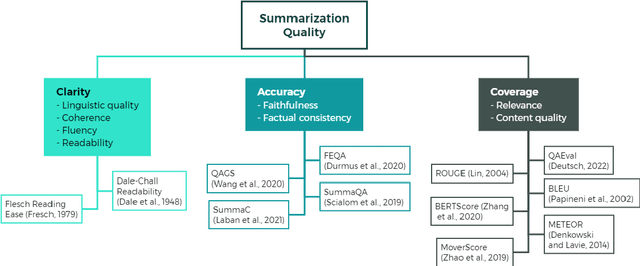


Evaluating text summarization has been a challenging task in natural language processing (NLP). Automatic metrics which heavily rely on reference summaries are not suitable in many situations, while human evaluation is time-consuming and labor-intensive. To bridge this gap, this paper proposes a novel method based on large language models (LLMs) for evaluating text summarization. We also conducts a comparative study on eight automatic metrics, human evaluation, and our proposed LLM-based method. Seven different types of state-of-the-art (SOTA) summarization models were evaluated. We perform extensive experiments and analysis on datasets with patent documents. Our results show that LLMs evaluation aligns closely with human evaluation, while widely-used automatic metrics such as ROUGE-2, BERTScore, and SummaC do not and also lack consistency. Based on the empirical comparison, we propose a LLM-powered framework for automatically evaluating and improving text summarization, which is beneficial and could attract wide attention among the community.