 Add to Chrome
 Add to Firefox
 Add to Edge
Overview of the MedHopQA track at BioCreative IX: track description, participation and evaluation of systems for multi-hop medical question answering
May 12, 2026
Multi-hop question answering (QA) remains a significant challenge in the biomedical domain, requiring systems to integrate information across multiple sources to answer complex questions. To address this problem, the BioCreative IX MedHopQA shared task was designed to benchmark in multi-hop reasoning for large language models (LLMs). We developed a novel dataset of 1,000 challenging QA pairs spanning diseases, genes, and chemicals, with particular emphasis on rare diseases. Each question was constructed to require two-hop reasoning through the integration of information from two distinct Wikipedia pages. The challenge attracted 48 submissions from 13 teams. Systems were evaluated using both surface string comparison and conceptual accuracy (MedCPT score). The results showed a substantial performance gap between baseline LLMs and enhanced systems. The top-ranked submission achieved an 89.30% F1 score on the MedCPT metric and an 87.30% exact match (EM) score, compared with 67.40% and 60.20%, respectively, for the zero-shot baseline. A central finding of the challenge was that retrieval-augmented generation (RAG) and related retrieval-based strategies were critical for strong performance. In addition, concept-level evaluation improved answer assessment when correct responses differed in surface form. The MedHopQA dataset is publicly available to support continued progress in this important area. Challenge materials: https://www.ncbi.nlm.nih.gov/research/bionlp/medhopqa and benchmark https://www.codabench.org/competitions/7609/

From Top-1 to Top-K: A Reproducibility Study and Benchmarking of Counterfactual Explanations for Recommender Systems
Apr 21, 2026Counterfactual explanations (CEs) provide an intuitive way to understand recommender systems by identifying minimal modifications to user-item interactions that alter recommendation outcomes. Existing CE methods for recommender systems, however, have been evaluated under heterogeneous protocols, using different datasets, recommenders, metrics, and even explanation formats, which hampers reproducibility and fair comparison. Our paper systematically reproduces, re-implement, and re-evaluate eleven state-of-the-art CE methods for recommender systems, covering both native explainers (e.g., LIME-RS, SHAP, PRINCE, ACCENT, LXR, GREASE) and specific graph-based explainers originally proposed for GNNs. Here, a unified benchmarking framework is proposed to assess explainers along three dimensions: explanation format (implicit vs. explicit), evaluation level (item-level vs. list-level), and perturbation scope (user interaction vectors vs. user-item interaction graphs). Our evaluation protocol includes effectiveness, sparsity, and computational complexity metrics, and extends existing item-level assessments to top-K list-level explanations. Through extensive experiments on three real-world datasets and six representative recommender models, we analyze how well previously reported strengths of CE methods generalize across diverse setups. We observe that the trade-off between effectiveness and sparsity depends strongly on the specific method and evaluation setting, particularly under the explicit format; in addition, explainer performance remains largely consistent across item level and list level evaluations, and several graph-based explainers exhibit notable scalability limitations on large recommender graphs. Our results refine and challenge earlier conclusions about the robustness and practicality of CE generation methods in recommender systems: https://github.com/L2R-UET/CFExpRec.
XAI-enhanced Comparative Opinion Mining via Aspect-based Scoring and Semantic Reasoning
Mar 01, 2026Comparative opinion mining involves comparing products from different reviews. However, transformer-based models designed for this task often lack transparency, which can adversely hinder the development of trust in users. In this paper, we propose XCom, an enhanced transformer-based model separated into two principal modules, i.e., (i) aspect-based rating prediction and (ii) semantic analysis for comparative opinion mining. XCom also incorporates a Shapley additive explanations module to provide interpretable insights into the model's deliberative decisions. Empirically, XCom achieves leading performances compared to other baselines, which demonstrates its effectiveness in providing meaningful explanations, making it a more reliable tool for comparative opinion mining. Source code is available at: https://anonymous.4open.science/r/XCom.
Counterfactual Understanding via Retrieval-aware Multimodal Modeling for Time-to-Event Survival Prediction
Feb 23, 2026This paper tackles the problem of time-to-event counterfactual survival prediction, aiming to optimize individualized survival outcomes in the presence of heterogeneity and censored data. We propose CURE, a framework that advances counterfactual survival modeling via comprehensive multimodal embedding and latent subgroup retrieval. CURE integrates clinical, paraclinical, demographic, and multi-omics information, which are aligned and fused through cross-attention mechanisms. Complex multi-omics signals can be adaptively refined using a mixture-of-experts architecture, emphasizing the most informative omics components. Building upon this representation, CURE implicitly retrieves patient-specific latent subgroups that capture both baseline survival dynamics and treatment-dependent variations. Experimental results on METABRIC and TCGA-LUAD datasets demonstrate that proposed CURE model consistently outperforms strong baselines in survival analysis, evaluated using the Time-dependent Concordance Index ($C^{td}$) and Integrated Brier Score (IBS). These findings highlight the potential of CURE to enhance multimodal understanding and serve as a foundation for future treatment recommendation models. All code and related resources are publicly available to facilitate the reproducibility https://github.com/L2R-UET/CURE.
NOWJ @BioCreative IX ToxHabits: An Ensemble Deep Learning Approach for Detecting Substance Use and Contextual Information in Clinical Texts
Feb 10, 2026Extracting drug use information from unstructured Electronic Health Records remains a major challenge in clinical Natural Language Processing. While Large Language Models demonstrate advancements, their use in clinical NLP is limited by concerns over trust, control, and efficiency. To address this, we present NOWJ submission to the ToxHabits Shared Task at BioCreative IX. This task targets the detection of toxic substance use and contextual attributes in Spanish clinical texts, a domain-specific, low-resource setting. We propose a multi-output ensemble system tackling both Subtask 1 - ToxNER and Subtask 2 - ToxUse. Our system integrates BETO with a CRF layer for sequence labeling, employs diverse training strategies, and uses sentence filtering to boost precision. Our top run achieved 0.94 F1 and 0.97 precision for Trigger Detection, and 0.91 F1 for Argument Detection.
Comparing Without Saying: A Dataset and Benchmark for Implicit Comparative Opinion Mining from Same-User Reviews
Jan 20, 2026Existing studies on comparative opinion mining have mainly focused on explicit comparative expressions, which are uncommon in real-world reviews. This leaves implicit comparisons - here users express preferences across separate reviews - largely underexplored. We introduce SUDO, a novel dataset for implicit comparative opinion mining from same-user reviews, allowing reliable inference of user preferences even without explicit comparative cues. SUDO comprises 4,150 annotated review pairs (15,191 sentences) with a bi-level structure capturing aspect-level mentions and review-level preferences. We benchmark this task using two baseline architectures: traditional machine learning- and language model-based baselines. Experimental results show that while the latter outperforms the former, overall performance remains moderate, revealing the inherent difficulty of the task and establishing SUDO as a challenging and valuable benchmark for future research.
UETQuintet at BioCreative IX -- MedHopQA: Enhancing Biomedical QA with Selective Multi-hop Reasoning and Contextual Retrieval
Jan 11, 2026Biomedical Question Answering systems play a critical role in processing complex medical queries, yet they often struggle with the intricate nature of medical data and the demand for multi-hop reasoning. In this paper, we propose a model designed to effectively address both direct and sequential questions. While sequential questions are decomposed into a chain of sub-questions to perform reasoning across a chain of steps, direct questions are processed directly to ensure efficiency and minimise processing overhead. Additionally, we leverage multi-source information retrieval and in-context learning to provide rich, relevant context for generating answers. We evaluated our model on the BioCreative IX - MedHopQA Shared Task datasets. Our approach achieves an Exact Match score of 0.84, ranking second on the current leaderboard. These results highlight the model's capability to meet the challenges of Biomedical Question Answering, offering a versatile solution for advancing medical research and practice.
Multi-modal Adaptive Mixture of Experts for Cold-start Recommendation
Aug 11, 2025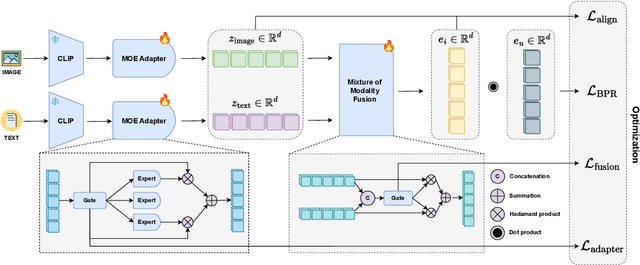
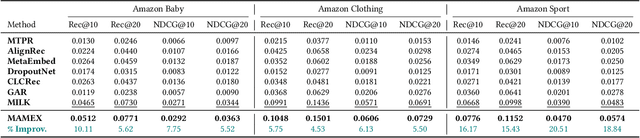
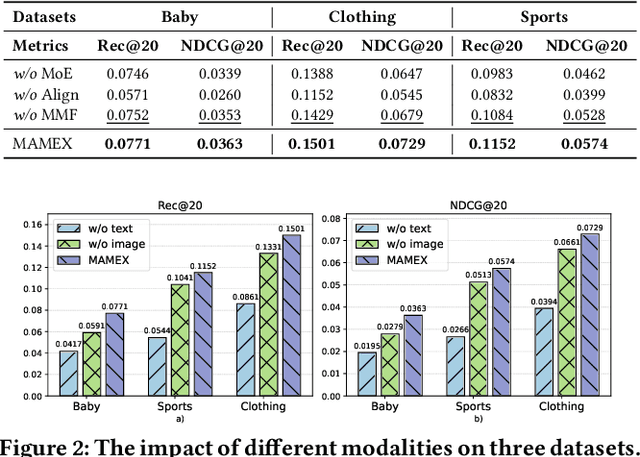
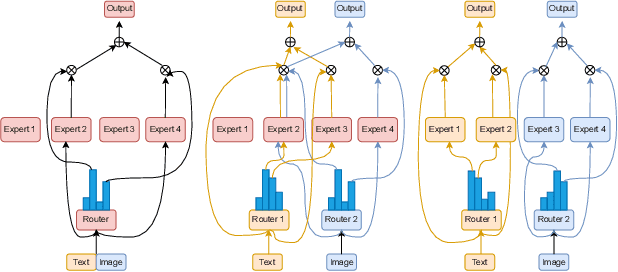
Recommendation systems have faced significant challenges in cold-start scenarios, where new items with a limited history of interaction need to be effectively recommended to users. Though multimodal data (e.g., images, text, audio, etc.) offer rich information to address this issue, existing approaches often employ simplistic integration methods such as concatenation, average pooling, or fixed weighting schemes, which fail to capture the complex relationships between modalities. Our study proposes a novel Mixture of Experts (MoE) framework for multimodal cold-start recommendation, named MAMEX, which dynamically leverages latent representation from different modalities. MAMEX utilizes modality-specific expert networks and introduces a learnable gating mechanism that adaptively weights the contribution of each modality based on its content characteristics. This approach enables MAMEX to emphasize the most informative modalities for each item while maintaining robustness when certain modalities are less relevant or missing. Extensive experiments on benchmark datasets show that MAMEX outperforms state-of-the-art methods in cold-start scenarios, with superior accuracy and adaptability. For reproducibility, the code has been made available on Github https://github.com/L2R-UET/MAMEX.
Personalized Diffusion Model Reshapes Cold-Start Bundle Recommendation
May 20, 2025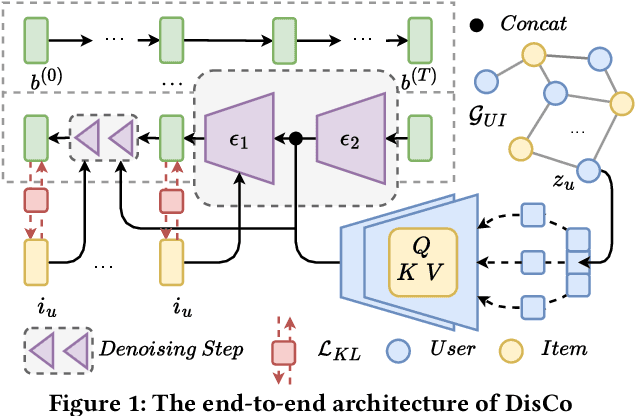
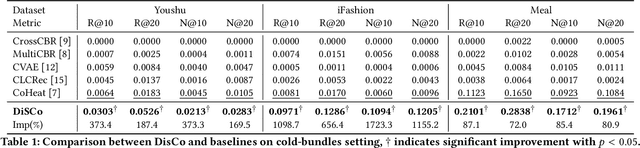
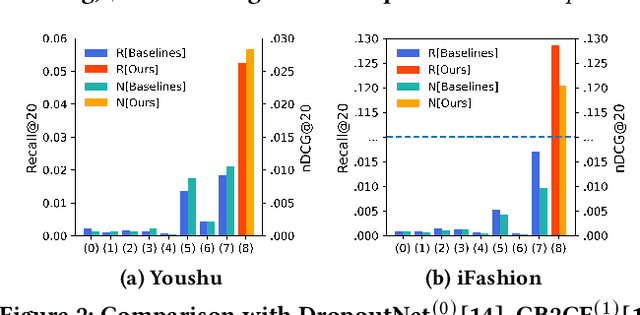
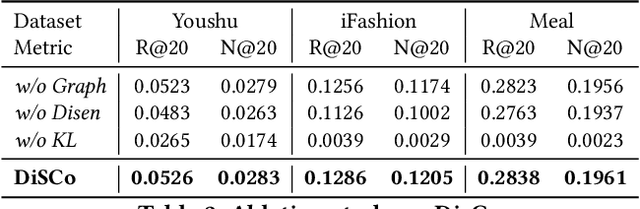
Bundle recommendation aims to recommend a set of items to each user. However, the sparser interactions between users and bundles raise a big challenge, especially in cold-start scenarios. Traditional collaborative filtering methods do not work well for this kind of problem because these models rely on interactions to update the latent embedding, which is hard to work in a cold-start setting. We propose a new approach (DisCo), which relies on a personalized Diffusion backbone, enhanced by disentangled aspects for the user's interest, to generate a bundle in distribution space for each user to tackle the cold-start challenge. During the training phase, DisCo adjusts an additional objective loss term to avoid bias, a prevalent issue while using the generative model for top-$K$ recommendation purposes. Our empirical experiments show that DisCo outperforms five comparative baselines by a large margin on three real-world datasets. Thereby, this study devises a promising framework and essential viewpoints in cold-start recommendation. Our materials for reproducibility are available at: https://github.com/bt-nghia/DisCo.
BRIDGE: Bundle Recommendation via Instruction-Driven Generation
Dec 24, 2024Bundle recommendation aims to suggest a set of interconnected items to users. However, diverse interaction types and sparse interaction matrices often pose challenges for previous approaches in accurately predicting user-bundle adoptions. Inspired by the distant supervision strategy and generative paradigm, we propose BRIDGE, a novel framework for bundle recommendation. It consists of two main components namely the correlation-based item clustering and the pseudo bundle generation modules. Inspired by the distant supervision approach, the former is to generate more auxiliary information, e.g., instructive item clusters, for training without using external data. This information is subsequently aggregated with collaborative signals from user historical interactions to create pseudo `ideal' bundles. This capability allows BRIDGE to explore all aspects of bundles, rather than being limited to existing real-world bundles. It effectively bridging the gap between user imagination and predefined bundles, hence improving the bundle recommendation performance. Experimental results validate the superiority of our models over state-of-the-art ranking-based methods across five benchmark datasets.