 Add to Chrome
 Add to Firefox
 Add to Edge
Seq2Seq2Seq: Lossless Data Compression via Discrete Latent Transformers and Reinforcement Learning
Feb 12, 2026
Efficient lossless compression is essential for minimizing storage costs and transmission overhead while preserving data integrity. Traditional compression techniques, such as dictionary-based and statistical methods, often struggle to optimally exploit the structure and redundancy in complex data formats. Recent advancements in deep learning have opened new avenues for compression; however, many existing approaches depend on dense vector representations that obscure the underlying token structure. To address these limitations, we propose a novel lossless compression method that leverages Reinforcement Learning applied to a T5 language model architecture. This approach enables the compression of data into sequences of tokens rather than traditional vector representations. Unlike auto-encoders, which typically encode information into continuous latent spaces, our method preserves the token-based structure, aligning more closely with the original data format. This preservation allows for higher compression ratios while maintaining semantic integrity. By training the model using an off-policy Reinforcement Learning algorithm, we optimize sequence length to minimize redundancy and enhance compression efficiency. Our method introduces an efficient and adaptive data compression system built upon advanced Reinforcement Learning techniques, functioning independently of external grammatical or world knowledge. This approach shows significant improvements in compression ratios compared to conventional methods. By leveraging the latent information within language models, our system effectively compresses data without requiring explicit content understanding, paving the way for more robust and practical compression solutions across various applications.

From Semantic Roles to Opinion Roles: SRL Data Extraction for Multi-Task and Transfer Learning in Low-Resource ORL
Nov 11, 2025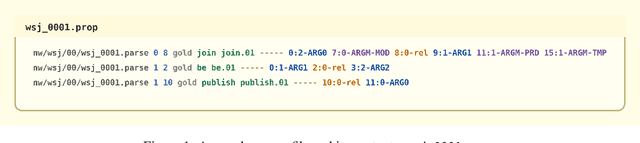
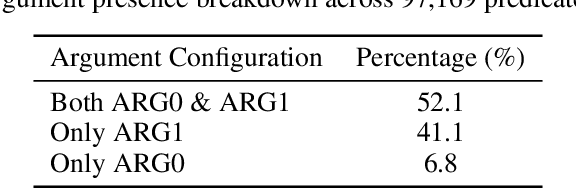
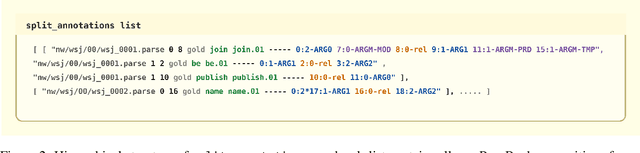
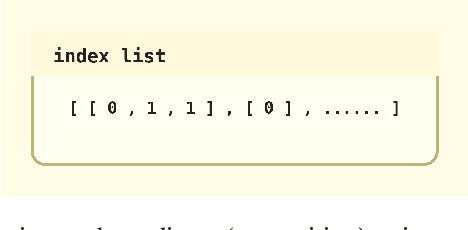
This report presents a detailed methodology for constructing a high-quality Semantic Role Labeling (SRL) dataset from the Wall Street Journal (WSJ) portion of the OntoNotes 5.0 corpus and adapting it for Opinion Role Labeling (ORL) tasks. Leveraging the PropBank annotation framework, we implement a reproducible extraction pipeline that aligns predicate-argument structures with surface text, converts syntactic tree pointers to coherent spans, and applies rigorous cleaning to ensure semantic fidelity. The resulting dataset comprises 97,169 predicate-argument instances with clearly defined Agent (ARG0), Predicate (REL), and Patient (ARG1) roles, mapped to ORL's Holder, Expression, and Target schema. We provide a detailed account of our extraction algorithms, discontinuous argument handling, annotation corrections, and statistical analysis of the resulting dataset. This work offers a reusable resource for researchers aiming to leverage SRL for enhancing ORL, especially in low-resource opinion mining scenarios.
Active Few-Shot Learning for Text Classification
Feb 26, 2025The rise of Large Language Models (LLMs) has boosted the use of Few-Shot Learning (FSL) methods in natural language processing, achieving acceptable performance even when working with limited training data. The goal of FSL is to effectively utilize a small number of annotated samples in the learning process. However, the performance of FSL suffers when unsuitable support samples are chosen. This problem arises due to the heavy reliance on a limited number of support samples, which hampers consistent performance improvement even when more support samples are added. To address this challenge, we propose an active learning-based instance selection mechanism that identifies effective support instances from the unlabeled pool and can work with different LLMs. Our experiments on five tasks show that our method frequently improves the performance of FSL. We make our implementation available on GitHub.
Views Are My Own, But Also Yours: Benchmarking Theory of Mind using Common Ground
Mar 04, 2024
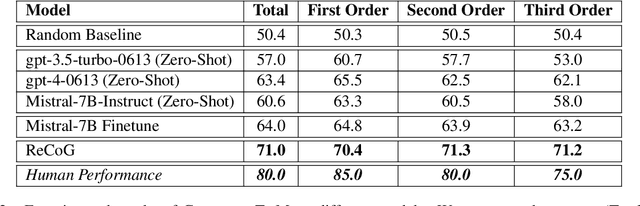
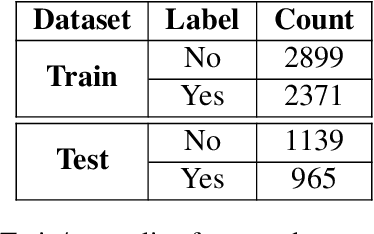
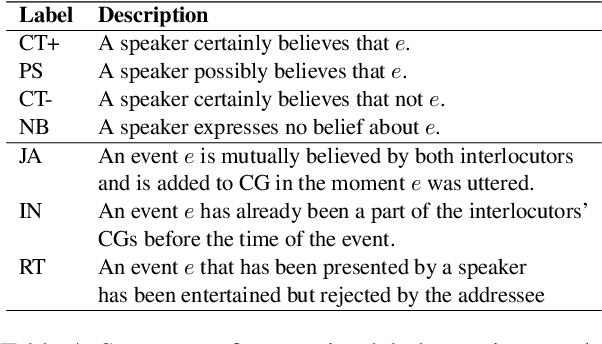
Evaluating the theory of mind (ToM) capabilities of language models (LMs) has recently received much attention. However, many existing benchmarks rely on synthetic data which risks misaligning the resulting experiments with human behavior. We introduce the first ToM dataset based on naturally occurring spoken dialogs, Common-ToM, and show that LMs struggle to demonstrate ToM. We then show that integrating a simple, explicit representation of beliefs improves LM performance on Common-ToM.