 Add to Chrome
 Add to Firefox
 Add to Edge
Link Sign Prediction
Papers and Code
A Scalable Inter-edge Correlation Modeling in CopulaGNN for Link Sign Prediction
Jan 27, 2026
Link sign prediction on a signed graph is a task to determine whether the relationship represented by an edge is positive or negative. Since the presence of negative edges violates the graph homophily assumption that adjacent nodes are similar, regular graph methods have not been applicable without auxiliary structures to handle them. We aim to directly model the latent statistical dependency among edges with the Gaussian copula and its corresponding correlation matrix, extending CopulaGNN. However, a naive modeling of edge-edge relations is computationally intractable even for a graph with moderate scale. To address this, we propose to 1) represent the correlation matrix as a Gramian of edge embeddings, significantly reducing the number of parameters, and 2) reformulate the conditional probability distribution to dramatically reduce the inference cost. We theoretically verify scalability of our method by proving its linear convergence. Also, our extensive experiments demonstrate that it achieves significantly faster convergence than baselines, maintaining competitive prediction performance to the state-of-the-art models.

Causal inference and model explainability tools for retail
Dec 14, 2025Most major retailers today have multiple divisions focused on various aspects, such as marketing, supply chain, online customer experience, store customer experience, employee productivity, and vendor fulfillment. They also regularly collect data corresponding to all these aspects as dashboards and weekly/monthly/quarterly reports. Although several machine learning and statistical techniques have been in place to analyze and predict key metrics, such models typically lack interpretability. Moreover, such techniques also do not allow the validation or discovery of causal links. In this paper, we aim to provide a recipe for applying model interpretability and causal inference for deriving sales insights. In this paper, we review the existing literature on causal inference and interpretability in the context of problems in e-commerce and retail, and apply them to a real-world dataset. We find that an inherently explainable model has a lower variance of SHAP values, and show that including multiple confounders through a double machine learning approach allows us to get the correct sign of causal effect.
GegenNet: Spectral Convolutional Neural Networks for Link Sign Prediction in Signed Bipartite Graphs
Aug 27, 2025Given a signed bipartite graph (SBG) G with two disjoint node sets U and V, the goal of link sign prediction is to predict the signs of potential links connecting U and V based on known positive and negative edges in G. The majority of existing solutions towards link sign prediction mainly focus on unipartite signed graphs, which are sub-optimal due to the neglect of node heterogeneity and unique bipartite characteristics of SBGs. To this end, recent studies adapt graph neural networks to SBGs by introducing message-passing schemes for both inter-partition (UxV) and intra-partition (UxU or VxV) node pairs. However, the fundamental spectral convolutional operators were originally designed for positive links in unsigned graphs, and thus, are not optimal for inferring missing positive or negative links from known ones in SBGs. Motivated by this, this paper proposes GegenNet, a novel and effective spectral convolutional neural network model for link sign prediction in SBGs. In particular, GegenNet achieves enhanced model capacity and high predictive accuracy through three main technical contributions: (i) fast and theoretically grounded spectral decomposition techniques for node feature initialization; (ii) a new spectral graph filter based on the Gegenbauer polynomial basis; and (iii) multi-layer sign-aware spectral convolutional networks alternating Gegenbauer polynomial filters with positive and negative edges. Our extensive empirical studies reveal that GegenNet can achieve significantly superior performance (up to a gain of 4.28% in AUC and 11.69% in F1) in link sign prediction compared to 11 strong competitors over 6 benchmark SBG datasets.
Scaling Laws for Gradient Descent and Sign Descent for Linear Bigram Models under Zipf's Law
May 25, 2025Recent works have highlighted optimization difficulties faced by gradient descent in training the first and last layers of transformer-based language models, which are overcome by optimizers such as Adam. These works suggest that the difficulty is linked to the heavy-tailed distribution of words in text data, where the frequency of the $k$th most frequent word $\pi_k$ is proportional to $1/k$, following Zipf's law. To better understand the impact of the data distribution on training performance, we study a linear bigram model for next-token prediction when the tokens follow a power law $\pi_k \propto 1/k^\alpha$ parameterized by the exponent $\alpha > 0$. We derive optimization scaling laws for deterministic gradient descent and sign descent as a proxy for Adam as a function of the exponent $\alpha$. Existing theoretical investigations in scaling laws assume that the eigenvalues of the data decay as a power law with exponent $\alpha > 1$. This assumption effectively makes the problem ``finite dimensional'' as most of the loss comes from a few of the largest eigencomponents. In comparison, we show that the problem is more difficult when the data have heavier tails. The case $\alpha = 1$ as found in text data is ``worst-case'' for gradient descent, in that the number of iterations required to reach a small relative error scales almost linearly with dimension. While the performance of sign descent also depends on the dimension, for Zipf-distributed data the number of iterations scales only with the square-root of the dimension, leading to a large improvement for large vocabularies.
Effective and Lightweight Representation Learning for Link Sign Prediction in Signed Bipartite Graphs
Dec 25, 2024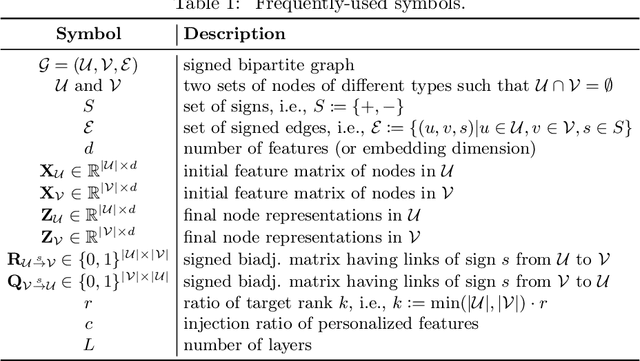
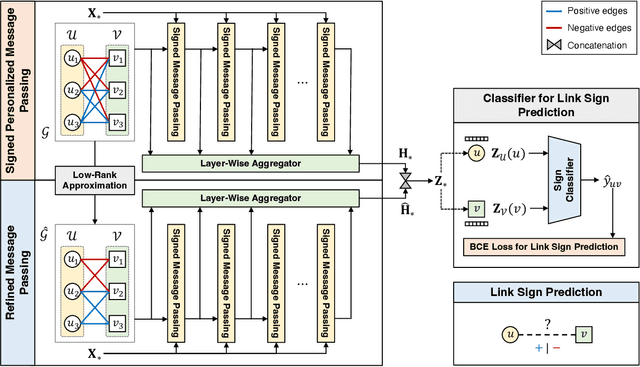
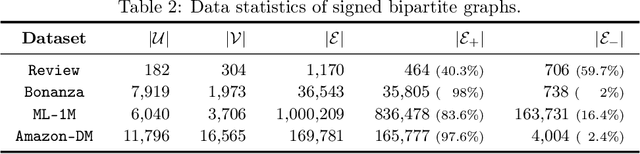
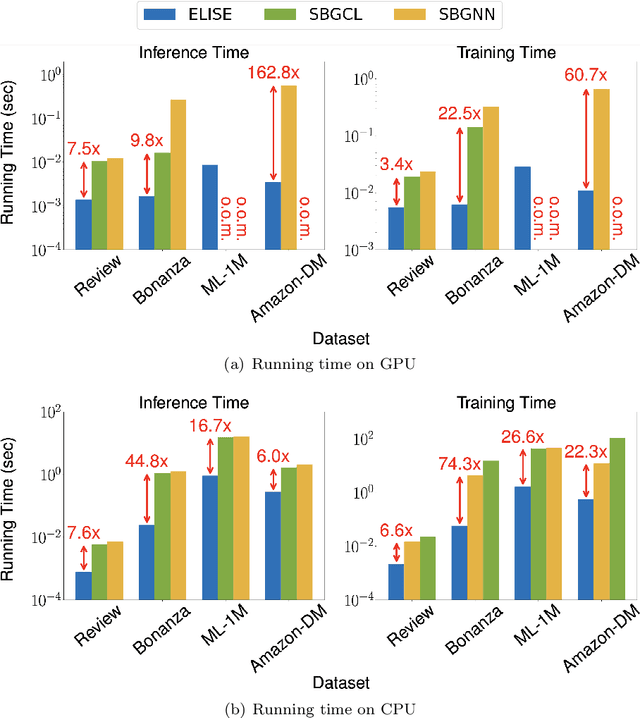
How can we effectively and efficiently learn node representations in signed bipartite graphs? A signed bipartite graph is a graph consisting of two nodes sets where nodes of different types are positively or negative connected, and it has been extensively used to model various real-world relationships such as e-commerce, etc. To analyze such a graph, previous studies have focused on designing methods for learning node representations using graph neural networks. In particular, these methods insert edges between nodes of the same type based on balance theory, enabling them to leverage augmented structures in their learning. However, the existing methods rely on a naive message passing design, which is prone to over-smoothing and susceptible to noisy interactions in real-world graphs. Furthermore, they suffer from computational inefficiency due to their heavy design and the significant increase in the number of added edges. In this paper, we propose ELISE, an effective and lightweight GNN-based approach for learning signed bipartite graphs. We first extend personalized propagation to a signed bipartite graph, incorporating signed edges during message passing. This extension adheres to balance theory without introducing additional edges, mitigating the over-smoothing issue and enhancing representation power. We then jointly learn node embeddings on a low-rank approximation of the signed bipartite graph, which reduces potential noise and emphasizes its global structure, further improving expressiveness without significant loss of efficiency. We encapsulate these ideas into ELISE, designing it to be lightweight, unlike the previous methods that add too many edges and cause inefficiency. Through extensive experiments on real-world signed bipartite graphs, we demonstrate that ELISE outperforms its competitors for predicting link signs while providing faster training and inference time.
The Signed Two-Space Proximity Model for Learning Representations in Protein-Protein Interaction Networks
Mar 05, 2025Accurately predicting complex protein-protein interactions (PPIs) is crucial for decoding biological processes, from cellular functioning to disease mechanisms. However, experimental methods for determining PPIs are computationally expensive. Thus, attention has been recently drawn to machine learning approaches. Furthermore, insufficient effort has been made toward analyzing signed PPI networks, which capture both activating (positive) and inhibitory (negative) interactions. To accurately represent biological relationships, we present the Signed Two-Space Proximity Model (S2-SPM) for signed PPI networks, which explicitly incorporates both types of interactions, reflecting the complex regulatory mechanisms within biological systems. This is achieved by leveraging two independent latent spaces to differentiate between positive and negative interactions while representing protein similarity through proximity in these spaces. Our approach also enables the identification of archetypes representing extreme protein profiles. S2-SPM's superior performance in predicting the presence and sign of interactions in SPPI networks is demonstrated in link prediction tasks against relevant baseline methods. Additionally, the biological prevalence of the identified archetypes is confirmed by an enrichment analysis of Gene Ontology (GO) terms, which reveals that distinct biological tasks are associated with archetypal groups formed by both interactions. This study is also validated regarding statistical significance and sensitivity analysis, providing insights into the functional roles of different interaction types. Finally, the robustness and consistency of the extracted archetype structures are confirmed using the Bayesian Normalized Mutual Information (BNMI) metric, proving the model's reliability in capturing meaningful SPPI patterns.
Graph Spring Neural ODEs for Link Sign Prediction
Dec 18, 2024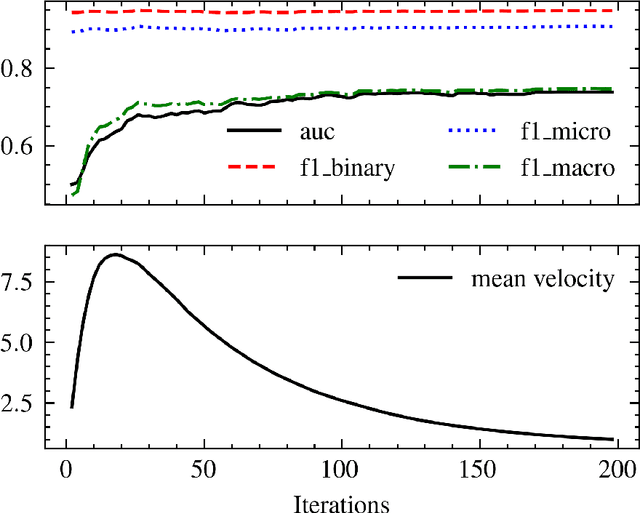
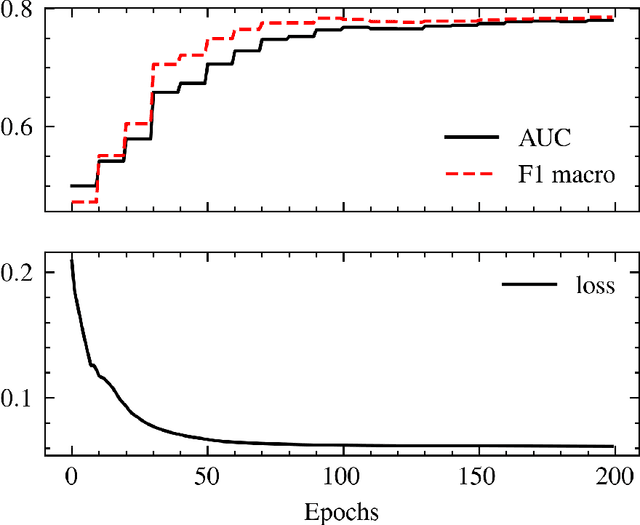
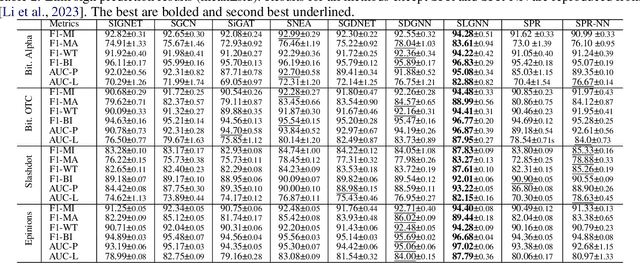
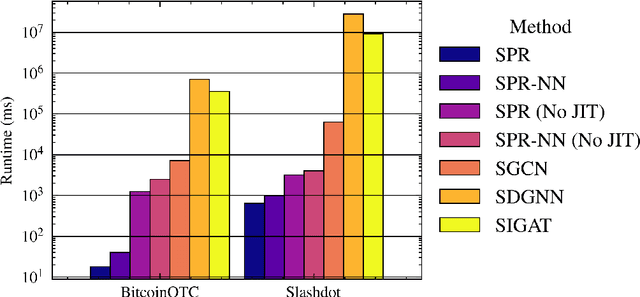
Signed graphs allow for encoding positive and negative relations between nodes and are used to model various online activities. Node representation learning for signed graphs is a well-studied task with important applications such as sign prediction. While the size of datasets is ever-increasing, recent methods often sacrifice scalability for accuracy. We propose a novel message-passing layer architecture called Graph Spring Network (GSN) modeled after spring forces. We combine it with a Graph Neural Ordinary Differential Equations (ODEs) formalism to optimize the system dynamics in embedding space to solve a downstream prediction task. Once the dynamics is learned, embedding generation for novel datasets is done by solving the ODEs in time using a numerical integration scheme. Our GSN layer leverages the fast-to-compute edge vector directions and learnable scalar functions that only depend on nodes' distances in latent space to compute the nodes' positions. Conversely, Graph Convolution and Graph Attention Network layers rely on learnable vector functions that require the full positions of input nodes in latent space. We propose a specific implementation called Spring-Neural-Network (SPR-NN) using a set of small neural networks mimicking attracting and repulsing spring forces that we train for link sign prediction. Experiments show that our method achieves accuracy close to the state-of-the-art methods with node generation time speedup factors of up to 28,000 on large graphs.
KAN KAN Buff Signed Graph Neural Networks?
Jan 01, 2025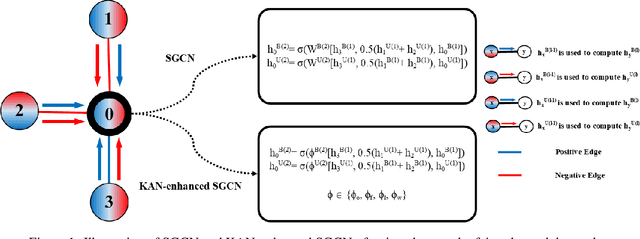
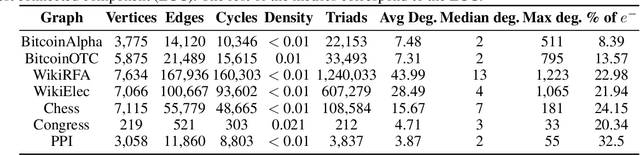
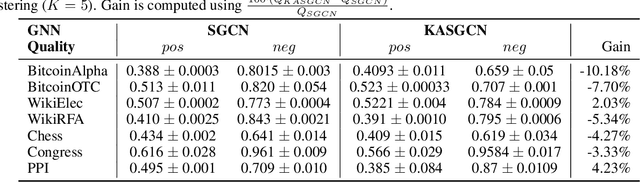
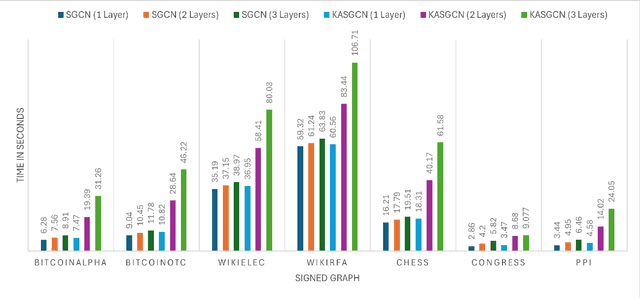
Graph Representation Learning aims to create embeddings for nodes and edges, capturing their features and interconnections. Graph Neural Networks (GNNs) have excelled in this task, leveraging neural networks to model complex graph relationships. Recently, the Kolmogorov-Arnold Neural Network (KAN) emerged as an alternative to Multi-Layer Perceptron (MLP), showing improved accuracy and interpretability with fewer parameters. While KANs have been integrated into unsigned GNNs, their application in signed GNNs remains unexplored. This paper integrates KAN into Signed Graph Convolutional Networks (SGCNs) to evaluate its performance on signed graphs where edges have positive or negative signs. We empirically assess KAN-enhanced SGCNs (KASGCN) on downstream tasks such as signed community detection and link sign prediction to enhance the embedding quality in signed networks. Considering the variability in the results indicated by the relatively large standard deviation, KASGCN demonstrates competitive performance with, or similar to, the vanilla SGCN in the evaluated downstream tasks, and its effectiveness is context-dependent (signed graph and parameters...etc.).
DropEdge not Foolproof: Effective Augmentation Method for Signed Graph Neural Networks
Sep 29, 2024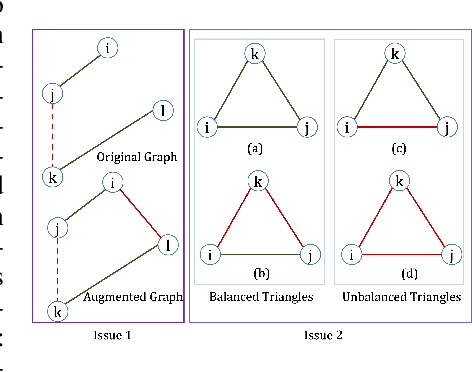


The paper discusses signed graphs, which model friendly or antagonistic relationships using edges marked with positive or negative signs, focusing on the task of link sign prediction. While Signed Graph Neural Networks (SGNNs) have advanced, they face challenges like graph sparsity and unbalanced triangles. The authors propose using data augmentation (DA) techniques to address these issues, although many existing methods are not suitable for signed graphs due to a lack of side information. They highlight that the random DropEdge method, a rare DA approach applicable to signed graphs, does not enhance link sign prediction performance. In response, they introduce the Signed Graph Augmentation (SGA) framework, which includes a structure augmentation module to identify candidate edges and a strategy for selecting beneficial candidates, ultimately improving SGNN training. Experimental results show that SGA significantly boosts the performance of SGNN models, with a notable 32.3% improvement in F1-micro for SGCN on the Slashdot dataset.
CSGDN: Contrastive Signed Graph Diffusion Network for Predicting Crop Gene-Trait Associations
Oct 10, 2024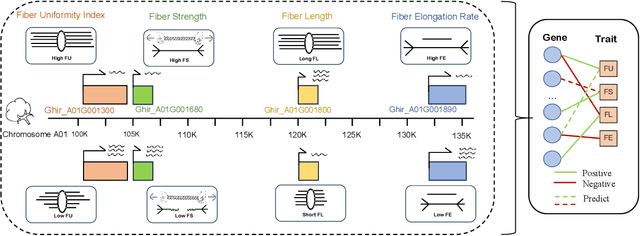

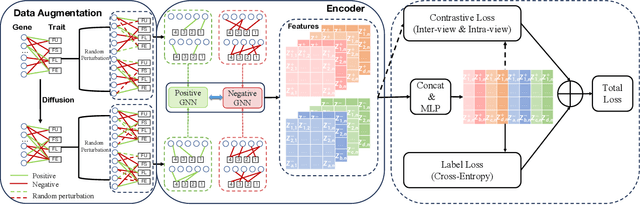

Positive and negative association preidiction between gene and trait help studies for crops to perform complex physiological functions. The transcription and regulation activity of specific genes will be adjusted accordingly in different cell types, developmental stages, and physiological states to meet the needs of organisms. Determing gene-trait associations can resolve the mechanism of trait formation and benefit the improvement of crop yield and quality. There are the following two problems in obtaining the positive/negative associations between gene and trait: 1) High-throughput DNA/RNA sequencing and trait data collection are expensive and time-consuming due to the need to process large sample sizes; 2) experiments introduce both random and systematic errors, and, at the same time, calculations or predictions using software or models may produce noise. To address these two issues, we propose a Contrastive Signed Graph Diffusion Network, CSGDN, to learn robust node representations with fewer training samples to achieve higher link prediction accuracy. CSGDN employs a signed graph diffusion method to uncover the underlying regulatory associations between genes and traits. Then, stochastic perterbation strategies are used to create two views for both original and diffusive graphs. At last, a multi-view contrastive learning paradigm loss is designed to unify the node presentations learned from the two views to resist interference and reduce noise. We conduct experiments to validate the performance of CSGDN on three crop datasets: Gossypium hirsutum, Brassica napus, and Triticum turgidum. The results demonstrate that the proposed model outperforms state-of-the-art methods by up to 9.28% AUC for link sign prediction in G. hirsutum dataset.