 Add to Chrome
 Add to Firefox
 Add to Edge
AlphaFree: Recommendation Free from Users, IDs, and GNNs
Mar 03, 2026
Can we design effective recommender systems free from users, IDs, and GNNs? Recommender systems are central to personalized content delivery across domains, with top-K item recommendation being a fundamental task to retrieve the most relevant items from historical interactions. Existing methods rely on entrenched design conventions, often adopted without reconsideration, such as storing per-user embeddings (user-dependent), initializing features from raw IDs (ID-dependent), and employing graph neural networks (GNN-dependent). These dependencies incur several limitations, including high memory costs, cold-start and over-smoothing issues, and poor generalization to unseen interactions. In this work, we propose AlphaFree, a novel recommendation method free from users, IDs, and GNNs. Our main ideas are to infer preferences on-the-fly without user embeddings (user-free), replace raw IDs with language representations (LRs) from pre-trained language models (ID-free), and capture collaborative signals through augmentation with similar items and contrastive learning, without GNNs (GNN-free). Extensive experiments on various real-world datasets show that AlphaFree consistently outperforms its competitors, achieving up to around 40% improvements over non-LR-based methods and up to 5.7% improvements over LR-based methods, while significantly reducing GPU memory usage by up to 69% under high-dimensional LRs.

Effective and Lightweight Representation Learning for Link Sign Prediction in Signed Bipartite Graphs
Dec 25, 2024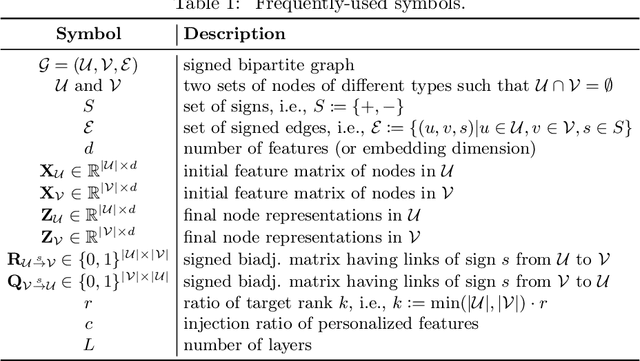
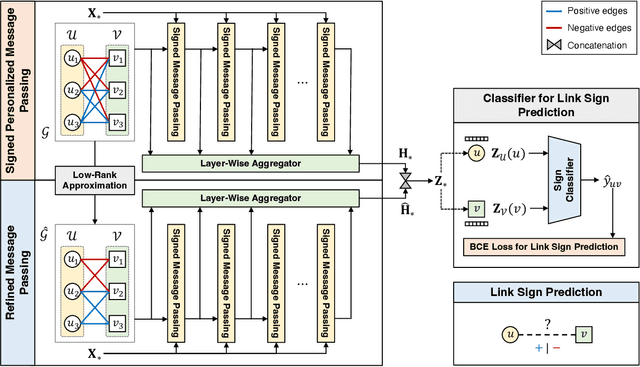
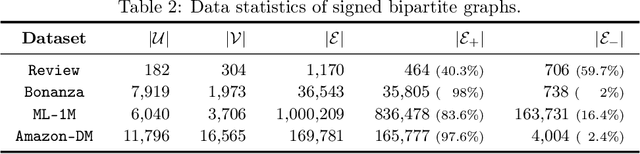
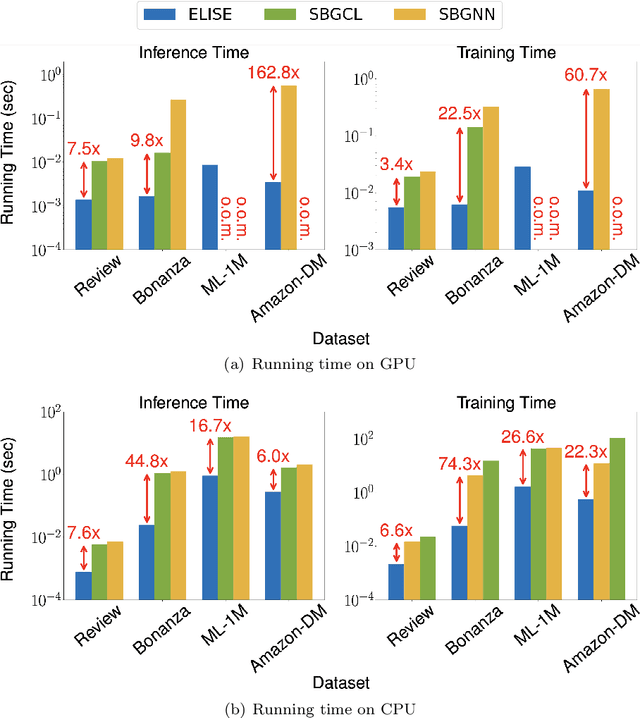
How can we effectively and efficiently learn node representations in signed bipartite graphs? A signed bipartite graph is a graph consisting of two nodes sets where nodes of different types are positively or negative connected, and it has been extensively used to model various real-world relationships such as e-commerce, etc. To analyze such a graph, previous studies have focused on designing methods for learning node representations using graph neural networks. In particular, these methods insert edges between nodes of the same type based on balance theory, enabling them to leverage augmented structures in their learning. However, the existing methods rely on a naive message passing design, which is prone to over-smoothing and susceptible to noisy interactions in real-world graphs. Furthermore, they suffer from computational inefficiency due to their heavy design and the significant increase in the number of added edges. In this paper, we propose ELISE, an effective and lightweight GNN-based approach for learning signed bipartite graphs. We first extend personalized propagation to a signed bipartite graph, incorporating signed edges during message passing. This extension adheres to balance theory without introducing additional edges, mitigating the over-smoothing issue and enhancing representation power. We then jointly learn node embeddings on a low-rank approximation of the signed bipartite graph, which reduces potential noise and emphasizes its global structure, further improving expressiveness without significant loss of efficiency. We encapsulate these ideas into ELISE, designing it to be lightweight, unlike the previous methods that add too many edges and cause inefficiency. Through extensive experiments on real-world signed bipartite graphs, we demonstrate that ELISE outperforms its competitors for predicting link signs while providing faster training and inference time.