 Add to Chrome
 Add to Firefox
 Add to Edge
Mosaic: A Benchmark Suite for Differentiable Physics Solvers
Jun 26, 2026
Differentiable partial differential equation (PDE) solvers underpin solver-in-the-loop ML training, gradient-based optimal control, and inverse problems, yet the practical cost of obtaining correct, usable gradients from a given solver on a given problem is largely undocumented. Integration effort, computational cost, gradient accuracy, and numerical conditioning vary widely across solvers and are discoverable only by trial and error. We introduce Mosaic, an extensible benchmarking framework for differentiable PDE solvers that standardizes access to solver gradients. Each solver is packaged as a containerized component (Tesseract) exposing a uniform gradient API regardless of language or automatic differentiation (AD) strategy, enabling researchers to evaluate, compare, and build on non-trivial physical solvers. Our evaluation of 14 solvers across fluid dynamics, structural mechanics, and heat transfer demonstrates that the benchmark surfaces practically relevant differences: order-of-magnitude variation in computational cost and Jacobian conditioning, alongside structural incompatibilities that eliminate solvers from realistic tasks entirely. Despite this variation, all solvers that produce gradients converge to similar optima, indicating that the practical barriers are memory limits, numerical stability, and setup compatibility rather than gradient accuracy alone. Mosaic is open-source and available at https://github.com/pasteurlabs/mosaic.

Surrogate-Based Differentiable Pipeline for Shape Optimization
Nov 13, 2025Gradient-based optimization of engineering designs is limited by non-differentiable components in the typical computer-aided engineering (CAE) workflow, which calculates performance metrics from design parameters. While gradient-based methods could provide noticeable speed-ups in high-dimensional design spaces, codes for meshing, physical simulations, and other common components are not differentiable even if the math or physics underneath them is. We propose replacing non-differentiable pipeline components with surrogate models which are inherently differentiable. Using a toy example of aerodynamic shape optimization, we demonstrate an end-to-end differentiable pipeline where a 3D U-Net full-field surrogate replaces both meshing and simulation steps by training it on the mapping between the signed distance field (SDF) of the shape and the fields of interest. This approach enables gradient-based shape optimization without the need for differentiable solvers, which can be useful in situations where adjoint methods are unavailable and/or hard to implement.
Graph Spring Neural ODEs for Link Sign Prediction
Dec 18, 2024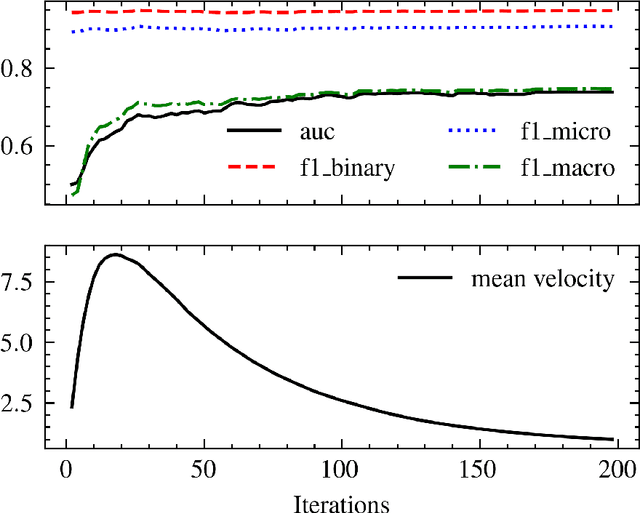
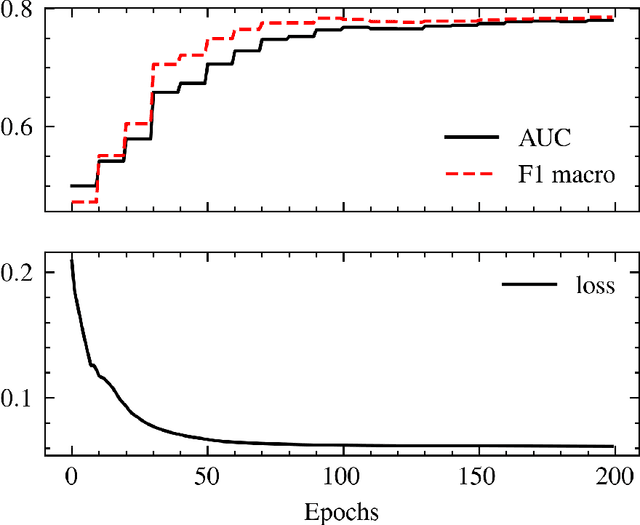
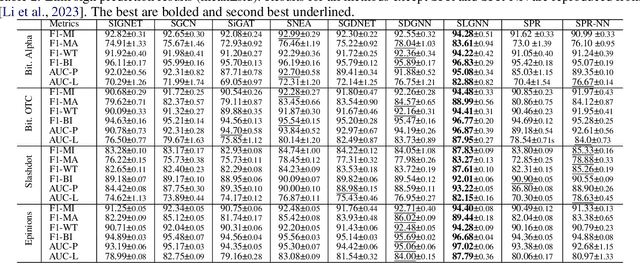
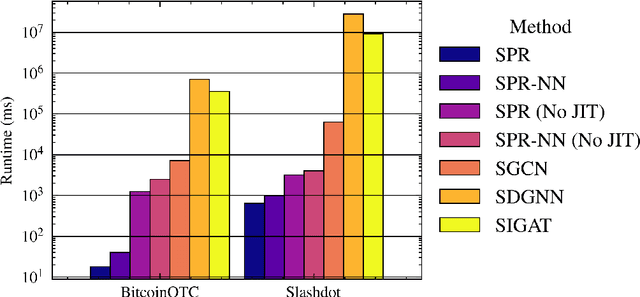
Signed graphs allow for encoding positive and negative relations between nodes and are used to model various online activities. Node representation learning for signed graphs is a well-studied task with important applications such as sign prediction. While the size of datasets is ever-increasing, recent methods often sacrifice scalability for accuracy. We propose a novel message-passing layer architecture called Graph Spring Network (GSN) modeled after spring forces. We combine it with a Graph Neural Ordinary Differential Equations (ODEs) formalism to optimize the system dynamics in embedding space to solve a downstream prediction task. Once the dynamics is learned, embedding generation for novel datasets is done by solving the ODEs in time using a numerical integration scheme. Our GSN layer leverages the fast-to-compute edge vector directions and learnable scalar functions that only depend on nodes' distances in latent space to compute the nodes' positions. Conversely, Graph Convolution and Graph Attention Network layers rely on learnable vector functions that require the full positions of input nodes in latent space. We propose a specific implementation called Spring-Neural-Network (SPR-NN) using a set of small neural networks mimicking attracting and repulsing spring forces that we train for link sign prediction. Experiments show that our method achieves accuracy close to the state-of-the-art methods with node generation time speedup factors of up to 28,000 on large graphs.