 Add to Chrome
 Add to Firefox
 Add to Edge
Handwritten Word Generation
Papers and Code
BeHGAN: Bengali Handwritten Word Generation from Plain Text Using Generative Adversarial Networks
Dec 25, 2025
Handwritten Text Recognition (HTR) is a well-established research area. In contrast, Handwritten Text Generation (HTG) is an emerging field with significant potential. This task is challenging due to the variation in individual handwriting styles. A large and diverse dataset is required to generate realistic handwritten text. However, such datasets are difficult to collect and are not readily available. Bengali is the fifth most spoken language in the world. While several studies exist for languages such as English and Arabic, Bengali handwritten text generation has received little attention. To address this gap, we propose a method for generating Bengali handwritten words. We developed and used a self-collected dataset of Bengali handwriting samples. The dataset includes contributions from approximately five hundred individuals across different ages and genders. All images were pre-processed to ensure consistency and quality. Our approach demonstrates the ability to produce diverse handwritten outputs from input plain text. We believe this work contributes to the advancement of Bengali handwriting generation and can support further research in this area.

synthocr-gen: A synthetic ocr dataset generator for low-resource languages- breaking the data barrier
Jan 22, 2026Optical Character Recognition (OCR) for low-resource languages remains a significant challenge due to the scarcity of large-scale annotated training datasets. Languages such as Kashmiri, with approximately 7 million speakers and a complex Perso-Arabic script featuring unique diacritical marks, currently lack support in major OCR systems including Tesseract, TrOCR, and PaddleOCR. Manual dataset creation for such languages is prohibitively expensive, time-consuming, and error-prone, often requiring word by word transcription of printed or handwritten text. We present SynthOCR-Gen, an open-source synthetic OCR dataset generator specifically designed for low-resource languages. Our tool addresses the fundamental bottleneck in OCR development by transforming digital Unicode text corpora into ready-to-use training datasets. The system implements a comprehensive pipeline encompassing text segmentation (character, word, n-gram, sentence, and line levels), Unicode normalization with script purity enforcement, multi-font rendering with configurable distribution, and 25+ data augmentation techniques simulating real-world document degradations including rotation, blur, noise, and scanner artifacts. We demonstrate the efficacy of our approach by generating a 600,000-sample word-segmented Kashmiri OCR dataset, which we release publicly on HuggingFace. This work provides a practical pathway for bringing low-resource languages into the era of vision-language AI models, and the tool is openly available for researchers and practitioners working with underserved writing systems worldwide.
Dual Orthogonal Guidance for Robust Diffusion-based Handwritten Text Generation
Aug 23, 2025Diffusion-based Handwritten Text Generation (HTG) approaches achieve impressive results on frequent, in-vocabulary words observed at training time and on regular styles. However, they are prone to memorizing training samples and often struggle with style variability and generation clarity. In particular, standard diffusion models tend to produce artifacts or distortions that negatively affect the readability of the generated text, especially when the style is hard to produce. To tackle these issues, we propose a novel sampling guidance strategy, Dual Orthogonal Guidance (DOG), that leverages an orthogonal projection of a negatively perturbed prompt onto the original positive prompt. This approach helps steer the generation away from artifacts while maintaining the intended content, and encourages more diverse, yet plausible, outputs. Unlike standard Classifier-Free Guidance (CFG), which relies on unconditional predictions and produces noise at high guidance scales, DOG introduces a more stable, disentangled direction in the latent space. To control the strength of the guidance across the denoising process, we apply a triangular schedule: weak at the start and end of denoising, when the process is most sensitive, and strongest in the middle steps. Experimental results on the state-of-the-art DiffusionPen and One-DM demonstrate that DOG improves both content clarity and style variability, even for out-of-vocabulary words and challenging writing styles.
Exploring LLM-Generated Feedback for Economics Essays: How Teaching Assistants Evaluate and Envision Its Use
May 21, 2025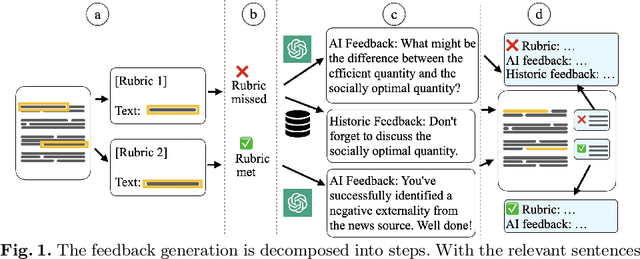
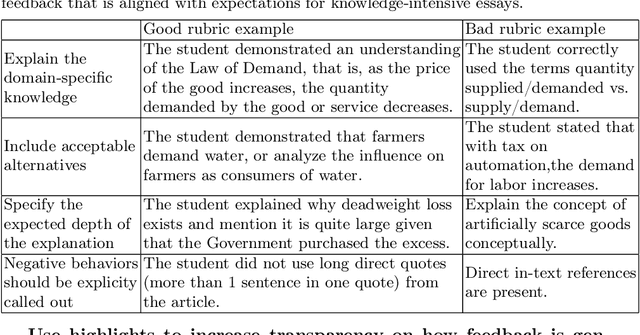
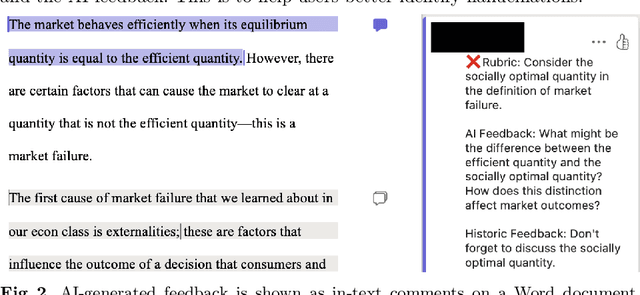
This project examines the prospect of using AI-generated feedback as suggestions to expedite and enhance human instructors' feedback provision. In particular, we focus on understanding the teaching assistants' perspectives on the quality of AI-generated feedback and how they may or may not utilize AI feedback in their own workflows. We situate our work in a foundational college Economics class, which has frequent short essay assignments. We developed an LLM-powered feedback engine that generates feedback on students' essays based on grading rubrics used by the teaching assistants (TAs). To ensure that TAs can meaningfully critique and engage with the AI feedback, we had them complete their regular grading jobs. For a randomly selected set of essays that they had graded, we used our feedback engine to generate feedback and displayed the feedback as in-text comments in a Word document. We then performed think-aloud studies with 5 TAs over 20 1-hour sessions to have them evaluate the AI feedback, contrast the AI feedback with their handwritten feedback, and share how they envision using the AI feedback if they were offered as suggestions. The study highlights the importance of providing detailed rubrics for AI to generate high-quality feedback for knowledge-intensive essays. TAs considered that using AI feedback as suggestions during their grading could expedite grading, enhance consistency, and improve overall feedback quality. We discuss the importance of decomposing the feedback generation task into steps and presenting intermediate results, in order for TAs to use the AI feedback.
The Cursive Transformer
Mar 31, 2025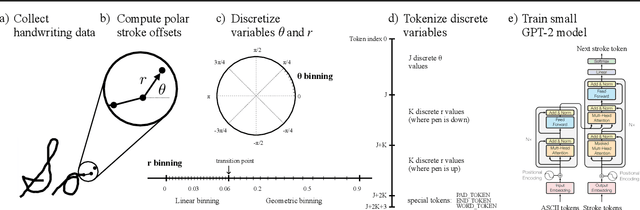
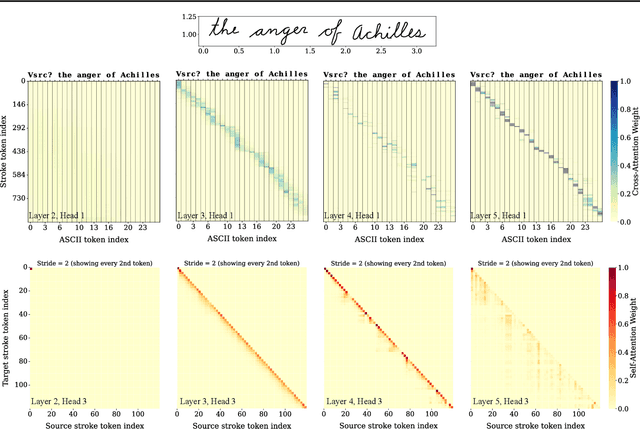


Transformers trained on tokenized text, audio, and images can generate high-quality autoregressive samples. But handwriting data, represented as sequences of pen coordinates, remains underexplored. We introduce a novel tokenization scheme that converts pen stroke offsets to polar coordinates, discretizes them into bins, and then turns them into sequences of tokens with which to train a standard GPT model. This allows us to capture complex stroke distributions without using any specialized architectures (eg. the mixture density network or the self-advancing ASCII attention head from Graves 2014). With just 3,500 handwritten words and a few simple data augmentations, we are able to train a model that can generate realistic cursive handwriting. Our approach is simpler and more performant than previous RNN-based methods.
Zero-Shot Paragraph-level Handwriting Imitation with Latent Diffusion Models
Sep 01, 2024
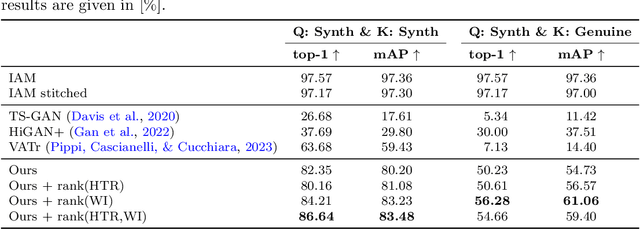

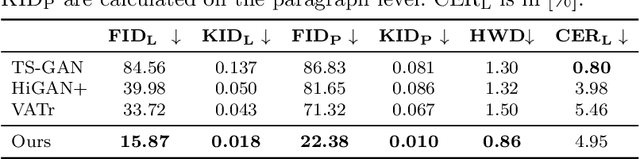
The imitation of cursive handwriting is mainly limited to generating handwritten words or lines. Multiple synthetic outputs must be stitched together to create paragraphs or whole pages, whereby consistency and layout information are lost. To close this gap, we propose a method for imitating handwriting at the paragraph level that also works for unseen writing styles. Therefore, we introduce a modified latent diffusion model that enriches the encoder-decoder mechanism with specialized loss functions that explicitly preserve the style and content. We enhance the attention mechanism of the diffusion model with adaptive 2D positional encoding and the conditioning mechanism to work with two modalities simultaneously: a style image and the target text. This significantly improves the realism of the generated handwriting. Our approach sets a new benchmark in our comprehensive evaluation. It outperforms all existing imitation methods at both line and paragraph levels, considering combined style and content preservation.
Semi-Supervised Adaptation of Diffusion Models for Handwritten Text Generation
Dec 20, 2024The generation of images of realistic looking, readable handwritten text is a challenging task which is referred to as handwritten text generation (HTG). Given a string and examples from a writer, the goal is to synthesize an image depicting the correctly spelled word in handwriting with the calligraphic style of the desired writer. An important application of HTG is the generation of training images in order to adapt downstream models for new data sets. With their success in natural image generation, diffusion models (DMs) have become the state-of-the-art approach in HTG. In this work, we present an extension of a latent DM for HTG to enable generation of writing styles not seen during training by learning style conditioning with a masked auto encoder. Our proposed content encoder allows for different ways of conditioning the DM on textual and calligraphic features. Additionally, we employ classifier-free guidance and explore the influence on the quality of the generated training images. For adapting the model to a new unlabeled data set, we propose a semi-supervised training scheme. We evaluate our approach on the IAM-database and use the RIMES-database to examine the generation of data not seen during training achieving improvements in this particularly promising application of DMs for HTG.
DiffusionPen: Towards Controlling the Style of Handwritten Text Generation
Sep 09, 2024


Handwritten Text Generation (HTG) conditioned on text and style is a challenging task due to the variability of inter-user characteristics and the unlimited combinations of characters that form new words unseen during training. Diffusion Models have recently shown promising results in HTG but still remain under-explored. We present DiffusionPen (DiffPen), a 5-shot style handwritten text generation approach based on Latent Diffusion Models. By utilizing a hybrid style extractor that combines metric learning and classification, our approach manages to capture both textual and stylistic characteristics of seen and unseen words and styles, generating realistic handwritten samples. Moreover, we explore several variation strategies of the data with multi-style mixtures and noisy embeddings, enhancing the robustness and diversity of the generated data. Extensive experiments using IAM offline handwriting database show that our method outperforms existing methods qualitatively and quantitatively, and its additional generated data can improve the performance of Handwriting Text Recognition (HTR) systems. The code is available at: https://github.com/koninik/DiffusionPen.
KITAB-Bench: A Comprehensive Multi-Domain Benchmark for Arabic OCR and Document Understanding
Feb 20, 2025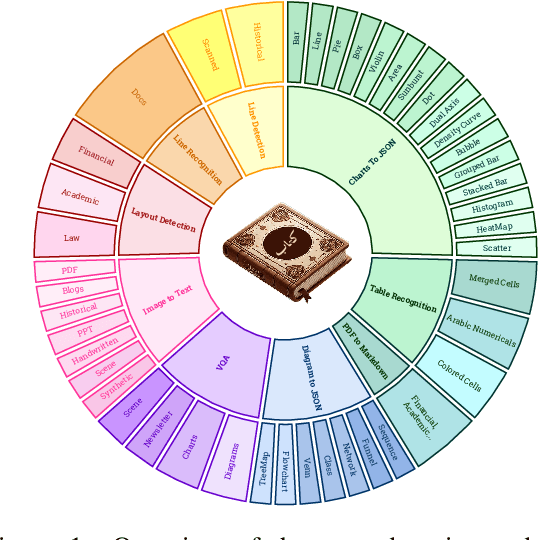
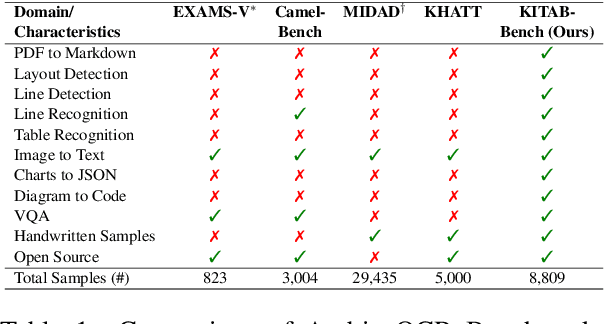
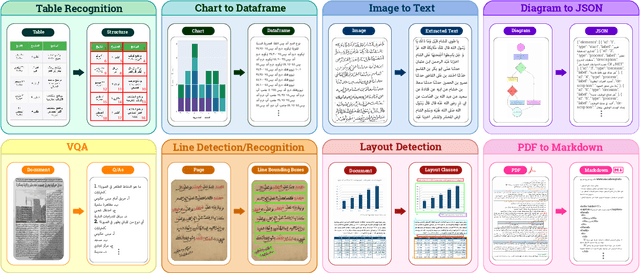
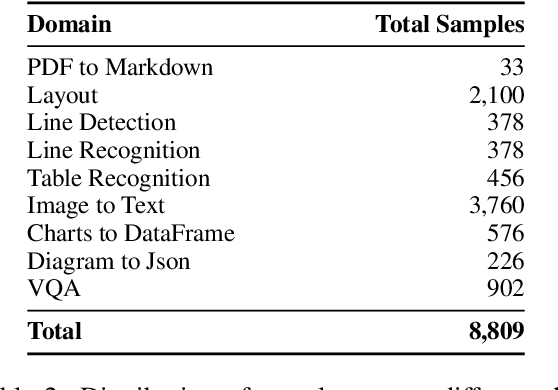
With the growing adoption of Retrieval-Augmented Generation (RAG) in document processing, robust text recognition has become increasingly critical for knowledge extraction. While OCR (Optical Character Recognition) for English and other languages benefits from large datasets and well-established benchmarks, Arabic OCR faces unique challenges due to its cursive script, right-to-left text flow, and complex typographic and calligraphic features. We present KITAB-Bench, a comprehensive Arabic OCR benchmark that fills the gaps in current evaluation systems. Our benchmark comprises 8,809 samples across 9 major domains and 36 sub-domains, encompassing diverse document types including handwritten text, structured tables, and specialized coverage of 21 chart types for business intelligence. Our findings show that modern vision-language models (such as GPT-4, Gemini, and Qwen) outperform traditional OCR approaches (like EasyOCR, PaddleOCR, and Surya) by an average of 60% in Character Error Rate (CER). Furthermore, we highlight significant limitations of current Arabic OCR models, particularly in PDF-to-Markdown conversion, where the best model Gemini-2.0-Flash achieves only 65% accuracy. This underscores the challenges in accurately recognizing Arabic text, including issues with complex fonts, numeral recognition errors, word elongation, and table structure detection. This work establishes a rigorous evaluation framework that can drive improvements in Arabic document analysis methods and bridge the performance gap with English OCR technologies.
Unlocking the Archives: Using Large Language Models to Transcribe Handwritten Historical Documents
Nov 02, 2024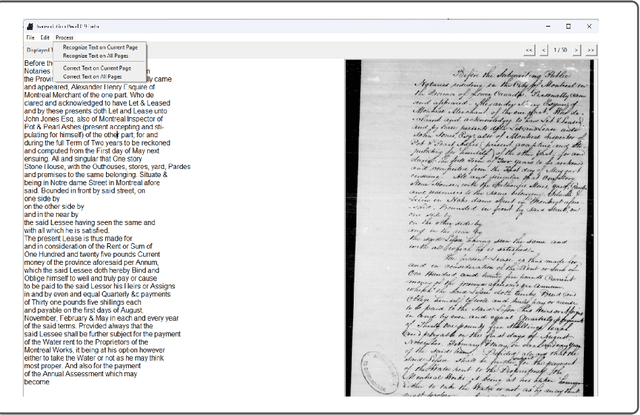
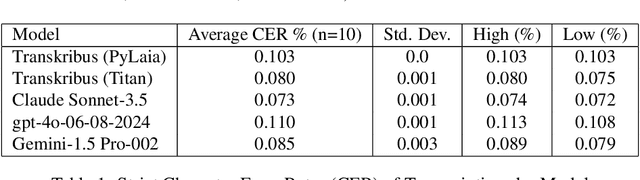
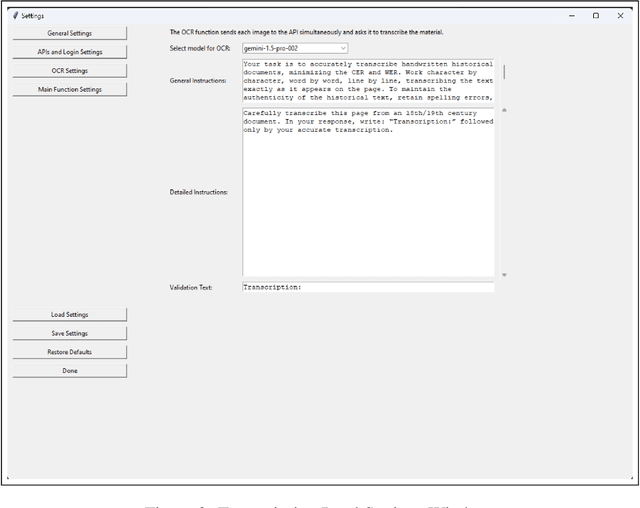
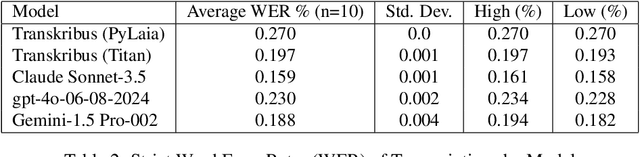
This study demonstrates that Large Language Models (LLMs) can transcribe historical handwritten documents with significantly higher accuracy than specialized Handwritten Text Recognition (HTR) software, while being faster and more cost-effective. We introduce an open-source software tool called Transcription Pearl that leverages these capabilities to automatically transcribe and correct batches of handwritten documents using commercially available multimodal LLMs from OpenAI, Anthropic, and Google. In tests on a diverse corpus of 18th/19th century English language handwritten documents, LLMs achieved Character Error Rates (CER) of 5.7 to 7% and Word Error Rates (WER) of 8.9 to 15.9%, improvements of 14% and 32% respectively over specialized state-of-the-art HTR software like Transkribus. Most significantly, when LLMs were then used to correct those transcriptions as well as texts generated by conventional HTR software, they achieved near-human levels of accuracy, that is CERs as low as 1.8% and WERs of 3.5%. The LLMs also completed these tasks 50 times faster and at approximately 1/50th the cost of proprietary HTR programs. These results demonstrate that when LLMs are incorporated into software tools like Transcription Pearl, they provide an accessible, fast, and highly accurate method for mass transcription of historical handwritten documents, significantly streamlining the digitization process.