 Add to Chrome
 Add to Firefox
 Add to Edge
AI-Mediated Feedback Improves Student Revisions: A Randomized Trial with FeedbackWriter in a Large Undergraduate Course
Feb 18, 2026
Despite growing interest in using LLMs to generate feedback on students' writing, little is known about how students respond to AI-mediated versus human-provided feedback. We address this gap through a randomized controlled trial in a large introductory economics course (N=354), where we introduce and deploy FeedbackWriter - a system that generates AI suggestions to teaching assistants (TAs) while they provide feedback on students' knowledge-intensive essays. TAs have the full capacity to adopt, edit, or dismiss the suggestions. Students were randomly assigned to receive either handwritten feedback from TAs (baseline) or AI-mediated feedback where TAs received suggestions from FeedbackWriter. Students revise their drafts based on the feedback, which is further graded. In total, 1,366 essays were graded using the system. We found that students receiving AI-mediated feedback produced significantly higher-quality revisions, with gains increasing as TAs adopted more AI suggestions. TAs found the AI suggestions useful for spotting gaps and clarifying rubrics.

Exploring LLM-Generated Feedback for Economics Essays: How Teaching Assistants Evaluate and Envision Its Use
May 21, 2025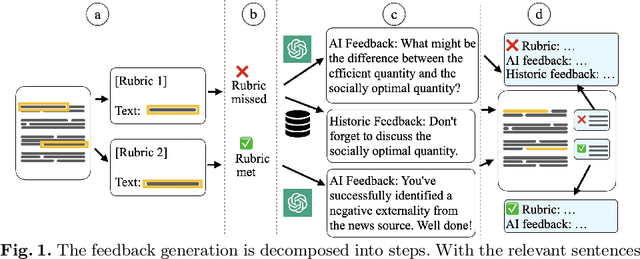
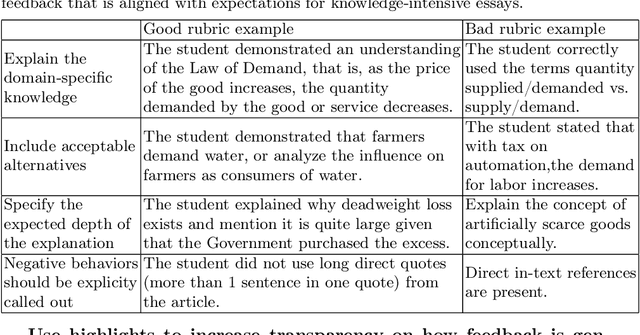
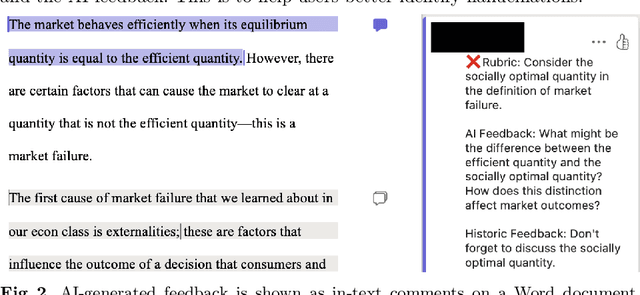
This project examines the prospect of using AI-generated feedback as suggestions to expedite and enhance human instructors' feedback provision. In particular, we focus on understanding the teaching assistants' perspectives on the quality of AI-generated feedback and how they may or may not utilize AI feedback in their own workflows. We situate our work in a foundational college Economics class, which has frequent short essay assignments. We developed an LLM-powered feedback engine that generates feedback on students' essays based on grading rubrics used by the teaching assistants (TAs). To ensure that TAs can meaningfully critique and engage with the AI feedback, we had them complete their regular grading jobs. For a randomly selected set of essays that they had graded, we used our feedback engine to generate feedback and displayed the feedback as in-text comments in a Word document. We then performed think-aloud studies with 5 TAs over 20 1-hour sessions to have them evaluate the AI feedback, contrast the AI feedback with their handwritten feedback, and share how they envision using the AI feedback if they were offered as suggestions. The study highlights the importance of providing detailed rubrics for AI to generate high-quality feedback for knowledge-intensive essays. TAs considered that using AI feedback as suggestions during their grading could expedite grading, enhance consistency, and improve overall feedback quality. We discuss the importance of decomposing the feedback generation task into steps and presenting intermediate results, in order for TAs to use the AI feedback.