 Add to Chrome
 Add to Firefox
 Add to Edge
BeHGAN: Bengali Handwritten Word Generation from Plain Text Using Generative Adversarial Networks
Dec 25, 2025
Handwritten Text Recognition (HTR) is a well-established research area. In contrast, Handwritten Text Generation (HTG) is an emerging field with significant potential. This task is challenging due to the variation in individual handwriting styles. A large and diverse dataset is required to generate realistic handwritten text. However, such datasets are difficult to collect and are not readily available. Bengali is the fifth most spoken language in the world. While several studies exist for languages such as English and Arabic, Bengali handwritten text generation has received little attention. To address this gap, we propose a method for generating Bengali handwritten words. We developed and used a self-collected dataset of Bengali handwriting samples. The dataset includes contributions from approximately five hundred individuals across different ages and genders. All images were pre-processed to ensure consistency and quality. Our approach demonstrates the ability to produce diverse handwritten outputs from input plain text. We believe this work contributes to the advancement of Bengali handwriting generation and can support further research in this area.

FUSE: Unifying Spectral and Semantic Cues for Robust AI-Generated Image Detection
Dec 25, 2025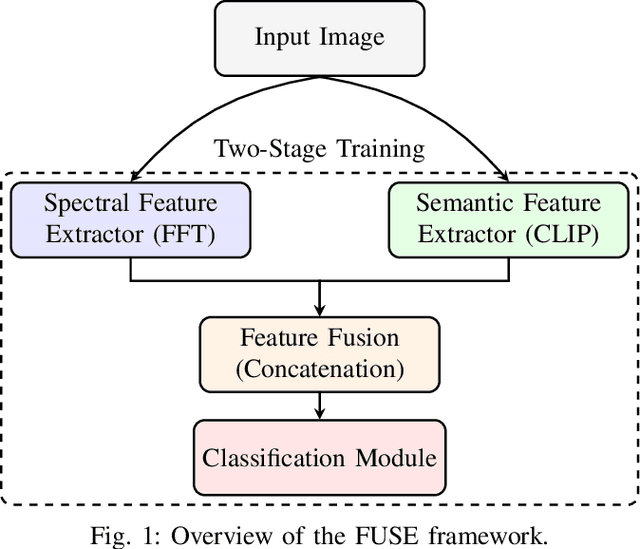
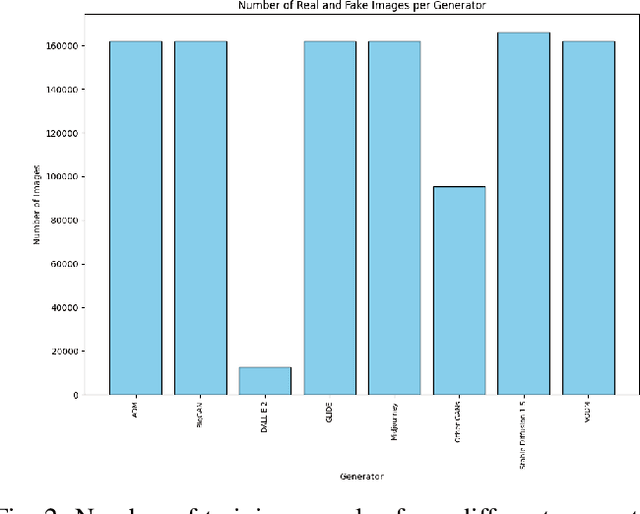
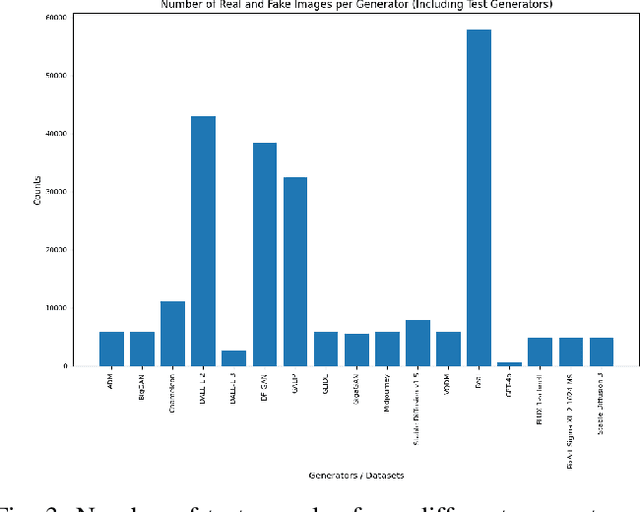
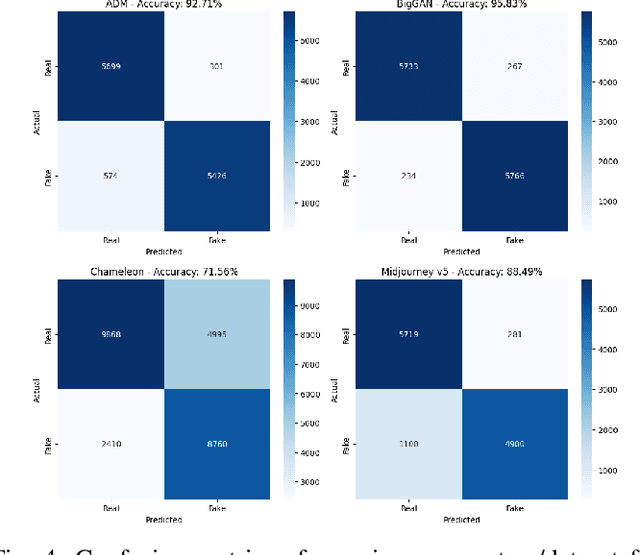
The fast evolution of generative models has heightened the demand for reliable detection of AI-generated images. To tackle this challenge, we introduce FUSE, a hybrid system that combines spectral features extracted through Fast Fourier Transform with semantic features obtained from the CLIP's Vision encoder. The features are fused into a joint representation and trained progressively in two stages. Evaluations on GenImage, WildFake, DiTFake, GPT-ImgEval and Chameleon datasets demonstrate strong generalization across multiple generators. Our FUSE (Stage 1) model demonstrates state-of-the-art results on the Chameleon benchmark. It also attains 91.36% mean accuracy on the GenImage dataset, 88.71% accuracy across all tested generators, and a mean Average Precision of 94.96%. Stage 2 training further improves performance for most generators. Unlike existing methods, which often perform poorly on high-fidelity images in Chameleon, our approach maintains robustness across diverse generators. These findings highlight the benefits of integrating spectral and semantic features for generalized detection of images generated by AI.
Detecting AI-Generated Paraphrases in Bengali: A Comparative Study of Zero-Shot and Fine-Tuned Transformers
Dec 25, 2025Large language models (LLMs) can produce text that closely resembles human writing. This capability raises concerns about misuse, including disinformation and content manipulation. Detecting AI-generated text is essential to maintain authenticity and prevent malicious applications. Existing research has addressed detection in multiple languages, but the Bengali language remains largely unexplored. Bengali's rich vocabulary and complex structure make distinguishing human-written and AI-generated text particularly challenging. This study investigates five transformer-based models: XLMRoBERTa-Large, mDeBERTaV3-Base, BanglaBERT-Base, IndicBERT-Base and MultilingualBERT-Base. Zero-shot evaluation shows that all models perform near chance levels (around 50% accuracy) and highlight the need for task-specific fine-tuning. Fine-tuning significantly improves performance, with XLM-RoBERTa, mDeBERTa and MultilingualBERT achieving around 91% on both accuracy and F1-score. IndicBERT demonstrates comparatively weaker performance, indicating limited effectiveness in fine-tuning for this task. This work advances AI-generated text detection in Bengali and establishes a foundation for building robust systems to counter AI-generated content.
Zero-Shot to Zero-Lies: Detecting Bengali Deepfake Audio through Transfer Learning
Dec 25, 2025The rapid growth of speech synthesis and voice conversion systems has made deepfake audio a major security concern. Bengali deepfake detection remains largely unexplored. In this work, we study automatic detection of Bengali audio deepfakes using the BanglaFake dataset. We evaluate zeroshot inference with several pretrained models. These include Wav2Vec2-XLSR-53, Whisper, PANNsCNN14, WavLM and Audio Spectrogram Transformer. Zero-shot results show limited detection ability. The best model, Wav2Vec2-XLSR-53, achieves 53.80% accuracy, 56.60% AUC and 46.20% EER. We then f ine-tune multiple architectures for Bengali deepfake detection. These include Wav2Vec2-Base, LCNN, LCNN-Attention, ResNet18, ViT-B16 and CNN-BiLSTM. Fine-tuned models show strong performance gains. ResNet18 achieves the highest accuracy of 79.17%, F1 score of 79.12%, AUC of 84.37% and EER of 24.35%. Experimental results confirm that fine-tuning significantly improves performance over zero-shot inference. This study provides the first systematic benchmark of Bengali deepfake audio detection. It highlights the effectiveness of f ine-tuned deep learning models for this low-resource language.