 Add to Chrome
 Add to Firefox
 Add to Edge
Handwritten Text Recognition
Papers and Code
Evaluating OCR Performance for Assistive Technology: Effects of Walking Speed, Camera Placement, and Camera Type
Feb 02, 2026
Optical character recognition (OCR), which converts printed or handwritten text into machine-readable form, is widely used in assistive technology for people with blindness and low vision. Yet, most evaluations rely on static datasets that do not reflect the challenges of mobile use. In this study, we systematically evaluated OCR performance under both static and dynamic conditions. Static tests measured detection range across distances of 1-7 meters and viewing angles of 0-75 degrees horizontally. Dynamic tests examined the impact of motion by varying walking speed from slow (0.8 m/s) to very fast (1.8 m/s) and comparing three camera mounting positions: head-mounted, shoulder-mounted, and hand-held. We evaluated both a smartphone and smart glasses, using the phone's main and ultra-wide cameras. Four OCR engines were benchmarked to assess accuracy at different distances and viewing angles: Google Vision, PaddleOCR 3.0, EasyOCR, and Tesseract. PaddleOCR 3.0 was then used to evaluate accuracy at different walking speeds. Accuracy was computed at the character level using the Levenshtein ratio against manually defined ground truth. Results showed that recognition accuracy declined with increased walking speed and wider viewing angles. Google Vision achieved the highest overall accuracy, with PaddleOCR close behind as the strongest open-source alternative. Across devices, the phone's main camera achieved the highest accuracy, and a shoulder-mounted placement yielded the highest average among body positions; however, differences among shoulder, head, and hand were not statistically significant.

Youtu-Parsing: Perception, Structuring and Recognition via High-Parallelism Decoding
Jan 28, 2026This paper presents Youtu-Parsing, an efficient and versatile document parsing model designed for high-performance content extraction. The architecture employs a native Vision Transformer (ViT) featuring a dynamic-resolution visual encoder to extract shared document features, coupled with a prompt-guided Youtu-LLM-2B language model for layout analysis and region-prompted decoding. Leveraging this decoupled and feature-reusable framework, we introduce a high-parallelism decoding strategy comprising two core components: token parallelism and query parallelism. The token parallelism strategy concurrently generates up to 64 candidate tokens per inference step, which are subsequently validated through a verification mechanism. This approach yields a 5--11x speedup over traditional autoregressive decoding and is particularly well-suited for highly structured scenarios, such as table recognition. To further exploit the advantages of region-prompted decoding, the query parallelism strategy enables simultaneous content prediction for multiple bounding boxes (up to five), providing an additional 2x acceleration while maintaining output quality equivalent to standard decoding. Youtu-Parsing encompasses a diverse range of document elements, including text, formulas, tables, charts, seals, and hierarchical structures. Furthermore, the model exhibits strong robustness when handling rare characters, multilingual text, and handwritten content. Extensive evaluations demonstrate that Youtu-Parsing achieves state-of-the-art (SOTA) performance on both the OmniDocBench and olmOCR-bench benchmarks. Overall, Youtu-Parsing demonstrates significant experimental value and practical utility for large-scale document intelligence applications.
CER-HV: A CER-Based Human-in-the-Loop Framework for Cleaning Datasets Applied to Arabic-Script HTR
Jan 23, 2026Handwritten text recognition (HTR) for Arabic-script languages still lags behind Latin-script HTR, despite recent advances in model architectures, datasets, and benchmarks. We show that data quality is a significant limiting factor in many published datasets and propose CER-HV (CER-based Ranking with Human Verification) as a framework to detect and clean label errors. CER-HV combines a CER-based noise detector, built on a carefully configured Convolutional Recurrent Neural Network (CRNN) with early stopping to avoid overfitting noisy samples, and a human-in-the-loop (HITL) step that verifies high-ranking samples. The framework reveals that several existing datasets contain previously underreported problems, including transcription, segmentation, orientation, and non-text content errors. These have been identified with up to 90 percent precision in the Muharaf and 80-86 percent in the PHTI datasets. We also show that our CRNN achieves state-of-the-art performance across five of the six evaluated datasets, reaching 8.45 percent Character Error Rate (CER) on KHATT (Arabic), 8.26 percent on PHTI (Pashto), 10.66 percent on Ajami, and 10.11 percent on Muharaf (Arabic), all without any data cleaning. We establish a new baseline of 11.3 percent CER on the PHTD (Persian) dataset. Applying CER-HV improves the evaluation CER by 0.3-0.6 percent on the cleaner datasets and 1.0-1.8 percent on the noisier ones. Although our experiments focus on documents written in an Arabic-script language, including Arabic, Persian, Urdu, Ajami, and Pashto, the framework is general and can be applied to other text recognition datasets.
synthocr-gen: A synthetic ocr dataset generator for low-resource languages- breaking the data barrier
Jan 22, 2026Optical Character Recognition (OCR) for low-resource languages remains a significant challenge due to the scarcity of large-scale annotated training datasets. Languages such as Kashmiri, with approximately 7 million speakers and a complex Perso-Arabic script featuring unique diacritical marks, currently lack support in major OCR systems including Tesseract, TrOCR, and PaddleOCR. Manual dataset creation for such languages is prohibitively expensive, time-consuming, and error-prone, often requiring word by word transcription of printed or handwritten text. We present SynthOCR-Gen, an open-source synthetic OCR dataset generator specifically designed for low-resource languages. Our tool addresses the fundamental bottleneck in OCR development by transforming digital Unicode text corpora into ready-to-use training datasets. The system implements a comprehensive pipeline encompassing text segmentation (character, word, n-gram, sentence, and line levels), Unicode normalization with script purity enforcement, multi-font rendering with configurable distribution, and 25+ data augmentation techniques simulating real-world document degradations including rotation, blur, noise, and scanner artifacts. We demonstrate the efficacy of our approach by generating a 600,000-sample word-segmented Kashmiri OCR dataset, which we release publicly on HuggingFace. This work provides a practical pathway for bringing low-resource languages into the era of vision-language AI models, and the tool is openly available for researchers and practitioners working with underserved writing systems worldwide.
FP-THD: Full page transcription of historical documents
Jan 20, 2026The transcription of historical documents written in Latin in XV and XVI centuries has special challenges as it must maintain the characters and special symbols that have distinct meanings to ensure that historical texts retain their original style and significance. This work proposes a pipeline for the transcription of historical documents preserving these special features. We propose to extend an existing text line recognition method with a layout analysis model. We analyze historical text images using a layout analysis model to extract text lines, which are then processed by an OCR model to generate a fully digitized page. We showed that our pipeline facilitates the processing of the page and produces an efficient result. We evaluated our approach on multiple datasets and demonstrate that the masked autoencoder effectively processes different types of text, including handwritten, printed and multi-language.
BeHGAN: Bengali Handwritten Word Generation from Plain Text Using Generative Adversarial Networks
Dec 25, 2025Handwritten Text Recognition (HTR) is a well-established research area. In contrast, Handwritten Text Generation (HTG) is an emerging field with significant potential. This task is challenging due to the variation in individual handwriting styles. A large and diverse dataset is required to generate realistic handwritten text. However, such datasets are difficult to collect and are not readily available. Bengali is the fifth most spoken language in the world. While several studies exist for languages such as English and Arabic, Bengali handwritten text generation has received little attention. To address this gap, we propose a method for generating Bengali handwritten words. We developed and used a self-collected dataset of Bengali handwriting samples. The dataset includes contributions from approximately five hundred individuals across different ages and genders. All images were pre-processed to ensure consistency and quality. Our approach demonstrates the ability to produce diverse handwritten outputs from input plain text. We believe this work contributes to the advancement of Bengali handwriting generation and can support further research in this area.
Application of deep learning approaches for medieval historical documents transcription
Dec 21, 2025Handwritten text recognition and optical character recognition solutions show excellent results with processing data of modern era, but efficiency drops with Latin documents of medieval times. This paper presents a deep learning method to extract text information from handwritten Latin-language documents of the 9th to 11th centuries. The approach takes into account the properties inherent in medieval documents. The paper provides a brief introduction to the field of historical document transcription, a first-sight analysis of the raw data, and the related works and studies. The paper presents the steps of dataset development for further training of the models. The explanatory data analysis of the processed data is provided as well. The paper explains the pipeline of deep learning models to extract text information from the document images, from detecting objects to word recognition using classification models and embedding word images. The paper reports the following results: recall, precision, F1 score, intersection over union, confusion matrix, and mean string distance. The plots of the metrics are also included. The implementation is published on the GitHub repository.
* 15 pages, 15 figures, 4 tables. Originally published by CEUR Workshop Proceedings (CEUR-WS.org, ISSN 1613-0073), available: https://ceur-ws.org/Vol-4133/S_05_Kozlenko.pdf
Digitizing Nepal's Written Heritage: A Comprehensive HTR Pipeline for Old Nepali Manuscripts
Dec 18, 2025
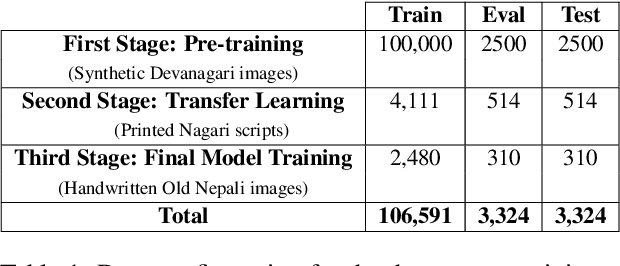


This paper presents the first end-to-end pipeline for Handwritten Text Recognition (HTR) for Old Nepali, a historically significant but low-resource language. We adopt a line-level transcription approach and systematically explore encoder-decoder architectures and data-centric techniques to improve recognition accuracy. Our best model achieves a Character Error Rate (CER) of 4.9\%. In addition, we implement and evaluate decoding strategies and analyze token-level confusions to better understand model behaviour and error patterns. While the dataset we used for evaluation is confidential, we release our training code, model configurations, and evaluation scripts to support further research in HTR for low-resource historical scripts.
Seeing Justice Clearly: Handwritten Legal Document Translation with OCR and Vision-Language Models
Dec 19, 2025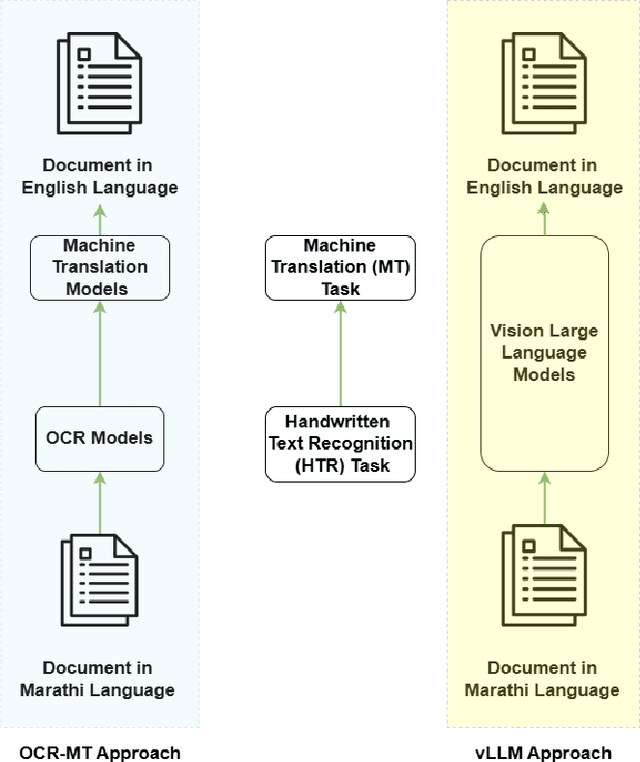
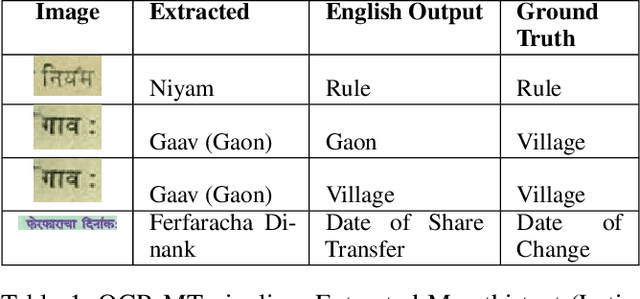
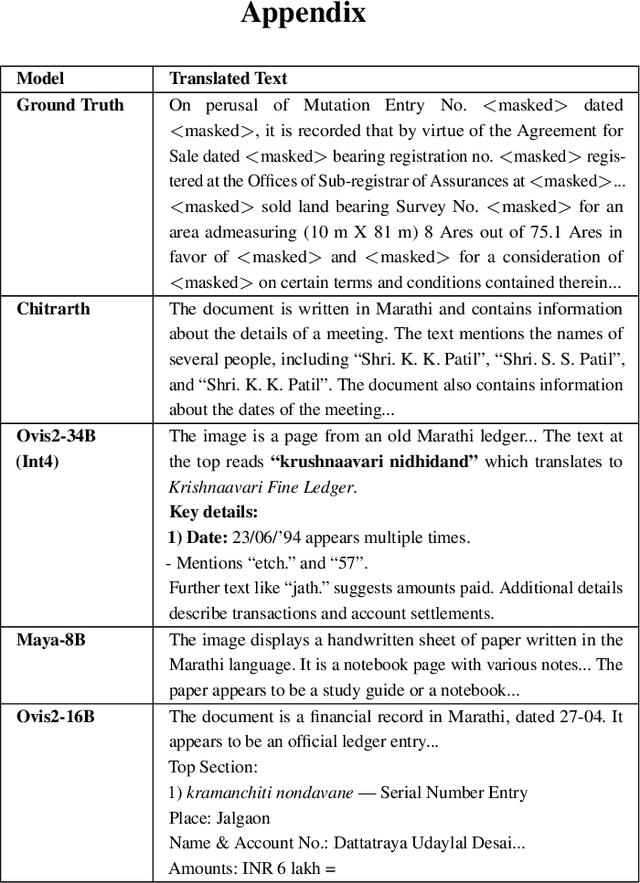
Handwritten text recognition (HTR) and machine translation continue to pose significant challenges, particularly for low-resource languages like Marathi, which lack large digitized corpora and exhibit high variability in handwriting styles. The conventional approach to address this involves a two-stage pipeline: an OCR system extracts text from handwritten images, which is then translated into the target language using a machine translation model. In this work, we explore and compare the performance of traditional OCR-MT pipelines with Vision Large Language Models that aim to unify these stages and directly translate handwritten text images in a single, end-to-end step. Our motivation is grounded in the urgent need for scalable, accurate translation systems to digitize legal records such as FIRs, charge sheets, and witness statements in India's district and high courts. We evaluate both approaches on a curated dataset of handwritten Marathi legal documents, with the goal of enabling efficient legal document processing, even in low-resource environments. Our findings offer actionable insights toward building robust, edge-deployable solutions that enhance access to legal information for non-native speakers and legal professionals alike.
ThaiOCRBench: A Task-Diverse Benchmark for Vision-Language Understanding in Thai
Nov 06, 2025We present ThaiOCRBench, the first comprehensive benchmark for evaluating vision-language models (VLMs) on Thai text-rich visual understanding tasks. Despite recent progress in multimodal modeling, existing benchmarks predominantly focus on high-resource languages, leaving Thai underrepresented, especially in tasks requiring document structure understanding. ThaiOCRBench addresses this gap by offering a diverse, human-annotated dataset comprising 2,808 samples across 13 task categories. We evaluate a wide range of state-of-the-art VLMs in a zero-shot setting, spanning both proprietary and open-source systems. Results show a significant performance gap, with proprietary models (e.g., Gemini 2.5 Pro) outperforming open-source counterparts. Notably, fine-grained text recognition and handwritten content extraction exhibit the steepest performance drops among open-source models. Through detailed error analysis, we identify key challenges such as language bias, structural mismatch, and hallucinated content. ThaiOCRBench provides a standardized framework for assessing VLMs in low-resource, script-complex settings, and provides actionable insights for improving Thai-language document understanding.