 Add to Chrome
 Add to Firefox
 Add to Edge
Model Capability Dominates: Inference-Time Optimization Lessons from AIMO 3
Mar 29, 2026
Majority voting over multiple LLM attempts improves mathematical reasoning, but correlated errors limit the effective sample size. A natural fix: assign structurally different reasoning strategies to different voters to decorrelate errors. We test this Diverse Prompt Mixer in the AIMO~3 competition: 3 models, 23+ experiments, and 50 IMO-level problems on a single H100 80 GB with a 5-hour limit. Every intervention fails. High-temperature sampling already decorrelates errors sufficiently; weaker prompt strategies reduce per-attempt accuracy more than they reduce correlation. Across a 17-point model capability gap and every inference-time optimization we tried, model capability dominates by an order of magnitude.

Formula-One Prompting: Adaptive Reasoning Through Equations For Applied Mathematics
Jan 27, 2026Prompting techniques such as Chain-of-Thought (CoT) and Program-of-Thought (PoT) improve LLM mathematical reasoning by structuring intermediate steps in natural language or code. However, applied mathematics problems in domains like finance, physics, and cryptography often require recalling or deriving governing equations, a step that current approaches do not explicitly leverage. We propose Formula-One Prompting (F-1), a two-phase approach that uses mathematical equations as an intermediate representation before adaptive solving. F-1 first formulates governing equations from problem descriptions, then selects a solving strategy among CoT, PoT, or direct computation based on the generated equations, all within a single LLM call. Results across five models and four benchmarks show F-1 outperforms CoT by +5.76% and PoT by +8.42% on average. Crucially, gains are largest in applied domains: +13.30% on FinanceMath over CoT, and within OlympiadBench, larger gains on physics (+2.55%) than pure math (+0.44%). This demonstrates that F-1 is more effective than CoT in applied mathematics problems.
Typhoon OCR: Open Vision-Language Model For Thai Document Extraction
Jan 21, 2026Document extraction is a core component of digital workflows, yet existing vision-language models (VLMs) predominantly favor high-resource languages. Thai presents additional challenges due to script complexity from non-latin letters, the absence of explicit word boundaries, and the prevalence of highly unstructured real-world documents, limiting the effectiveness of current open-source models. This paper presents Typhoon OCR, an open VLM for document extraction tailored for Thai and English. The model is fine-tuned from vision-language backbones using a Thai-focused training dataset. The dataset is developed using a multi-stage data construction pipeline that combines traditional OCR, VLM-based restructuring, and curated synthetic data. Typhoon OCR is a unified framework capable of text transcription, layout reconstruction, and document-level structural consistency. The latest iteration of our model, Typhoon OCR V1.5, is a compact and inference-efficient model designed to reduce reliance on metadata and simplify deployment. Comprehensive evaluations across diverse Thai document categories, including financial reports, government forms, books, infographics, and handwritten documents, show that Typhoon OCR achieves performance comparable to or exceeding larger frontier proprietary models, despite substantially lower computational cost. The results demonstrate that open vision-language OCR models can achieve accurate text extraction and layout reconstruction for Thai documents, reaching performance comparable to proprietary systems while remaining lightweight and deployable.
ThaiOCRBench: A Task-Diverse Benchmark for Vision-Language Understanding in Thai
Nov 06, 2025We present ThaiOCRBench, the first comprehensive benchmark for evaluating vision-language models (VLMs) on Thai text-rich visual understanding tasks. Despite recent progress in multimodal modeling, existing benchmarks predominantly focus on high-resource languages, leaving Thai underrepresented, especially in tasks requiring document structure understanding. ThaiOCRBench addresses this gap by offering a diverse, human-annotated dataset comprising 2,808 samples across 13 task categories. We evaluate a wide range of state-of-the-art VLMs in a zero-shot setting, spanning both proprietary and open-source systems. Results show a significant performance gap, with proprietary models (e.g., Gemini 2.5 Pro) outperforming open-source counterparts. Notably, fine-grained text recognition and handwritten content extraction exhibit the steepest performance drops among open-source models. Through detailed error analysis, we identify key challenges such as language bias, structural mismatch, and hallucinated content. ThaiOCRBench provides a standardized framework for assessing VLMs in low-resource, script-complex settings, and provides actionable insights for improving Thai-language document understanding.
DoTA-RAG: Dynamic of Thought Aggregation RAG
Jun 14, 2025In this paper, we introduce DoTA-RAG (Dynamic-of-Thought Aggregation RAG), a retrieval-augmented generation system optimized for high-throughput, large-scale web knowledge indexes. Traditional RAG pipelines often suffer from high latency and limited accuracy over massive, diverse datasets. DoTA-RAG addresses these challenges with a three-stage pipeline: query rewriting, dynamic routing to specialized sub-indexes, and multi-stage retrieval and ranking. We further enhance retrieval by evaluating and selecting a superior embedding model, re-embedding the large FineWeb-10BT corpus. Moreover, we create a diverse Q&A dataset of 500 questions generated via the DataMorgana setup across a broad range of WebOrganizer topics and formats. DoTA-RAG improves the answer correctness score from 0.752 (baseline, using LiveRAG pre-built vector store) to 1.478 while maintaining low latency, and it achieves a 0.929 correctness score on the Live Challenge Day. These results highlight DoTA-RAG's potential for practical deployment in domains requiring fast, reliable access to large and evolving knowledge sources.
Typhoon 2: A Family of Open Text and Multimodal Thai Large Language Models
Dec 19, 2024

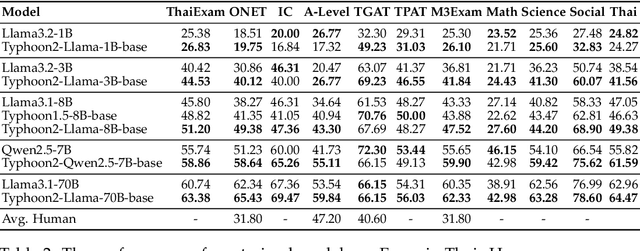
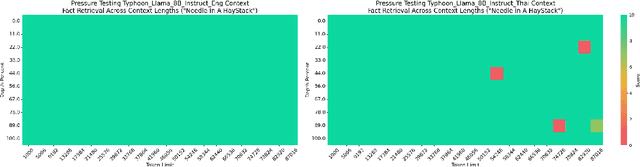
This paper introduces Typhoon 2, a series of text and multimodal large language models optimized for the Thai language. The series includes models for text, vision, and audio. Typhoon2-Text builds on state-of-the-art open models, such as Llama 3 and Qwen2, and we perform continual pre-training on a mixture of English and Thai data. We employ post-training techniques to enhance Thai language performance while preserving the base models' original capabilities. We release text models across a range of sizes, from 1 to 70 billion parameters, available in both base and instruction-tuned variants. To guardrail text generation, we release Typhoon2-Safety, a classifier enhanced for Thai cultures and language. Typhoon2-Vision improves Thai document understanding while retaining general visual capabilities, such as image captioning. Typhoon2-Audio introduces an end-to-end speech-to-speech model architecture capable of processing audio, speech, and text inputs and generating both text and speech outputs.