 Add to Chrome
 Add to Firefox
 Add to Edge
Font Style Transfer
Font style transfer is the process of transferring the style of one font to another font.
Papers and Code
FontCrafter: High-Fidelity Element-Driven Artistic Font Creation with Visual In-Context Generation
Mar 23, 2026
Artistic font generation aims to synthesize stylized glyphs based on a reference style. However, existing approaches suffer from limited style diversity and coarse control. In this work, we explore the potential of element-driven artistic font generation. Elements are the fundamental visual units of a font, serving as reference images for the desired style. Conceptually, we categorize elements into object elements (e.g., flowers or stones) with distinct structures and amorphous elements (e.g., flames or clouds) with unstructured textures. We introduce FontCrafter, an element-driven framework for font creation, and construct a large-scale dataset, ElementFont, which contains diverse element types and high-quality glyph images. However, achieving high-fidelity reconstruction of both texture and structure of reference elements remains challenging. To address this, we propose an in-context generation strategy that treats element images as visual context and uses an inpainting model to transfer element styles into glyph regions at the pixel level. To further control glyph shapes, we design a lightweight Context-aware Mask Adapter (CMA) that injects shape information. Moreover, a training-free attention redirection mechanism enables region-aware style control and suppresses stroke hallucination. In addition, edge repainting is applied to make boundaries more natural. Extensive experiments demonstrate that FontCrafter achieves strong zero-shot generation performance, particularly in preserving structural and textural fidelity, while also supporting flexible controls such as style mixture.

A Study on the Refining Handwritten Font by Mixing Font Styles
May 19, 2025Handwritten fonts have a distinct expressive character, but they are often difficult to read due to unclear or inconsistent handwriting. FontFusionGAN (FFGAN) is a novel method for improving handwritten fonts by combining them with printed fonts. Our method implements generative adversarial network (GAN) to generate font that mix the desirable features of handwritten and printed fonts. By training the GAN on a dataset of handwritten and printed fonts, it can generate legible and visually appealing font images. We apply our method to a dataset of handwritten fonts and demonstrate that it significantly enhances the readability of the original fonts while preserving their unique aesthetic. Our method has the potential to improve the readability of handwritten fonts, which would be helpful for a variety of applications including document creation, letter writing, and assisting individuals with reading and writing difficulties. In addition to addressing the difficulties of font creation for languages with complex character sets, our method is applicable to other text-image-related tasks, such as font attribute control and multilingual font style transfer.
FontAdapter: Instant Font Adaptation in Visual Text Generation
Jun 06, 2025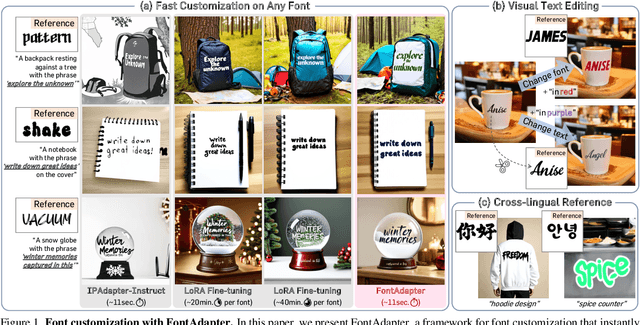

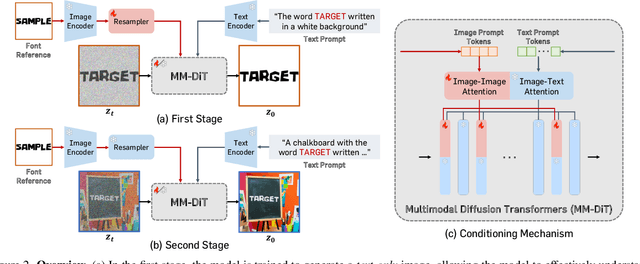
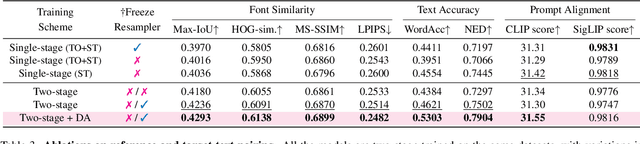
Text-to-image diffusion models have significantly improved the seamless integration of visual text into diverse image contexts. Recent approaches further improve control over font styles through fine-tuning with predefined font dictionaries. However, adapting unseen fonts outside the preset is computationally expensive, often requiring tens of minutes, making real-time customization impractical. In this paper, we present FontAdapter, a framework that enables visual text generation in unseen fonts within seconds, conditioned on a reference glyph image. To this end, we find that direct training on font datasets fails to capture nuanced font attributes, limiting generalization to new glyphs. To overcome this, we propose a two-stage curriculum learning approach: FontAdapter first learns to extract font attributes from isolated glyphs and then integrates these styles into diverse natural backgrounds. To support this two-stage training scheme, we construct synthetic datasets tailored to each stage, leveraging large-scale online fonts effectively. Experiments demonstrate that FontAdapter enables high-quality, robust font customization across unseen fonts without additional fine-tuning during inference. Furthermore, it supports visual text editing, font style blending, and cross-lingual font transfer, positioning FontAdapter as a versatile framework for font customization tasks.
AnyArtisticGlyph: Multilingual Controllable Artistic Glyph Generation
Apr 07, 2025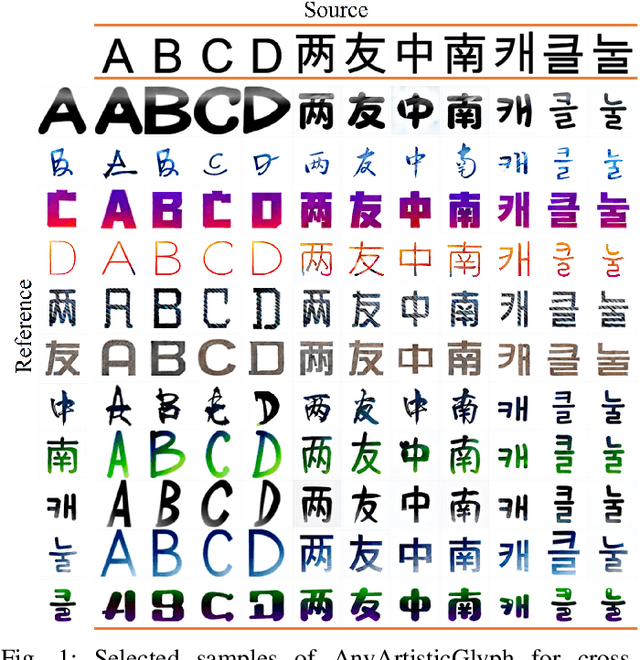
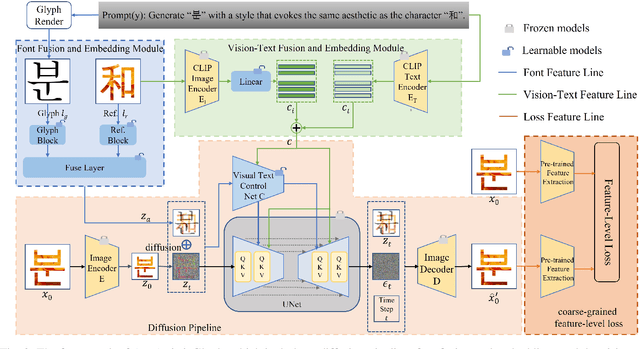
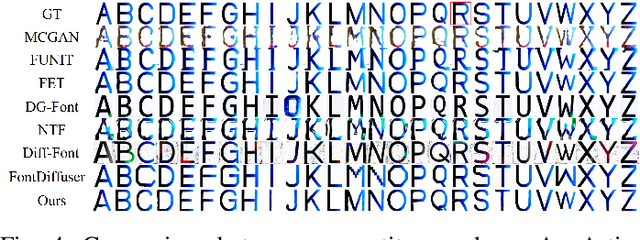
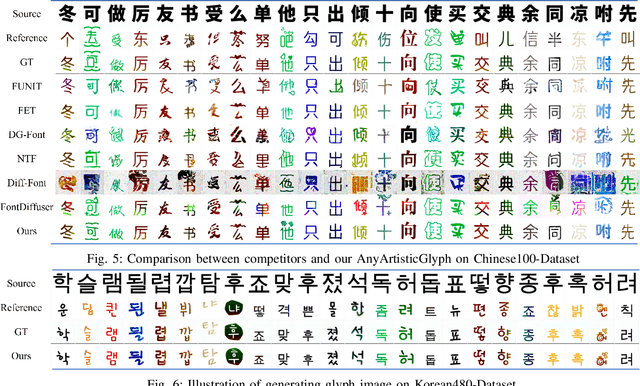
Artistic Glyph Image Generation (AGIG) differs from current creativity-focused generation models by offering finely controllable deterministic generation. It transfers the style of a reference image to a source while preserving its content. Although advanced and promising, current methods may reveal flaws when scrutinizing synthesized image details, often producing blurred or incorrect textures, posing a significant challenge. Hence, we introduce AnyArtisticGlyph, a diffusion-based, multilingual controllable artistic glyph generation model. It includes a font fusion and embedding module, which generates latent features for detailed structure creation, and a vision-text fusion and embedding module that uses the CLIP model to encode references and blends them with transformation caption embeddings for seamless global image generation. Moreover, we incorporate a coarse-grained feature-level loss to enhance generation accuracy. Experiments show that it produces natural, detailed artistic glyph images with state-of-the-art performance. Our project will be open-sourced on https://github.com/jiean001/AnyArtisticGlyph to advance text generation technology.
Group Diffusion Transformers are Unsupervised Multitask Learners
Oct 19, 2024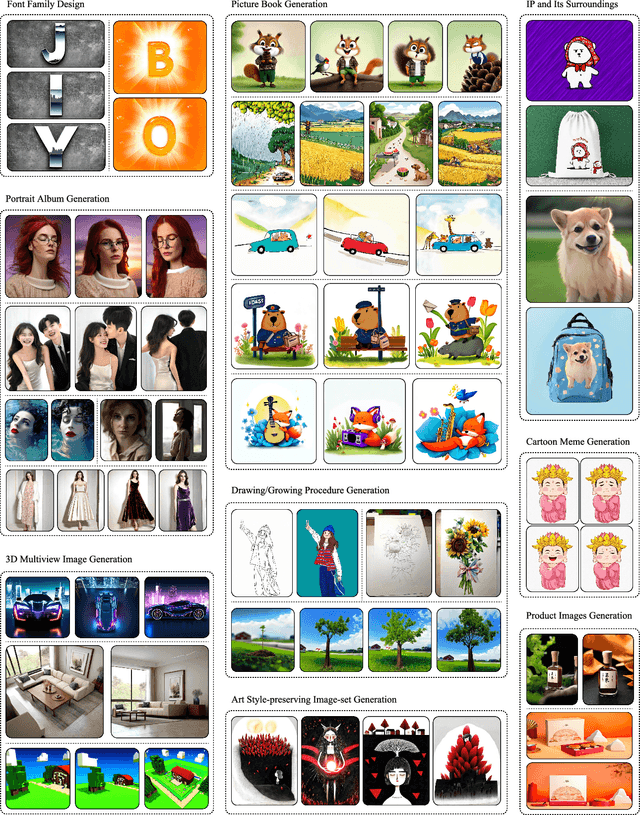
While large language models (LLMs) have revolutionized natural language processing with their task-agnostic capabilities, visual generation tasks such as image translation, style transfer, and character customization still rely heavily on supervised, task-specific datasets. In this work, we introduce Group Diffusion Transformers (GDTs), a novel framework that unifies diverse visual generation tasks by redefining them as a group generation problem. In this approach, a set of related images is generated simultaneously, optionally conditioned on a subset of the group. GDTs build upon diffusion transformers with minimal architectural modifications by concatenating self-attention tokens across images. This allows the model to implicitly capture cross-image relationships (e.g., identities, styles, layouts, surroundings, and color schemes) through caption-based correlations. Our design enables scalable, unsupervised, and task-agnostic pretraining using extensive collections of image groups sourced from multimodal internet articles, image galleries, and video frames. We evaluate GDTs on a comprehensive benchmark featuring over 200 instructions across 30 distinct visual generation tasks, including picture book creation, font design, style transfer, sketching, colorization, drawing sequence generation, and character customization. Our models achieve competitive zero-shot performance without any additional fine-tuning or gradient updates. Furthermore, ablation studies confirm the effectiveness of key components such as data scaling, group size, and model design. These results demonstrate the potential of GDTs as scalable, general-purpose visual generation systems.
Moyun: A Diffusion-Based Model for Style-Specific Chinese Calligraphy Generation
Oct 10, 2024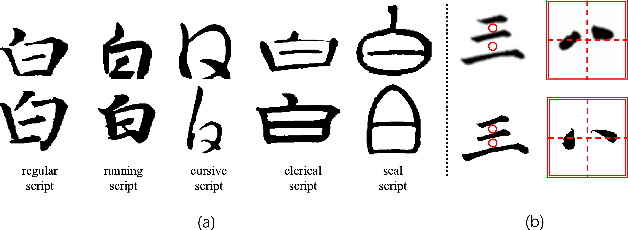
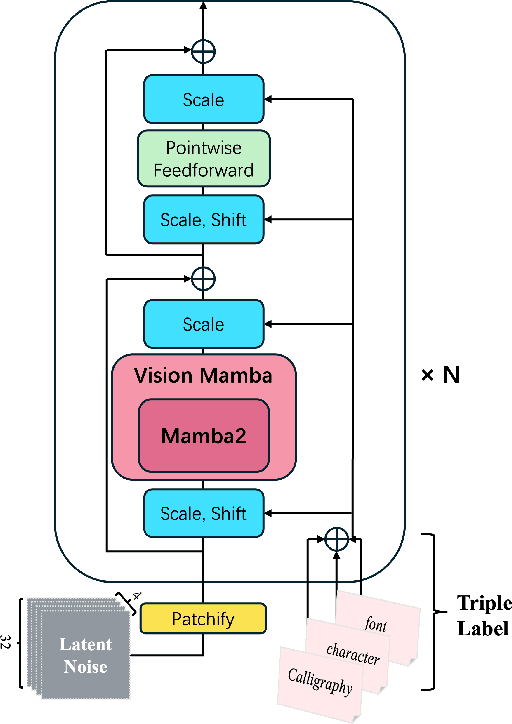


Although Chinese calligraphy generation has achieved style transfer, generating calligraphy by specifying the calligrapher, font, and character style remains challenging. To address this, we propose a new Chinese calligraphy generation model 'Moyun' , which replaces the Unet in the Diffusion model with Vision Mamba and introduces the TripleLabel control mechanism to achieve controllable calligraphy generation. The model was tested on our large-scale dataset 'Mobao' of over 1.9 million images, and the results demonstrate that 'Moyun' can effectively control the generation process and produce calligraphy in the specified style. Even for calligraphy the calligrapher has not written, 'Moyun' can generate calligraphy that matches the style of the calligrapher.
IDEA-Bench: How Far are Generative Models from Professional Designing?
Dec 16, 2024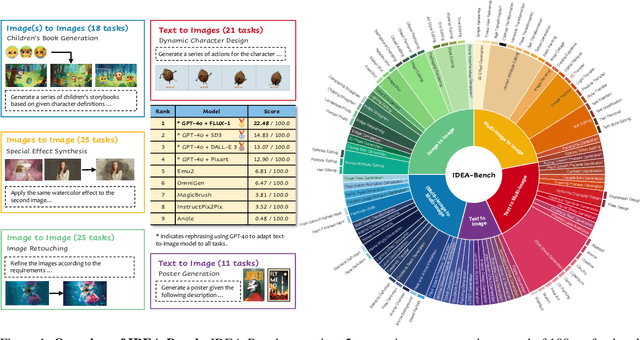
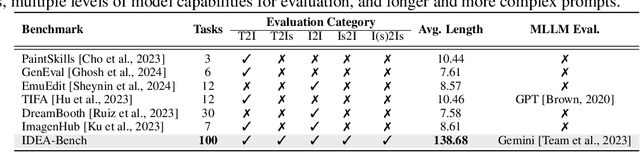
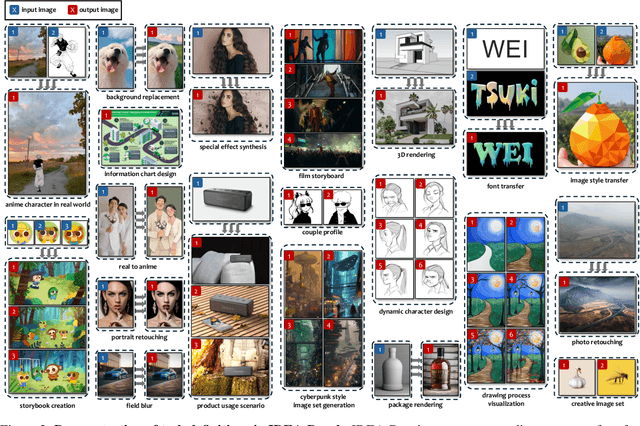
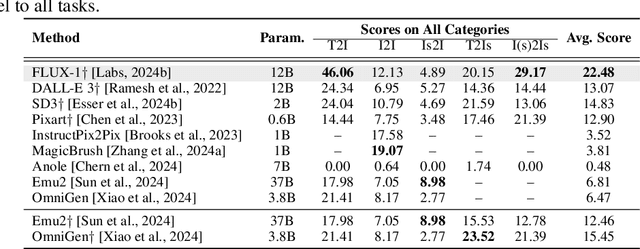
Real-world design tasks - such as picture book creation, film storyboard development using character sets, photo retouching, visual effects, and font transfer - are highly diverse and complex, requiring deep interpretation and extraction of various elements from instructions, descriptions, and reference images. The resulting images often implicitly capture key features from references or user inputs, making it challenging to develop models that can effectively address such varied tasks. While existing visual generative models can produce high-quality images based on prompts, they face significant limitations in professional design scenarios that involve varied forms and multiple inputs and outputs, even when enhanced with adapters like ControlNets and LoRAs. To address this, we introduce IDEA-Bench, a comprehensive benchmark encompassing 100 real-world design tasks, including rendering, visual effects, storyboarding, picture books, fonts, style-based, and identity-preserving generation, with 275 test cases to thoroughly evaluate a model's general-purpose generation capabilities. Notably, even the best-performing model only achieves 22.48 on IDEA-Bench, while the best general-purpose model only achieves 6.81. We provide a detailed analysis of these results, highlighting the inherent challenges and providing actionable directions for improvement. Additionally, we provide a subset of 18 representative tasks equipped with multimodal large language model (MLLM)-based auto-evaluation techniques to facilitate rapid model development and comparison. We releases the benchmark data, evaluation toolkits, and an online leaderboard at https://github.com/ali-vilab/IDEA-Bench, aiming to drive the advancement of generative models toward more versatile and applicable intelligent design systems.
TextMaster: Universal Controllable Text Edit
Oct 13, 2024In image editing tasks, high-quality text editing capabilities can significantly reduce human and material resource costs. Current methods rely heavily on training data based on OCR text segment detection, where the text is tightly aligned with the mask area. This reliance creates a strong dependency on the mask area and lacks modules for adjusting text spacing and size in various scenarios. When the amount of text to be edited does not match the modification area or when the mask area is too large, significant issues may arise. Furthermore, no existing methods have explored controllable style transfer for text editing.To address these challenges, we propose TextMaster, a solution capable of accurately editing text with high realism and proper layout in any scenario and image area. Our approach employs adaptive standard letter spacing as guidance during training and uses adaptive mask boosting to prevent the leakage of text position and size information. We also utilize an attention mechanism to calculate the bounding box regression loss for each character, making text layout methods learnable across different scenarios. By injecting high-resolution standard font information and applying perceptual loss in the text editing area, we further enhance text rendering accuracy and fidelity. Additionally, we achieve style consistency between the modified and target text through a novel style injection method. Extensive qualitative and quantitative evaluations demonstrate that our method outperforms all existing approaches.
Few shot font generation via transferring similarity guided global style and quantization local style
Sep 14, 2023Automatic few-shot font generation (AFFG), aiming at generating new fonts with only a few glyph references, reduces the labor cost of manually designing fonts. However, the traditional AFFG paradigm of style-content disentanglement cannot capture the diverse local details of different fonts. So, many component-based approaches are proposed to tackle this problem. The issue with component-based approaches is that they usually require special pre-defined glyph components, e.g., strokes and radicals, which is infeasible for AFFG of different languages. In this paper, we present a novel font generation approach by aggregating styles from character similarity-guided global features and stylized component-level representations. We calculate the similarity scores of the target character and the referenced samples by measuring the distance along the corresponding channels from the content features, and assigning them as the weights for aggregating the global style features. To better capture the local styles, a cross-attention-based style transfer module is adopted to transfer the styles of reference glyphs to the components, where the components are self-learned discrete latent codes through vector quantization without manual definition. With these designs, our AFFG method could obtain a complete set of component-level style representations, and also control the global glyph characteristics. The experimental results reflect the effectiveness and generalization of the proposed method on different linguistic scripts, and also show its superiority when compared with other state-of-the-art methods. The source code can be found at https://github.com/awei669/VQ-Font.
Style Generation in Robot Calligraphy with Deep Generative Adversarial Networks
Dec 15, 2023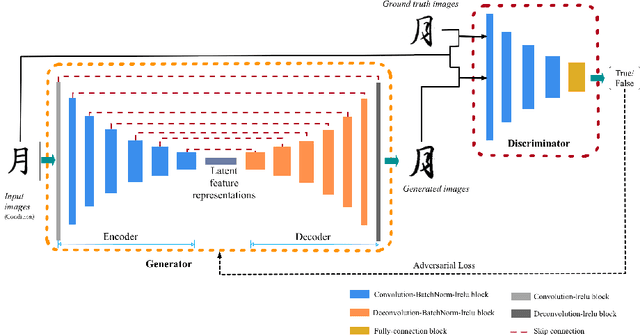
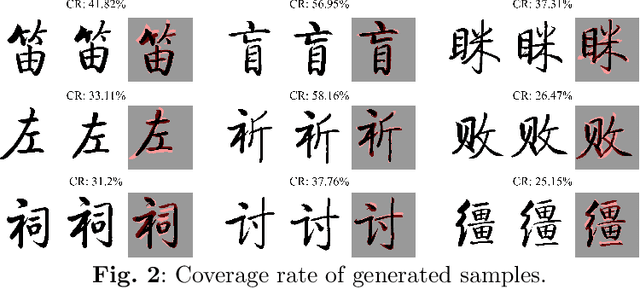
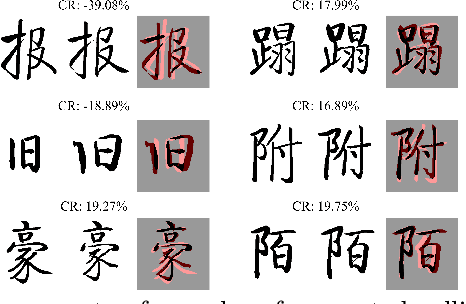
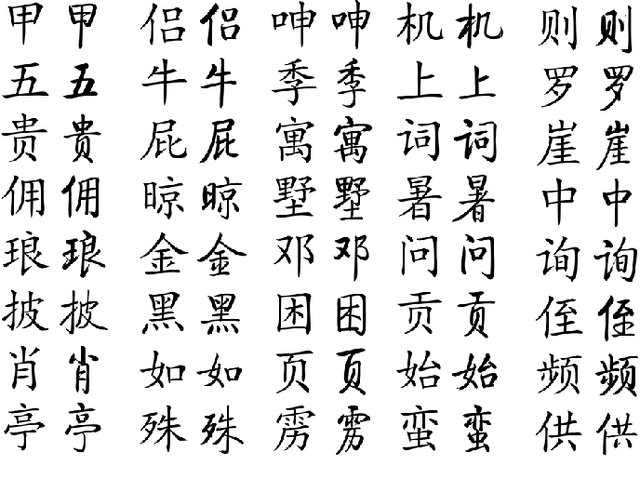
Robot calligraphy is an emerging exploration of artificial intelligence in the fields of art and education. Traditional calligraphy generation researches mainly focus on methods such as tool-based image processing, generative models, and style transfer. Unlike the English alphabet, the number of Chinese characters is tens of thousands, which leads to difficulties in the generation of a style consistent Chinese calligraphic font with over 6000 characters. Due to the lack of high-quality data sets, formal definitions of calligraphy knowledge, and scientific art evaluation methods, The results generated are frequently of low quality and falls short of professional-level requirements. To address the above problem, this paper proposes an automatic calligraphy generation model based on deep generative adversarial networks (deepGAN) that can generate style calligraphy fonts with professional standards. The key highlights of the proposed method include: (1) The datasets use a high-precision calligraphy synthesis method to ensure its high quality and sufficient quantity; (2) Professional calligraphers are invited to conduct a series of Turing tests to evaluate the gap between model generation results and human artistic level; (3) Experimental results indicate that the proposed model is the state-of-the-art among current calligraphy generation methods. The Turing tests and similarity evaluations validate the effectiveness of the proposed method.