 Add to Chrome
 Add to Firefox
 Add to Edge
RLDX-1 Technical Report
May 05, 2026
While Vision-Language-Action models (VLAs) have shown remarkable progress toward human-like generalist robotic policies through the versatile intelligence (i.e. broad scene understanding and language-conditioned generalization) inherited from pre-trained Vision-Language Models, they still struggle with complex real-world tasks requiring broader functional capabilities (e.g. motion awareness, memory-aware decision making, and physical sensing). To address this, we introduce RLDX-1, a general-purpose robotic policy for dexterous manipulation built on the Multi-Stream Action Transformer (MSAT), an architecture that unifies these capabilities by integrating heterogeneous modalities through modality-specific streams with cross-modal joint self-attention. RLDX-1 further combines this architecture with system-level design choices, including synthesizing training data for rare manipulation scenarios, learning procedures specialized for human-like manipulation, and inference optimizations for real-time deployment. Through empirical evaluation, we show that RLDX-1 consistently outperforms recent frontier VLAs (e.g. $π_{0.5}$ and GR00T N1.6) across both simulation benchmarks and real-world tasks that require broad functional capabilities beyond general versatility. In particular, RLDX-1 shows superiority in ALLEX humanoid tasks by achieving success rates of 86.8% while $π_{0.5}$ and GR00T N1.6 achieve around 40%, highlighting the ability of RLDX-1 to control a high-DoF humanoid robot under diverse functional demands. Together, these results position RLDX-1 as a promising step toward reliable VLAs for complex, contact-rich, and dynamic real-world dexterous manipulation.

Modular Sensory Stream for Integrating Physical Feedback in Vision-Language-Action Models
Apr 25, 2026Humans understand and interact with the real world by relying on diverse physical feedback beyond visual perception. Motivated by this, recent approaches attempt to incorporate physical sensory signals into Vision-Language-Action models (VLAs). However, they typically focus on a single type of physical signal, failing to capture the heterogeneous and complementary nature of real-world interactions. In this paper, we propose MoSS, a modular sensory stream framework that adapts VLAs to leverage multiple sensory signals for action prediction. Specifically, we introduce decoupled modality streams that integrate heterogeneous physical signals into the action stream via joint cross-modal self-attention. To enable stable incorporation of new modalities, we adopt a two-stage training scheme that freezes pretrained VLA parameters in the early stage. Furthermore, to better capture contact interaction dynamics, we incorporate an auxiliary task that predicts future physical signals. Through extensive real-world experiments, we demonstrate that MoSS successfully augments VLAs to leverage diverse physical signals (i.e., tactile and torque), integrating multiple signals to achieve synergistic performance gains.
Contrastive Representation Regularization for Vision-Language-Action Models
Oct 02, 2025Vision-Language-Action (VLA) models have shown its capabilities in robot manipulation by leveraging rich representations from pre-trained Vision-Language Models (VLMs). However, their representations arguably remain suboptimal, lacking sensitivity to robotic signals such as control actions and proprioceptive states. To address the issue, we introduce Robot State-aware Contrastive Loss (RS-CL), a simple and effective representation regularization for VLA models, designed to bridge the gap between VLM representations and robotic signals. In particular, RS-CL aligns the representations more closely with the robot's proprioceptive states, by using relative distances between the states as soft supervision. Complementing the original action prediction objective, RS-CL effectively enhances control-relevant representation learning, while being lightweight and fully compatible with standard VLA training pipeline. Our empirical results demonstrate that RS-CL substantially improves the manipulation performance of state-of-the-art VLA models; it pushes the prior art from 30.8% to 41.5% on pick-and-place tasks in RoboCasa-Kitchen, through more accurate positioning during grasping and placing, and boosts success rates from 45.0% to 58.3% on challenging real-robot manipulation tasks.
HAMLET: Switch your Vision-Language-Action Model into a History-Aware Policy
Oct 02, 2025Inherently, robotic manipulation tasks are history-dependent: leveraging past context could be beneficial. However, most existing Vision-Language-Action models (VLAs) have been designed without considering this aspect, i.e., they rely solely on the current observation, ignoring preceding context. In this paper, we propose HAMLET, a scalable framework to adapt VLAs to attend to the historical context during action prediction. Specifically, we introduce moment tokens that compactly encode perceptual information at each timestep. Their representations are initialized with time-contrastive learning, allowing them to better capture temporally distinctive aspects. Next, we employ a lightweight memory module that integrates the moment tokens across past timesteps into memory features, which are then leveraged for action prediction. Through empirical evaluation, we show that HAMLET successfully transforms a state-of-the-art VLA into a history-aware policy, especially demonstrating significant improvements on long-horizon tasks that require historical context. In particular, on top of GR00T N1.5, HAMLET achieves an average success rate of 76.4% on history-dependent real-world tasks, surpassing the baseline performance by 47.2%. Furthermore, HAMLET pushes prior art performance from 64.1% to 66.4% on RoboCasa Kitchen (100-demo setup) and from 95.6% to 97.7% on LIBERO, highlighting its effectiveness even under generic robot-manipulation benchmarks.
FontAdapter: Instant Font Adaptation in Visual Text Generation
Jun 06, 2025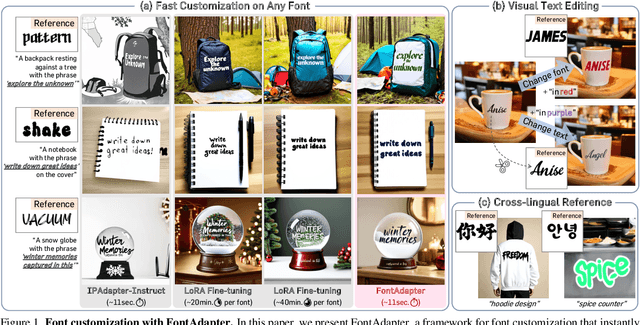

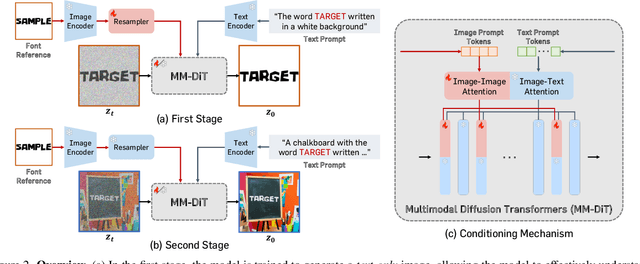
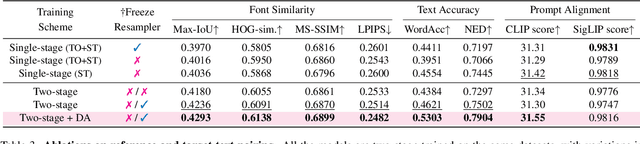
Text-to-image diffusion models have significantly improved the seamless integration of visual text into diverse image contexts. Recent approaches further improve control over font styles through fine-tuning with predefined font dictionaries. However, adapting unseen fonts outside the preset is computationally expensive, often requiring tens of minutes, making real-time customization impractical. In this paper, we present FontAdapter, a framework that enables visual text generation in unseen fonts within seconds, conditioned on a reference glyph image. To this end, we find that direct training on font datasets fails to capture nuanced font attributes, limiting generalization to new glyphs. To overcome this, we propose a two-stage curriculum learning approach: FontAdapter first learns to extract font attributes from isolated glyphs and then integrates these styles into diverse natural backgrounds. To support this two-stage training scheme, we construct synthetic datasets tailored to each stage, leveraging large-scale online fonts effectively. Experiments demonstrate that FontAdapter enables high-quality, robust font customization across unseen fonts without additional fine-tuning during inference. Furthermore, it supports visual text editing, font style blending, and cross-lingual font transfer, positioning FontAdapter as a versatile framework for font customization tasks.