 Add to Chrome
 Add to Firefox
 Add to Edge
Classification Of Age Related Macular
Papers and Code
ELEMENT: Multi-Modal Retinal Vessel Segmentation Based on a Coupled Region Growing and Machine Learning Approach
May 19, 2026
Vascular structures in the retina contain important information for the detection and analysis of ocular diseases, including age-related macular degeneration, diabetic retinopathy and glaucoma. Commonly used modalities in diagnosis of these diseases are fundus photography, scanning laser ophthalmoscope (SLO) and fluorescein angiography (FA). Typically, retinal vessel segmentation is carried out either manually or interactively, which makes it time consuming and prone to human errors. In this research, we propose a new multi-modal framework for vessel segmentation called ELEMENT (vEsseL sEgmentation using Machine lEarning and coNnecTivity). This framework consists of feature extraction and pixel-based classification using region growing and machine learning. The proposed features capture complementary evidence based on grey level and vessel connectivity properties. The latter information is seamlessly propagated through the pixels at the classification phase. ELEMENT reduces inconsistencies and speeds up the segmentation throughput. We analyze and compare the performance of the proposed approach against state-of-the-art vessel segmentation algorithms in three major groups of experiments, for each of the ocular modalities. Our method produced higher overall performance, with an overall accuracy of 97.40%, compared to 25 of the 26 state-of-the-art approaches, including six works based on deep learning, evaluated on the widely known DRIVE fundus image dataset. In the case of the STARE, CHASE-DB, VAMPIRE FA, IOSTAR SLO and RC-SLO datasets, the proposed framework outperformed all of the state-of-the-art methods with accuracies of 98.27%, 97.78%, 98.34%, 98.04% and 98.35%, respectively.

Toward Multimodal Conversational AI for Age-Related Macular Degeneration
Apr 28, 2026Despite strong performance of deep learning models in retinal disease detection, most systems produce static predictions without clinical reasoning or interactive explanation. Recent advances in multimodal large language models (MLLMs) integrate diagnostic predictions with clinically meaningful dialogue to support clinical decision-making and patient counseling. In this study, OcularChat, an MLLM, was fine-tuned from Qwen2.5-VL using simulated patient-physician dialogues to diagnose age-related macular degeneration (AMD) through visual question answering on color fundus photographs (CFPs). A total of 705,850 simulated dialogues paired with 46,167 CFPs were generated to train OcularChat to identify key AMD features and produce reasoned predictions. OcularChat demonstrated strong classification performance in AREDS, achieving accuracies of 0.954, 0.849, and 0.678 for the three diagnostic tasks: advanced AMD, pigmentary abnormalities, and drusen size, significantly outperforming existing MLLMs. On AREDS2, OcularChat remained the top-performing method on all tasks. Across three independent ophthalmologist graders, OcularChat achieved higher mean scores than a strong baseline model for advanced AMD (3.503 vs. 2.833), pigmentary abnormalities (3.272 vs. 2.828), drusen size (3.064 vs. 2.433), and overall impression (2.978 vs. 2.464) on a 5-point clinical grading rubric. Beyond strong objective performance in AMD severity classification, OcularChat demonstrated the ability to provide diagnostic reasoning, clinically relevant explanations, and interactive dialogue, with high performance in subjective ophthalmologist evaluation. These findings suggest that MLLMs may enable accurate, interpretable, and clinically useful image-based diagnosis and classification of AMD.
Retinal Cyst Detection from Optical Coherence Tomography Images
Apr 12, 2026Retinal Cysts are formed by leakage and accumulation of fluid in the retina due to the incompetence of retinal vasculature. These cystic spaces have significance in several ocular diseases such as age-related macular degeneration, diabetic macular edema, etc. Optical coherence tomography is one of the predominant diagnosing techniques for imaging retinal pathologies. Segmenting and quantification of intraretinal cysts plays the vital role in predicting visual acuity. In literature, several methods have been proposed for automatic segmentation of intraretinal cysts. As cystoid macular edema becomes a major problem to humankind, we need to quantify it accurately and operate it out, else it might cause many problems later on. Though research is being carried out in this area, not much of progress has been made and accuracy achieved so far is 68\% which is very less. Also, the methods depend on the quality of the image and give very low results for high noise images like topcon. This work uses ResNet CNN (Convolutional Neural Network) approach of segmentation by the way of patchwise classification for training on image set from cyst segmentation challenge dataset and testing on test data set given by 2 different graders for all 4 vendors in the challenge. It also compares these methods using first publicly available novel cyst segmentation challenge dataset. The methods were evaluated using quantitative measures to assess their robustness against the challenges of intraretinal cyst segmentation. The results are found to be better than the previous state of the art approaches giving more than 70\% dice coefficient on all vendors irrespective of their quality.
VOLMO: Versatile and Open Large Models for Ophthalmology
Mar 25, 2026Vision impairment affects millions globally, and early detection is critical to preventing irreversible vision loss. Ophthalmology workflows require clinicians to integrate medical images, structured clinical data, and free-text notes to determine disease severity and management, which is time-consuming and burdensome. Recent multimodal large language models (MLLMs) show promise, but existing general and medical MLLMs perform poorly in ophthalmology, and few ophthalmology-specific MLLMs are openly available. We present VOLMO (Versatile and Open Large Models for Ophthalmology), a model-agnostic, data-open framework for developing ophthalmology-specific MLLMs. VOLMO includes three stages: ophthalmology knowledge pretraining on 86,965 image-text pairs from 26,569 articles across 82 journals; domain task fine-tuning on 26,929 annotated instances spanning 12 eye conditions for disease screening and severity classification; and multi-step clinical reasoning on 913 patient case reports for assessment, planning, and follow-up care. Using this framework, we trained a compact 2B-parameter MLLM and compared it with strong baselines, including InternVL-2B, LLaVA-Med-7B, MedGemma-4B, MedGemma-27B, and RETFound. We evaluated these models on image description generation, disease screening and staging classification, and assessment-and-management generation, with additional manual review by two healthcare professionals and external validation on three independent cohorts for age-related macular degeneration and diabetic retinopathy. Across settings, VOLMO-2B consistently outperformed baselines, achieving stronger image description performance, an average F1 of 87.4% across 12 eye conditions, and higher scores in external validation.
KD-OCT: Efficient Knowledge Distillation for Clinical-Grade Retinal OCT Classification
Dec 09, 2025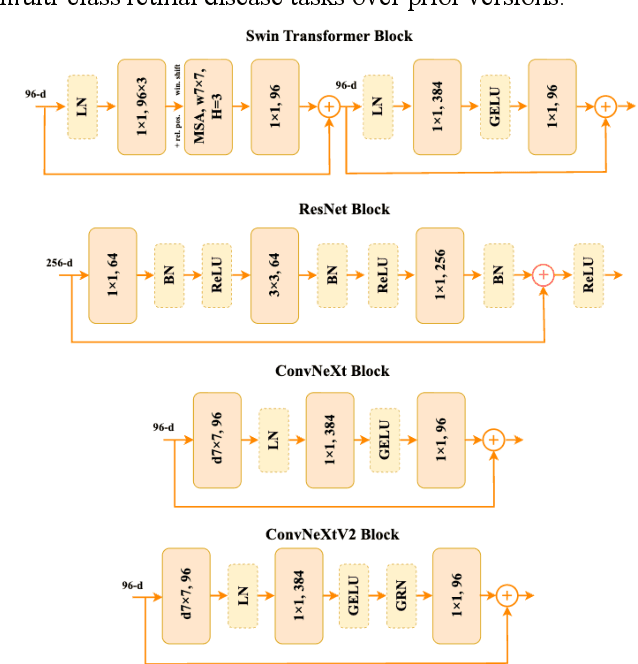
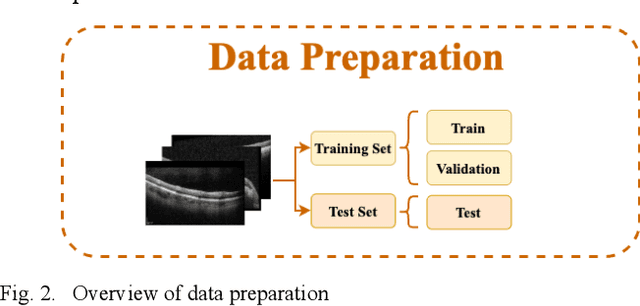
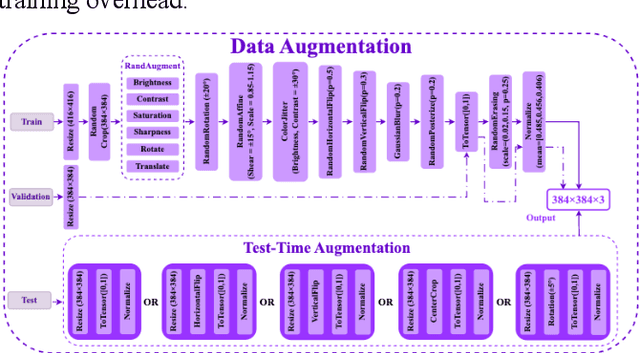
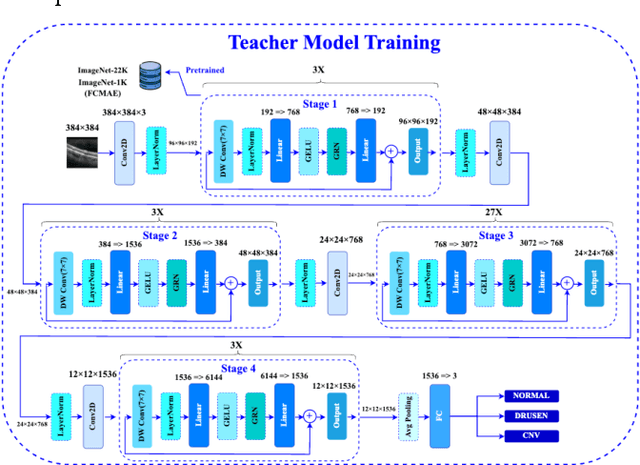
Age-related macular degeneration (AMD) and choroidal neovascularization (CNV)-related conditions are leading causes of vision loss worldwide, with optical coherence tomography (OCT) serving as a cornerstone for early detection and management. However, deploying state-of-the-art deep learning models like ConvNeXtV2-Large in clinical settings is hindered by their computational demands. Therefore, it is desirable to develop efficient models that maintain high diagnostic performance while enabling real-time deployment. In this study, a novel knowledge distillation framework, termed KD-OCT, is proposed to compress a high-performance ConvNeXtV2-Large teacher model, enhanced with advanced augmentations, stochastic weight averaging, and focal loss, into a lightweight EfficientNet-B2 student for classifying normal, drusen, and CNV cases. KD-OCT employs real-time distillation with a combined loss balancing soft teacher knowledge transfer and hard ground-truth supervision. The effectiveness of the proposed method is evaluated on the Noor Eye Hospital (NEH) dataset using patient-level cross-validation. Experimental results demonstrate that KD-OCT outperforms comparable multi-scale or feature-fusion OCT classifiers in efficiency-accuracy balance, achieving near-teacher performance with substantial reductions in model size and inference time. Despite the compression, the student model exceeds most existing frameworks, facilitating edge deployment for AMD screening. Code is available at https://github.com/erfan-nourbakhsh/KD-OCT.
HOG-CNN: Integrating Histogram of Oriented Gradients with Convolutional Neural Networks for Retinal Image Classification
Jul 29, 2025The analysis of fundus images is critical for the early detection and diagnosis of retinal diseases such as Diabetic Retinopathy (DR), Glaucoma, and Age-related Macular Degeneration (AMD). Traditional diagnostic workflows, however, often depend on manual interpretation and are both time- and resource-intensive. To address these limitations, we propose an automated and interpretable clinical decision support framework based on a hybrid feature extraction model called HOG-CNN. Our key contribution lies in the integration of handcrafted Histogram of Oriented Gradients (HOG) features with deep convolutional neural network (CNN) representations. This fusion enables our model to capture both local texture patterns and high-level semantic features from retinal fundus images. We evaluated our model on three public benchmark datasets: APTOS 2019 (for binary and multiclass DR classification), ORIGA (for Glaucoma detection), and IC-AMD (for AMD diagnosis); HOG-CNN demonstrates consistently high performance. It achieves 98.5\% accuracy and 99.2 AUC for binary DR classification, and 94.2 AUC for five-class DR classification. On the IC-AMD dataset, it attains 92.8\% accuracy, 94.8\% precision, and 94.5 AUC, outperforming several state-of-the-art models. For Glaucoma detection on ORIGA, our model achieves 83.9\% accuracy and 87.2 AUC, showing competitive performance despite dataset limitations. We show, through comprehensive appendix studies, the complementary strength of combining HOG and CNN features. The model's lightweight and interpretable design makes it particularly suitable for deployment in resource-constrained clinical environments. These results position HOG-CNN as a robust and scalable tool for automated retinal disease screening.
Learning Disease State from Noisy Ordinal Disease Progression Labels
Mar 13, 2025Learning from noisy ordinal labels is a key challenge in medical imaging. In this work, we ask whether ordinal disease progression labels (better, worse, or stable) can be used to learn a representation allowing to classify disease state. For neovascular age-related macular degeneration (nAMD), we cast the problem of modeling disease progression between medical visits as a classification task with ordinal ranks. To enhance generalization, we tailor our model to the problem setting by (1) independent image encoding, (2) antisymmetric logit space equivariance, and (3) ordinal scale awareness. In addition, we address label noise by learning an uncertainty estimate for loss re-weighting. Our approach learns an interpretable disease representation enabling strong few-shot performance for the related task of nAMD activity classification from single images, despite being trained only on image pairs with ordinal disease progression labels.
A Novel Ophthalmic Benchmark for Evaluating Multimodal Large Language Models with Fundus Photographs and OCT Images
Mar 10, 2025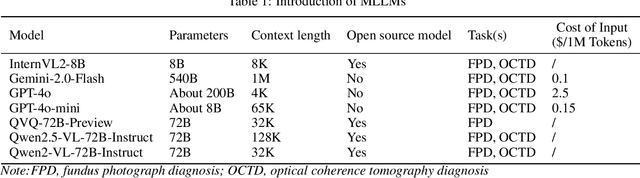
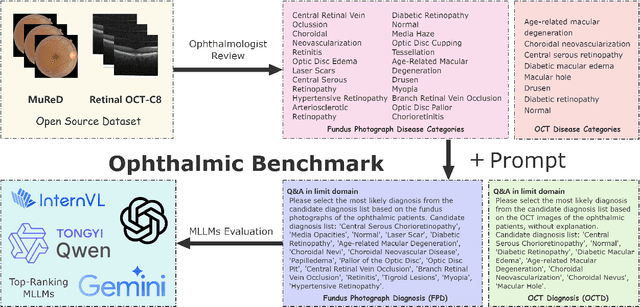
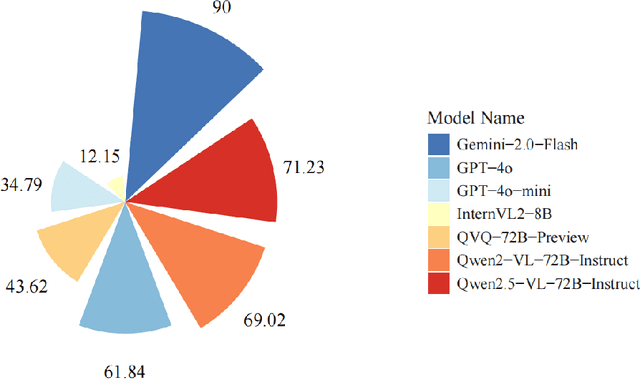
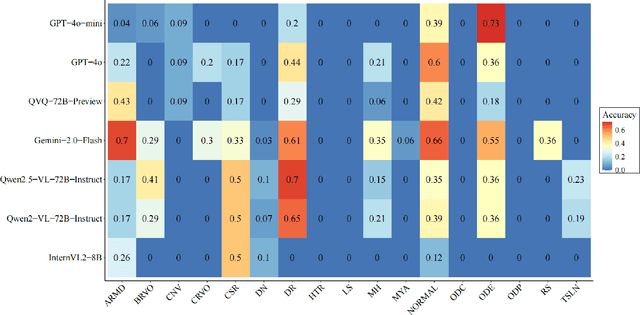
In recent years, large language models (LLMs) have demonstrated remarkable potential across various medical applications. Building on this foundation, multimodal large language models (MLLMs) integrate LLMs with visual models to process diverse inputs, including clinical data and medical images. In ophthalmology, LLMs have been explored for analyzing optical coherence tomography (OCT) reports, assisting in disease classification, and even predicting treatment outcomes. However, existing MLLM benchmarks often fail to capture the complexities of real-world clinical practice, particularly in the analysis of OCT images. Many suffer from limitations such as small sample sizes, a lack of diverse OCT datasets, and insufficient expert validation. These shortcomings hinder the accurate assessment of MLLMs' ability to interpret OCT scans and their broader applicability in ophthalmology. Our dataset, curated through rigorous quality control and expert annotation, consists of 439 fundus images and 75 OCT images. Using a standardized API-based framework, we assessed seven mainstream MLLMs and observed significant variability in diagnostic accuracy across different diseases. While some models performed well in diagnosing conditions such as diabetic retinopathy and age-related macular degeneration, they struggled with others, including choroidal neovascularization and myopia, highlighting inconsistencies in performance and the need for further refinement. Our findings emphasize the importance of developing clinically relevant benchmarks to provide a more accurate assessment of MLLMs' capabilities. By refining these models and expanding their scope, we can enhance their potential to transform ophthalmic diagnosis and treatment.
Diagnosis of diabetic retinopathy using machine learning & deep learning technique
Nov 25, 2024
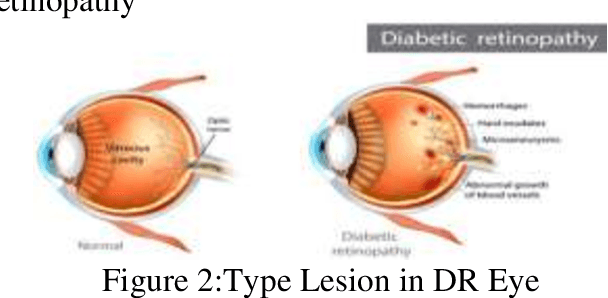
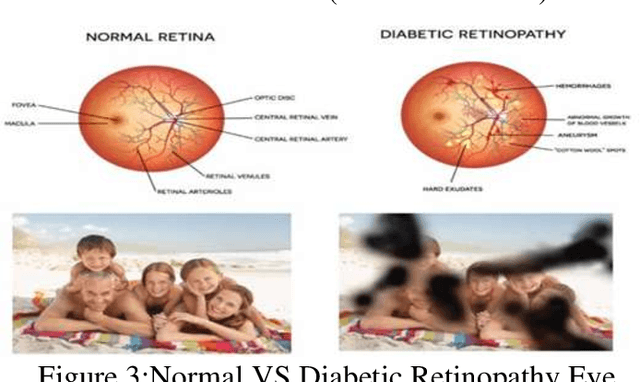
Fundus images are widely used for diagnosing various eye diseases, such as diabetic retinopathy, glaucoma, and age-related macular degeneration. However, manual analysis of fundus images is time-consuming and prone to errors. In this report, we propose a novel method for fundus detection using object detection and machine learning classification techniques. We use a YOLO_V8 to perform object detection on fundus images and locate the regions of interest (ROIs) such as optic disc, optic cup and lesions. We then use machine learning SVM classification algorithms to classify the ROIs into different DR stages based on the presence or absence of pathological signs such as exudates, microaneurysms, and haemorrhages etc. Our method achieves 84% accuracy and efficiency for fundus detection and can be applied for retinal fundus disease triage, especially in remote areas around the world.
* 9 pages, 11 figures, Journal Paper
Multiscale Color Guided Attention Ensemble Classifier for Age-Related Macular Degeneration using Concurrent Fundus and Optical Coherence Tomography Images
Sep 01, 2024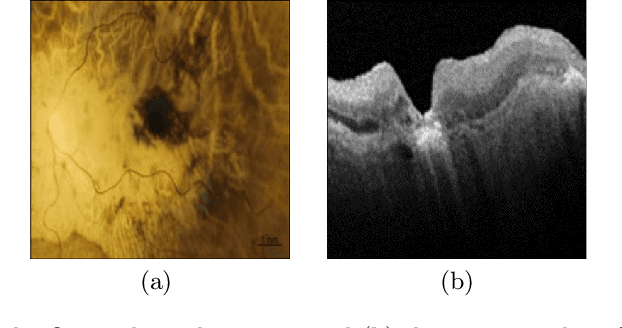
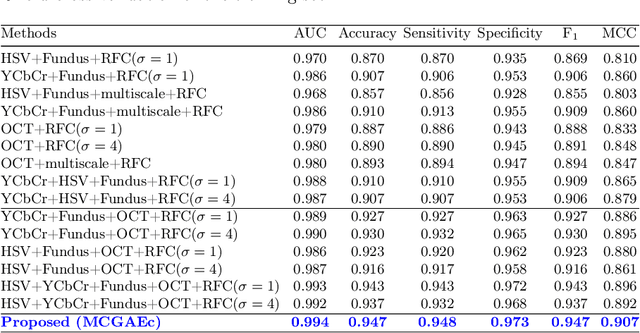
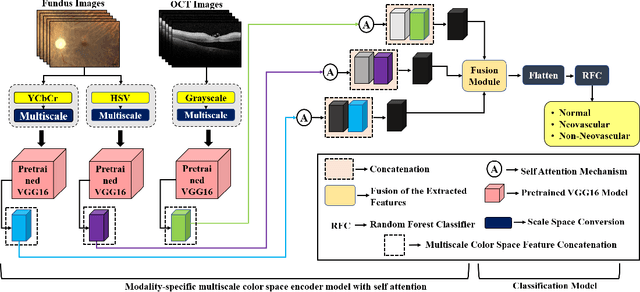
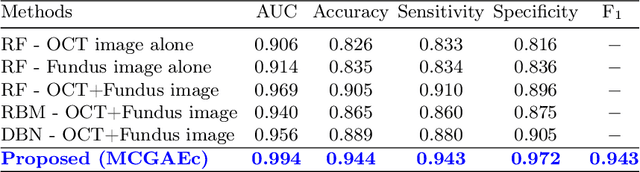
Automatic diagnosis techniques have evolved to identify age-related macular degeneration (AMD) by employing single modality Fundus images or optical coherence tomography (OCT). To classify ocular diseases, fundus and OCT images are the most crucial imaging modalities used in the clinical setting. Most deep learning-based techniques are established on a single imaging modality, which contemplates the ocular disorders to a specific extent and disregards other modality that comprises exhaustive information among distinct imaging modalities. This paper proposes a modality-specific multiscale color space embedding integrated with the attention mechanism based on transfer learning for classification (MCGAEc), which can efficiently extract the distinct modality information at various scales using the distinct color spaces. In this work, we first introduce the modality-specific multiscale color space encoder model, which includes diverse feature representations by integrating distinct characteristic color spaces on a multiscale into a unified framework. The extracted features from the prior encoder module are incorporated with the attention mechanism to extract the global features representation, which is integrated with the prior extracted features and transferred to the random forest classifier for the classification of AMD. To analyze the performance of the proposed MCGAEc method, a publicly available multi-modality dataset from Project Macula for AMD is utilized and compared with the existing models.