 Add to Chrome
 Add to Firefox
 Add to Edge
Ordinal Diffusion Models for Color Fundus Images
Feb 27, 2026
It has been suggested that generative image models such as diffusion models can improve performance on clinically relevant tasks by offering deep learning models supplementary training data. However, most conditional diffusion models treat disease stages as independent classes, ignoring the continuous nature of disease progression. This mismatch is problematic in medical imaging because continuous pathological processes are typically only observed through coarse, discrete but ordered labels as in ophthalmology for diabetic retinopathy (DR). We propose an ordinal latent diffusion model for generating color fundus images that explicitly incorporates the ordered structure of DR severity into the generation process. Instead of categorical conditioning, we used a scalar disease representation, enabling a smooth transition between adjacent stages. We evaluated our approach using visual realism metrics and classification-based clinical consistency analysis on the EyePACS dataset. Compared to a standard conditional diffusion model, our model reduced the Fréchet inception distance for four of the five DR stages and increased the quadratic weighted $κ$ from 0.79 to 0.87. Furthermore, interpolation experiments showed that the model captured a continuous spectrum of disease progression learned from ordered, coarse class labels.

Learning Disease State from Noisy Ordinal Disease Progression Labels
Mar 13, 2025Learning from noisy ordinal labels is a key challenge in medical imaging. In this work, we ask whether ordinal disease progression labels (better, worse, or stable) can be used to learn a representation allowing to classify disease state. For neovascular age-related macular degeneration (nAMD), we cast the problem of modeling disease progression between medical visits as a classification task with ordinal ranks. To enhance generalization, we tailor our model to the problem setting by (1) independent image encoding, (2) antisymmetric logit space equivariance, and (3) ordinal scale awareness. In addition, we address label noise by learning an uncertainty estimate for loss re-weighting. Our approach learns an interpretable disease representation enabling strong few-shot performance for the related task of nAMD activity classification from single images, despite being trained only on image pairs with ordinal disease progression labels.
Benchmarking Dependence Measures to Prevent Shortcut Learning in Medical Imaging
Jul 29, 2024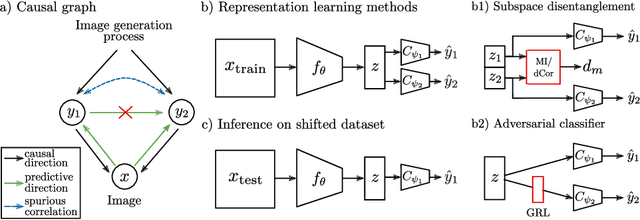


Medical imaging cohorts are often confounded by factors such as acquisition devices, hospital sites, patient backgrounds, and many more. As a result, deep learning models tend to learn spurious correlations instead of causally related features, limiting their generalizability to new and unseen data. This problem can be addressed by minimizing dependence measures between intermediate representations of task-related and non-task-related variables. These measures include mutual information, distance correlation, and the performance of adversarial classifiers. Here, we benchmark such dependence measures for the task of preventing shortcut learning. We study a simplified setting using Morpho-MNIST and a medical imaging task with CheXpert chest radiographs. Our results provide insights into how to mitigate confounding factors in medical imaging.
Disentangling representations of retinal images with generative models
Feb 29, 2024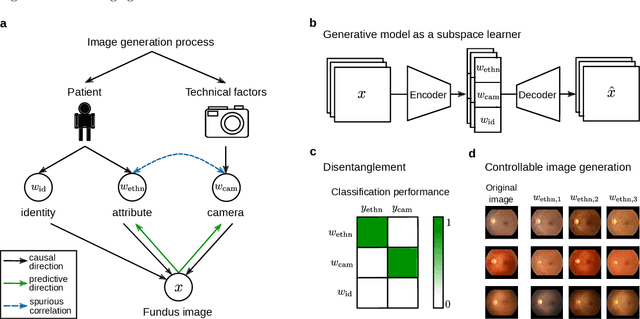

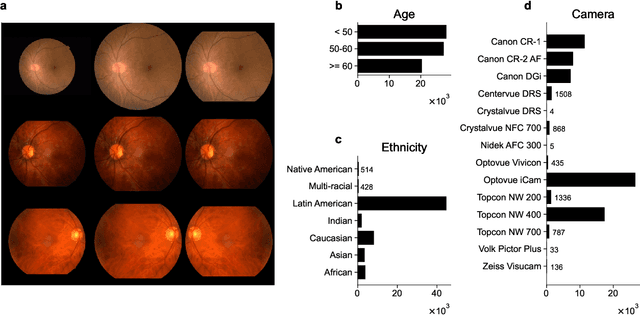

Retinal fundus images play a crucial role in the early detection of eye diseases and, using deep learning approaches, recent studies have even demonstrated their potential for detecting cardiovascular risk factors and neurological disorders. However, the impact of technical factors on these images can pose challenges for reliable AI applications in ophthalmology. For example, large fundus cohorts are often confounded by factors like camera type, image quality or illumination level, bearing the risk of learning shortcuts rather than the causal relationships behind the image generation process. Here, we introduce a novel population model for retinal fundus images that effectively disentangles patient attributes from camera effects, thus enabling controllable and highly realistic image generation. To achieve this, we propose a novel disentanglement loss based on distance correlation. Through qualitative and quantitative analyses, we demonstrate the effectiveness of this novel loss function in disentangling the learned subspaces. Our results show that our model provides a new perspective on the complex relationship between patient attributes and technical confounders in retinal fundus image generation.
Local policy search with Bayesian optimization
Jun 22, 2021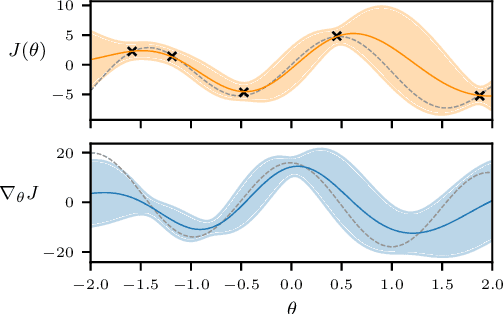
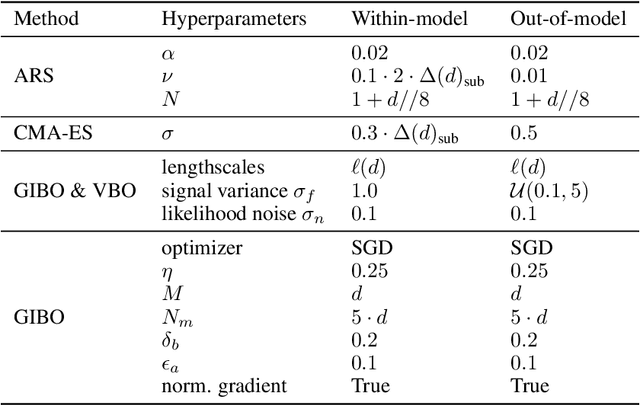
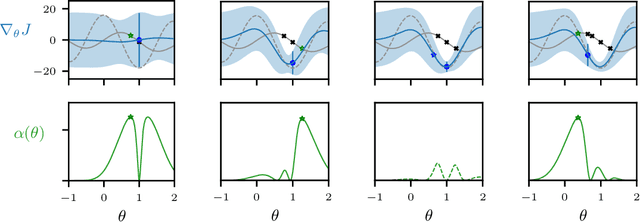
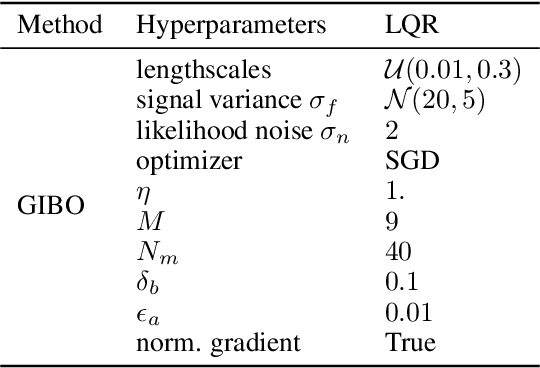
Reinforcement learning (RL) aims to find an optimal policy by interaction with an environment. Consequently, learning complex behavior requires a vast number of samples, which can be prohibitive in practice. Nevertheless, instead of systematically reasoning and actively choosing informative samples, policy gradients for local search are often obtained from random perturbations. These random samples yield high variance estimates and hence are sub-optimal in terms of sample complexity. Actively selecting informative samples is at the core of Bayesian optimization, which constructs a probabilistic surrogate of the objective from past samples to reason about informative subsequent ones. In this paper, we propose to join both worlds. We develop an algorithm utilizing a probabilistic model of the objective function and its gradient. Based on the model, the algorithm decides where to query a noisy zeroth-order oracle to improve the gradient estimates. The resulting algorithm is a novel type of policy search method, which we compare to existing black-box algorithms. The comparison reveals improved sample complexity and reduced variance in extensive empirical evaluations on synthetic objectives. Further, we highlight the benefits of active sampling on popular RL benchmarks.