 Add to Chrome
 Add to Firefox
 Add to Edge
A Context-Aware Middleware for Medical Image Based Reports: An approach based on image feature extraction and association rules
May 29, 2026
This work proposes a context-aware middleware for medical workflow organization and efficiency improvement. In hospitals, laboratories and teleradiology companies, each physician or technician is specialized in a specific kind of diagnosis or analysis. Therefore, certain types of medical images are often forwarded to a certain physician or a certain group. This forwarding is time consuming. That is, repeatedly deciding who would be the best physician, whether he is available at a certain moment given a certain context is exhaustive and may be very inefficient. Thus, the proposed middleware has the ability to process and collect data from images analyzed by each medical staff. Based on the collected data and current clinical context, the middleware is able to infer who would be the best fit staff to receive a certain incoming medical image.

Mathematical Morphology in Machine Learning
May 29, 2026This work introduces mathematical morphology-an established visual computing theory-into machine learning to exploit shape and density aspects often overlooked by standard techniques. We propose a fast clustering algorithm based on morphological reconstruction that accurately preserves cluster shapes and density. This scheme offers unique features: an intrinsic sense of maximal clusters, cost-free noise removal, and diverse growth patterns controlled by structuring elements.Additionally, we propose a novel distance metric combining Minkowski and Chebyshev distances, highly efficient for morphological dilations. In $Z^2$ discrete neighbourhood iterations, it is roughly 1.3 times faster than Manhattan and 329.5 times faster than Euclidean distances. When evaluated using a k-Nearest Neighbours (k-NN) classifier across 33 UCI datasets against 14 other distances, our metric achieved above-average accuracies most frequently (26 of 33 cases) and the best overall accuracy in 9 cases.Finally, we introduce novel morphological classifiers. Unlike current literature, this proposal uniquely models shape, density, and fractal information in datasets.
Fractal triangular search: a metaheuristic for image content search
May 20, 2026This work proposes a variable neighbourhood search (FTS) that uses a fractal-based local search primarily designed for images. Searching for specific content in images is posed as an optimisation problem, where evidence elements are expected to be present. Evidence elements improve the odds of finding the desired content and are closely associated to it in terms of spatial location. The proposed local search algorithm follows the fashion of a chain of triangles that engulf each other and grow indefinitely in a fractal fashion, while their orientation varies in each iteration. The authors carried out an extensive set of experiments, which confirmed that FTS outperforms state-of-the-art metaheuristics. On average, FTS was able to locate content faster, visiting less incorrect image locations. In the first group of experiments, FTS was faster in seven out of nine cases, being >8% faster on average, when compared to the second best search method. In the second group, FTS was faster in six out of seven cases, and it was >22% faster on average when compared to the approach ranked second best. FTS tends to outperform other metaheuristics substantially as the size of the image increases.
ELEMENT: Multi-Modal Retinal Vessel Segmentation Based on a Coupled Region Growing and Machine Learning Approach
May 19, 2026Vascular structures in the retina contain important information for the detection and analysis of ocular diseases, including age-related macular degeneration, diabetic retinopathy and glaucoma. Commonly used modalities in diagnosis of these diseases are fundus photography, scanning laser ophthalmoscope (SLO) and fluorescein angiography (FA). Typically, retinal vessel segmentation is carried out either manually or interactively, which makes it time consuming and prone to human errors. In this research, we propose a new multi-modal framework for vessel segmentation called ELEMENT (vEsseL sEgmentation using Machine lEarning and coNnecTivity). This framework consists of feature extraction and pixel-based classification using region growing and machine learning. The proposed features capture complementary evidence based on grey level and vessel connectivity properties. The latter information is seamlessly propagated through the pixels at the classification phase. ELEMENT reduces inconsistencies and speeds up the segmentation throughput. We analyze and compare the performance of the proposed approach against state-of-the-art vessel segmentation algorithms in three major groups of experiments, for each of the ocular modalities. Our method produced higher overall performance, with an overall accuracy of 97.40%, compared to 25 of the 26 state-of-the-art approaches, including six works based on deep learning, evaluated on the widely known DRIVE fundus image dataset. In the case of the STARE, CHASE-DB, VAMPIRE FA, IOSTAR SLO and RC-SLO datasets, the proposed framework outperformed all of the state-of-the-art methods with accuracies of 98.27%, 97.78%, 98.34%, 98.04% and 98.35%, respectively.
DM-CFO: A Diffusion Model for Compositional 3D Tooth Generation with Collision-Free Optimization
Mar 04, 2026The automatic design of a 3D tooth model plays a crucial role in dental digitization. However, current approaches face challenges in compositional 3D tooth generation because both the layouts and shapes of missing teeth need to be optimized.In addition, collision conflicts are often omitted in 3D Gaussian-based compositional 3D generation, where objects may intersect with each other due to the absence of explicit geometric information on the object surfaces. Motivated by graph generation through diffusion models and collision detection using 3D Gaussians, we propose an approach named DM-CFO for compositional tooth generation, where the layout of missing teeth is progressively restored during the denoising phase under both text and graph constraints. Then, the Gaussian parameters of each layout-guided tooth and the entire jaw are alternately updated using score distillation sampling (SDS). Furthermore, a regularization term based on the distances between the 3D Gaussians of neighboring teeth and the anchor tooth is introduced to penalize tooth intersections. Experimental results on three tooth-design datasets demonstrate that our approach significantly improves the multiview consistency and realism of the generated teeth compared with existing methods. Project page: https://amateurc.github.io/CF-3DTeeth/.
On the Automated Segmentation of Epicardial and Mediastinal Cardiac Adipose Tissues Using Classification Algorithms
Aug 30, 2022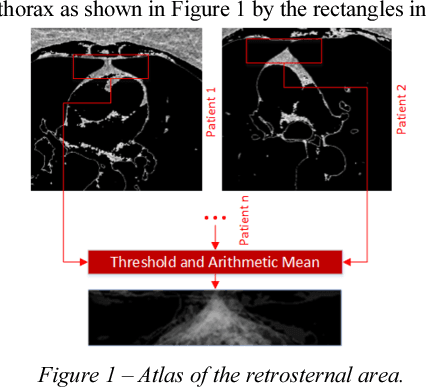
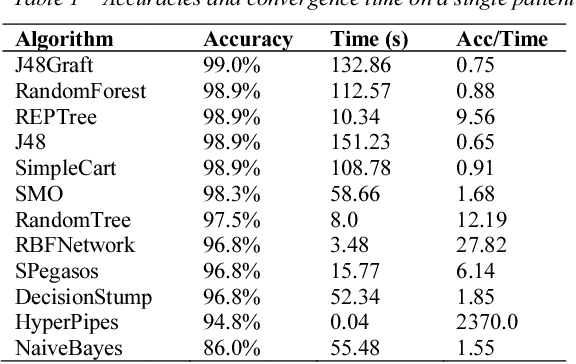
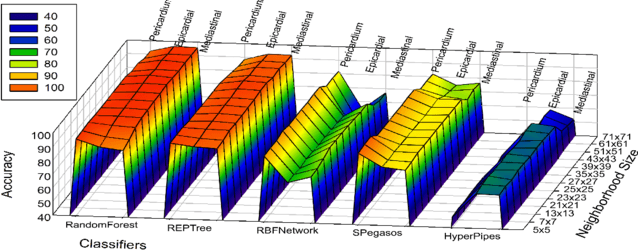
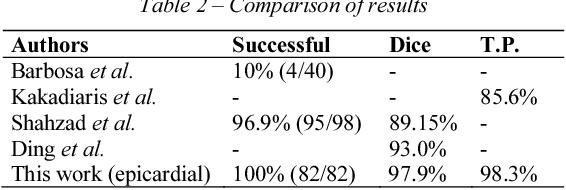
The quantification of fat depots on the surroundings of the heart is an accurate procedure for evaluating health risk factors correlated with several diseases. However, this type of evaluation is not widely employed in clinical practice due to the required human workload. This work proposes a novel technique for the automatic segmentation of cardiac fat pads. The technique is based on applying classification algorithms to the segmentation of cardiac CT images. Furthermore, we extensively evaluate the performance of several algorithms on this task and discuss which provided better predictive models. Experimental results have shown that the mean accuracy for the classification of epicardial and mediastinal fats has been 98.4% with a mean true positive rate of 96.2%. On average, the Dice similarity index, regarding the segmented patients and the ground truth, was equal to 96.8%. Therfore, our technique has achieved the most accurate results for the automatic segmentation of cardiac fats, to date.
A novel approach for the automated segmentation and volume quantification of cardiac fats on computed tomography
Dec 21, 2021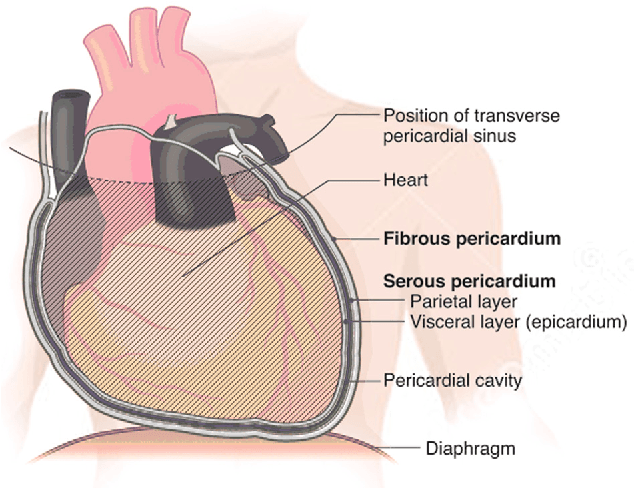
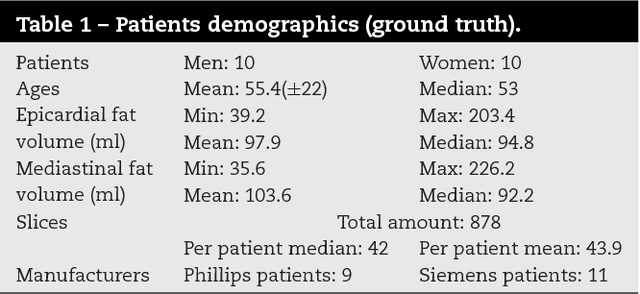
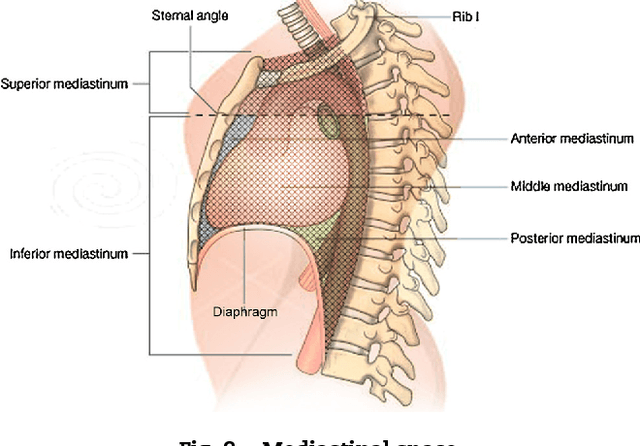
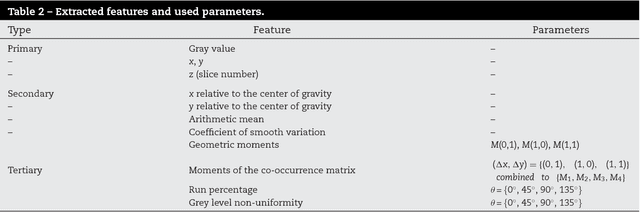
The deposits of fat on the surroundings of the heart are correlated to several health risk factors such as atherosclerosis, carotid stiffness, coronary artery calcification, atrial fibrillation and many others. These deposits vary unrelated to obesity, which reinforces its direct segmentation for further quantification. However, manual segmentation of these fats has not been widely deployed in clinical practice due to the required human workload and consequential high cost of physicians and technicians. In this work, we propose a unified method for an autonomous segmentation and quantification of two types of cardiac fats. The segmented fats are termed epicardial and mediastinal, and stand apart from each other by the pericardium. Much effort was devoted to achieve minimal user intervention. The proposed methodology mainly comprises registration and classification algorithms to perform the desired segmentation. We compare the performance of several classification algorithms on this task, including neural networks, probabilistic models and decision tree algorithms. Experimental results of the proposed methodology have shown that the mean accuracy regarding both epicardial and mediastinal fats is 98.5% (99.5% if the features are normalized), with a mean true positive rate of 98.0%. In average, the Dice similarity index was equal to 97.6%.