 Add to Chrome
 Add to Firefox
 Add to Edge
CoinVE-200K: A Large-Scale High-Quality Dataset for Compositional Instruction-Guided Video Editing
Aug 18, 2026
The quality and diversity of instruction-based video editing datasets are steadily improving, yet existing datasets mainly focus on single editing operations and fall short in supporting compositional instruction-guided video editing. In particular, multiple editing intents must be jointly understood and faithfully executed within the same video. To address this issue, we introduce CoinVE-200K, a large-scale, high-quality dataset for Compositional Instruction-Guided Video Editing. CoinVE-200K contains 1080p video-editing pairs of up to 201 frames, covering diverse compositional scenarios where each sample involves 2 to 5 atomic editing operations. The instructions target humans, objects, and backgrounds, and cover edit types such as addition, removal, modification, and stylization. All samples are built through a carefully designed generation and filtering pipeline to ensure instruction faithfulness, visual quality, temporal consistency, and compositional diversity. We also introduce CoinVE-Bench, a benchmark for compositional-instruction video editing across diverse subjects, operation types, and instruction complexities. Furthermore, we present CoinVE-Edit, a 22B compositional video editing model built upon Wan2.1-T2V-14B and Qwen3-VL-8B-Instruct. CoinVE-Edit disentangles region-aware attention for different editing instructions, enabling precise multi-region editing while preserving irrelevant content and temporal coherence. Experiments on CoinVE-Bench show that CoinVE-Edit achieves strong performance in instruction following, compositional editing accuracy, visual quality, and temporal consistency.

FADE: A Dataset for Detecting Falling Objects around Buildings in Video
Aug 11, 2024

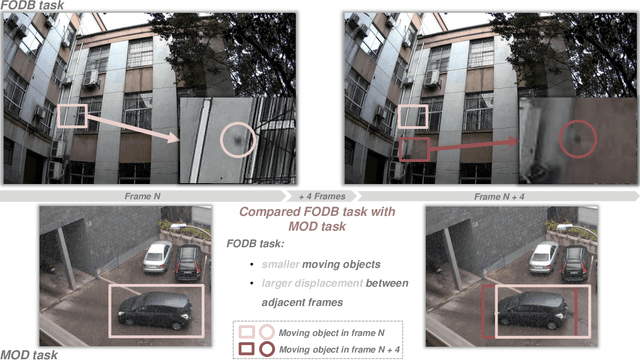
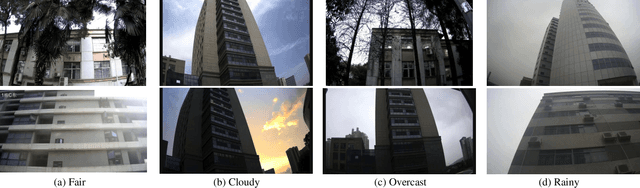
Falling objects from buildings can cause severe injuries to pedestrians due to the great impact force they exert. Although surveillance cameras are installed around some buildings, it is challenging for humans to capture such events in surveillance videos due to the small size and fast motion of falling objects, as well as the complex background. Therefore, it is necessary to develop methods to automatically detect falling objects around buildings in surveillance videos. To facilitate the investigation of falling object detection, we propose a large, diverse video dataset called FADE (FAlling Object DEtection around Buildings) for the first time. FADE contains 1,881 videos from 18 scenes, featuring 8 falling object categories, 4 weather conditions, and 4 video resolutions. Additionally, we develop a new object detection method called FADE-Net, which effectively leverages motion information and produces small-sized but high-quality proposals for detecting falling objects around buildings. Importantly, our method is extensively evaluated and analyzed by comparing it with the previous approaches used for generic object detection, video object detection, and moving object detection on the FADE dataset. Experimental results show that the proposed FADE-Net significantly outperforms other methods, providing an effective baseline for future research. The dataset and code are publicly available at https://fadedataset.github.io/FADE.github.io/.