 Add to Chrome
 Add to Firefox
 Add to Edge
CoinVE-200K: A Large-Scale High-Quality Dataset for Compositional Instruction-Guided Video Editing
Aug 18, 2026
The quality and diversity of instruction-based video editing datasets are steadily improving, yet existing datasets mainly focus on single editing operations and fall short in supporting compositional instruction-guided video editing. In particular, multiple editing intents must be jointly understood and faithfully executed within the same video. To address this issue, we introduce CoinVE-200K, a large-scale, high-quality dataset for Compositional Instruction-Guided Video Editing. CoinVE-200K contains 1080p video-editing pairs of up to 201 frames, covering diverse compositional scenarios where each sample involves 2 to 5 atomic editing operations. The instructions target humans, objects, and backgrounds, and cover edit types such as addition, removal, modification, and stylization. All samples are built through a carefully designed generation and filtering pipeline to ensure instruction faithfulness, visual quality, temporal consistency, and compositional diversity. We also introduce CoinVE-Bench, a benchmark for compositional-instruction video editing across diverse subjects, operation types, and instruction complexities. Furthermore, we present CoinVE-Edit, a 22B compositional video editing model built upon Wan2.1-T2V-14B and Qwen3-VL-8B-Instruct. CoinVE-Edit disentangles region-aware attention for different editing instructions, enabling precise multi-region editing while preserving irrelevant content and temporal coherence. Experiments on CoinVE-Bench show that CoinVE-Edit achieves strong performance in instruction following, compositional editing accuracy, visual quality, and temporal consistency.

3rd Place: A Global and Local Dual Retrieval Solution to Facebook AI Image Similarity Challenge
Dec 29, 2021
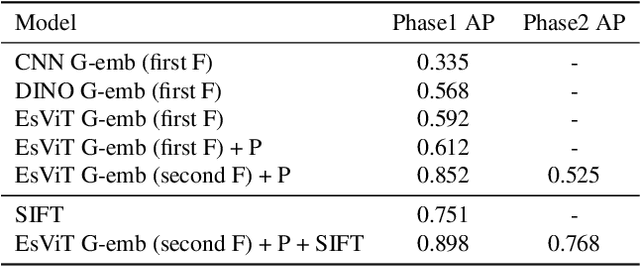
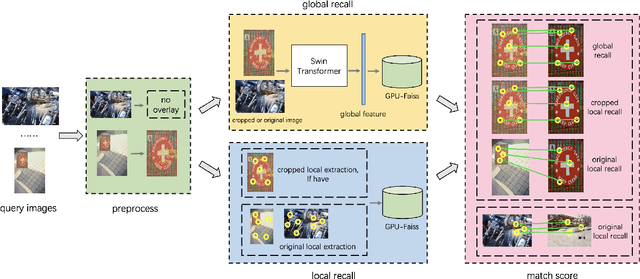
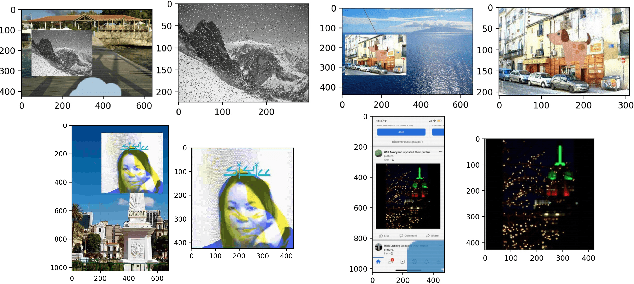
As a basic task of computer vision, image similarity retrieval is facing the challenge of large-scale data and image copy attacks. This paper presents our 3rd place solution to the matching track of Image Similarity Challenge (ISC) 2021 organized by Facebook AI. We propose a multi-branch retrieval method of combining global descriptors and local descriptors to cover all attack cases. Specifically, we attempt many strategies to optimize global descriptors, including abundant data augmentations, self-supervised learning with a single Transformer model, overlay detection preprocessing. Moreover, we introduce the robust SIFT feature and GPU Faiss for local retrieval which makes up for the shortcomings of the global retrieval. Finally, KNN-matching algorithm is used to judge the match and merge scores. We show some ablation experiments of our method, which reveals the complementary advantages of global and local features.
Semi-supervised Breast Lesion Detection in Ultrasound Video Based on Temporal Coherence
Jul 16, 2019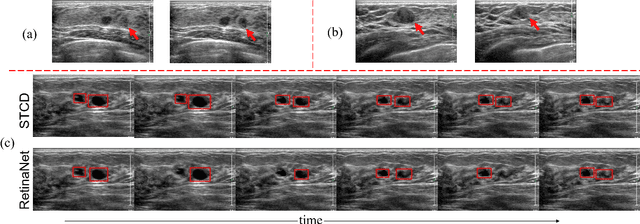
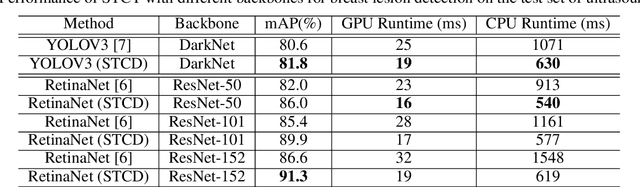
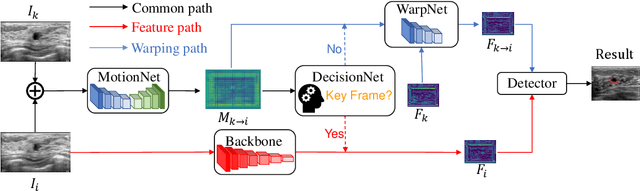
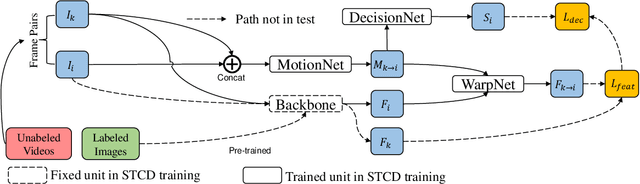
Breast lesion detection in ultrasound video is critical for computer-aided diagnosis. However, detecting lesion in video is quite challenging due to the blurred lesion boundary, high similarity to soft tissue and lack of video annotations. In this paper, we propose a semi-supervised breast lesion detection method based on temporal coherence which can detect the lesion more accurately. We aggregate features extracted from the historical key frames with adaptive key-frame scheduling strategy. Our proposed method accomplishes the unlabeled videos detection task by leveraging the supervision information from a different set of labeled images. In addition, a new WarpNet is designed to replace both the traditional spatial warping and feature aggregation operation, leading to a tremendous increase in speed. Experiments on 1,060 2D ultrasound sequences demonstrate that our proposed method achieves state-of-the-art video detection result as 91.3% in mean average precision and 19 ms per frame on GPU, compared to a RetinaNet based detection method in 86.6% and 32 ms.