 Add to Chrome
 Add to Firefox
 Add to Edge
AURORA: Asymmetry and Update-Induced Rotation for Robust Hallucination Detection in Large Language Models
Jun 28, 2026
Large Language Models (LLMs) have demonstrated remarkable capabilities across a wide range of natural language processing tasks. However, their tendency to generate hallucinations, namely factually incorrect or unfaithful outputs, poses a critical obstacle to their deployment in high-stakes applications. Although recent hallucination detection methods have made encouraging progress, they typically rely on costly output-level consistency checks or static hidden-state probes that capture shallow dataset-specific patterns, leading to substantial degradation under cross-dataset evaluation. In this work, we propose AURORA, a novel hallucination detection framework that shifts the focus from static representations to the weight-gradient dynamics of LLMs. Our key insight is that hallucinated and faithful answers induce qualitatively different gradient update patterns on the model's parameters. Specifically, hallucinated samples trigger asymmetric and structurally misaligned gradients, which can be captured through two complementary features: (1) the skewness of the cosine similarity distribution between weight matrices and their gradient update directions, and (2) the rotation ratio, which quantifies how much the gradient update reorients the singular-vector basis of weight matrices via SVD. AURORA achieves strong hallucination detection performance across four model families and four benchmark datasets. Further analyses demonstrate that our method scales effectively across model sizes and transfers to out-of-domain tasks, including mathematical reasoning and vision-language scenarios.

GPR: Towards a Generative Pre-trained One-Model Paradigm for Large-Scale Advertising Recommendation
Nov 13, 2025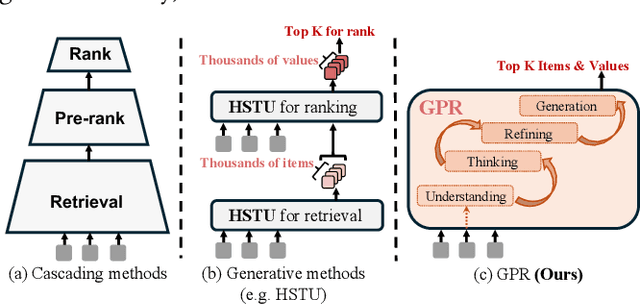
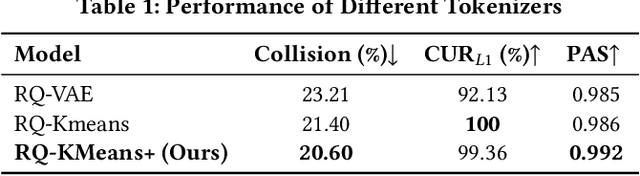
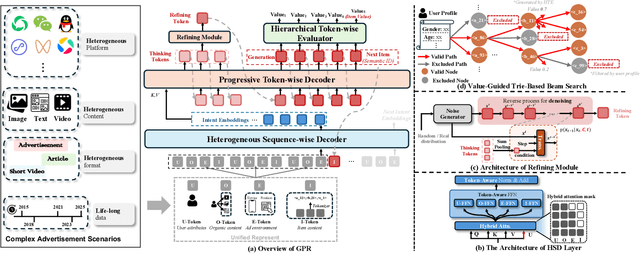
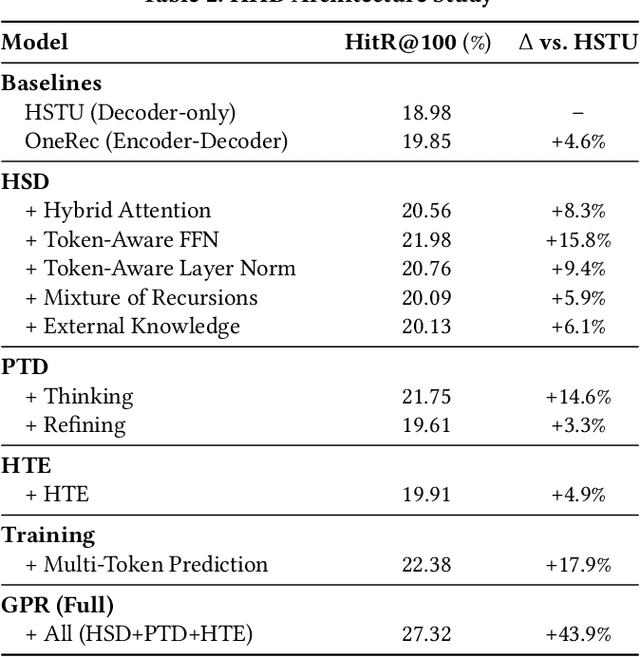
As an intelligent infrastructure connecting users with commercial content, advertising recommendation systems play a central role in information flow and value creation within the digital economy. However, existing multi-stage advertising recommendation systems suffer from objective misalignment and error propagation, making it difficult to achieve global optimality, while unified generative recommendation models still struggle to meet the demands of practical industrial applications. To address these issues, we propose GPR (Generative Pre-trained Recommender), the first one-model framework that redefines advertising recommendation as an end-to-end generative task, replacing the traditional cascading paradigm with a unified generative approach. To realize GPR, we introduce three key innovations spanning unified representation, network architecture, and training strategy. First, we design a unified input schema and tokenization method tailored to advertising scenarios, mapping both ads and organic content into a shared multi-level semantic ID space, thereby enhancing semantic alignment and modeling consistency across heterogeneous data. Second, we develop the Heterogeneous Hierarchical Decoder (HHD), a dual-decoder architecture that decouples user intent modeling from ad generation, achieving a balance between training efficiency and inference flexibility while maintaining strong modeling capacity. Finally, we propose a multi-stage joint training strategy that integrates Multi-Token Prediction (MTP), Value-Aware Fine-Tuning and the Hierarchy Enhanced Policy Optimization (HEPO) algorithm, forming a complete generative recommendation pipeline that unifies interest modeling, value alignment, and policy optimization. GPR has been fully deployed in the Tencent Weixin Channels advertising system, delivering significant improvements in key business metrics including GMV and CTCVR.
A Federated Splitting Framework for LLMs: Security, Efficiency, and Adaptability
May 21, 2025Private data is typically larger and of higher quality than public data, offering great potential to improve LLM. However, its scattered distribution across data silos and the high computational demands of LLMs limit their deployment in federated environments. To address this, the transformer-based split learning model has emerged, offloading most model parameters to the server while retaining only the embedding and output layers on clients to ensure privacy. However, it still faces significant challenges in security, efficiency, and adaptability: 1) embedding gradients are vulnerable to attacks, leading to reverse engineering of private data; 2) the autoregressive nature of LLMs means that federated split learning can only train and infer sequentially, causing high communication overhead; 3) fixed partition points lack adaptability to downstream tasks. In this paper, we introduce FL-LLaMA, a secure, efficient, and adaptive federated split framework based on LLaMA2. First, we place some input and output blocks on the local client and inject Gaussian noise into forward-pass hidden states, enabling secure end-to-end propagation. Second, we employ client-batch and server-hierarchical strategies to achieve parallel training, along with attention-mask compression and KV cache mechanisms to accelerate inference, reducing communication costs effectively. Third, we allow users to dynamically adjust the partition points for input/output blocks based on specific task requirements and hardware limitations. Experiments on NLU, summarization and conversational QA tasks show that FL-LLaMA maintains performance comparable to centralized LLaMA2, and achieves up to 2x train speedups and 8x inference speedups. Further analysis of privacy attacks and different partition points also demonstrates the effectiveness of FL-LLaMA in security and adaptability.