 Add to Chrome
 Add to Firefox
 Add to Edge
SLAI T-Rex: Full-Parameter Post-training of the DeepSeek-V4 Family on Ascend SuperPOD
Jul 22, 2026
Full-parameter post-training of trillion-parameter-scale MoE models introduces substantial system-level challenges for large-scale distributed training, including severe memory pressure, non-overlapped communication overhead, and inefficient kernel execution. While most large-scale LLM training systems are built around GPU-based clusters, this report presents an end-to-end optimization practice on the Ascend NPU SuperPOD. Using the DeepSeek-V4 model family as the target workload, we develop a hierarchical optimization framework spanning model-level parallelism, computation-communication orchestration, and low-level kernel execution. The resulting system achieves 34.22% Model FLOPs Utilization (MFU) with a 2.93x improvement over the open-source baseline recipe while maintaining training stability. Building on this optimized infrastructure, we further establish a CPT and SFT workflow for complex Operations Research (OR) tasks. We refer to the integrated framework as SLAI T-Rex. Using DeepSeek-V4-Flash, we develop OR-oriented CPT and SFT data pipelines that combine collected domain resources with solver-verified synthetic optimization documents. The resulting dataset contains 10K high-quality SFT samples spanning four task categories and three problem representations. The specialized model achieves the highest average zero-shot Pass@1 score among the evaluated models, reaching 71.81% and outperforming GPT-5.4-Mini and the base DeepSeek-V4-Flash model by 3.98 and 11.27 percentage points, respectively. Overall, this work demonstrates a full-stack pathway from efficient trillion-parameter model post-training on Ascend infra to domain-specialized Flash models for solver-grounded mathematical modeling, advancing frontier-model systems for complex reasoning.

GatedCLIP: Gated Multimodal Fusion for Hateful Memes Detection
Feb 24, 2026Detecting hateful content in multimodal memes presents unique challenges, as harmful messages often emerge from the complex interplay between benign images and text. We propose GatedCLIP, a Vision-Language model that enhances CLIP's multimodal capabilities with specialized architectural improvements for hateful memes detection. Our approach introduces learned projection heads that map CLIP embeddings to a task-optimized semantic space, a dynamic gated fusion mechanism that adaptively weights visual and textual features, and a contrastive learning objective that maintains cross-modal semantic alignment. Experiments on the Hateful Memes dataset demonstrate that GatedCLIP achieves an AUROC of 0.66, substantially outperforming the CLIP baseline (AUROC 0.49) while maintaining computational efficiency with only 350K trainable parameters.
FrontierCS: Evolving Challenges for Evolving Intelligence
Dec 17, 2025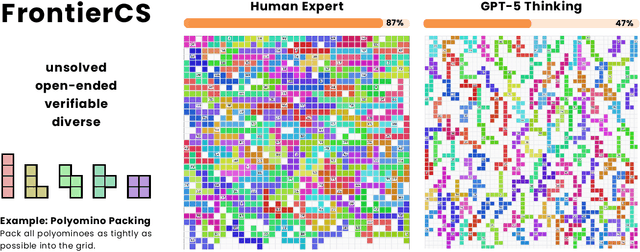

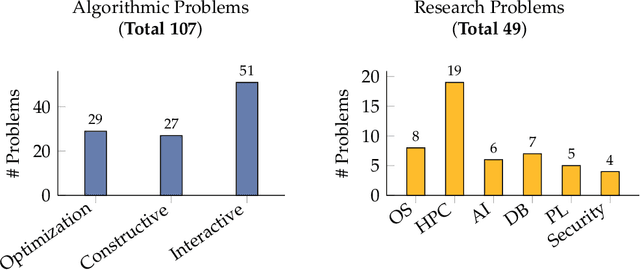

We introduce FrontierCS, a benchmark of 156 open-ended problems across diverse areas of computer science, designed and reviewed by experts, including CS PhDs and top-tier competitive programming participants and problem setters. Unlike existing benchmarks that focus on tasks with known optimal solutions, FrontierCS targets problems where the optimal solution is unknown, but the quality of a solution can be objectively evaluated. Models solve these tasks by implementing executable programs rather than outputting a direct answer. FrontierCS includes algorithmic problems, which are often NP-hard variants of competitive programming problems with objective partial scoring, and research problems with the same property. For each problem we provide an expert reference solution and an automatic evaluator. Combining open-ended design, measurable progress, and expert curation, FrontierCS provides a benchmark at the frontier of computer-science difficulty. Empirically, we find that frontier reasoning models still lag far behind human experts on both the algorithmic and research tracks, that increasing reasoning budgets alone does not close this gap, and that models often over-optimize for generating merely workable code instead of discovering high-quality algorithms and system designs.