 Add to Chrome
 Add to Firefox
 Add to Edge
RoboSynChallenge: Mastering Real-World Dexterity via Generalizing Synthesized Manipulation Skills
Aug 12, 2026
Achieving generalizable robotic manipulation remains a central challenge in embodied intelligence. Despite rapid advances in model architectures and learning algorithms, progress is often limited by the scarcity and narrow diversity of real-world data. The RoboSynChallenge competition introduces a unified benchmark to evaluate and advance the generalizability of manipulation policies across a spectrum of tasks, environments, and difficulty levels. To alleviate the shortage of realistic data, the challenge integrates large-scale synthetic data generation with standardized real-world robotic evaluation. Participants are encouraged to leverage synthesized state-action trials to improve general-purpose policy learning, while final assessments are conducted exclusively on unseen real-world manipulation environments. Baseline implementations, including Transformer-, Diffusion-, Vision-Language-Action, and World-Action-Model-based policies, are provided to ensure reproducibility and comparability. By coupling scalable simulation-based training with rigorous real-world validation, RoboSynChallenge aims to foster the development of broadly capable, data-efficient, and adaptable manipulation systems, thereby paving the way toward truly general robotic intelligence.

Mind the Unseen Mass: Unmasking LLM Hallucinations via Soft-Hybrid Alphabet Estimation
Apr 21, 2026This paper studies uncertainty quantification for large language models (LLMs) under black-box access, where only a small number of responses can be sampled for each query. In this setting, estimating the effective semantic alphabet size--that is, the number of distinct meanings expressed in the sampled responses--provides a useful proxy for downstream risk. However, frequency-based estimators tend to undercount rare semantic modes when the sample size is small, while graph-spectral quantities alone are not designed to estimate semantic occupancy accurately. To address this issue, we propose SHADE (Soft-Hybrid Alphabet Dynamic Estimator), a simple and interpretable estimator that combines Generalized Good-Turing coverage with a heat-kernel trace of the normalized Laplacian constructed from an entailment-weighted graph over sampled responses. The estimated coverage adaptively determines the fusion rule: under high coverage, SHADE uses a convex combination of the two signals, while under low coverage it applies a LogSumExp fusion to emphasize missing or weakly observed semantic modes. A finite-sample correction is then introduced to stabilize the resulting cardinality estimate before converting it into a coverage-adjusted semantic entropy score. Experiments on pooled semantic alphabet-size estimation against large-sample references and on QA incorrectness detection show that SHADE achieves the strongest improvements in the most sample-limited regime, while the performance gap narrows as the number of samples increases. These results suggest that hybrid semantic occupancy estimation is particularly beneficial when black-box uncertainty quantification must operate under tight sampling budgets.
GatedCLIP: Gated Multimodal Fusion for Hateful Memes Detection
Feb 24, 2026Detecting hateful content in multimodal memes presents unique challenges, as harmful messages often emerge from the complex interplay between benign images and text. We propose GatedCLIP, a Vision-Language model that enhances CLIP's multimodal capabilities with specialized architectural improvements for hateful memes detection. Our approach introduces learned projection heads that map CLIP embeddings to a task-optimized semantic space, a dynamic gated fusion mechanism that adaptively weights visual and textual features, and a contrastive learning objective that maintains cross-modal semantic alignment. Experiments on the Hateful Memes dataset demonstrate that GatedCLIP achieves an AUROC of 0.66, substantially outperforming the CLIP baseline (AUROC 0.49) while maintaining computational efficiency with only 350K trainable parameters.
MFAS: Emotion Recognition through Multiple Perspectives Fusion Architecture Search Emulating Human Cognition
Jun 12, 2023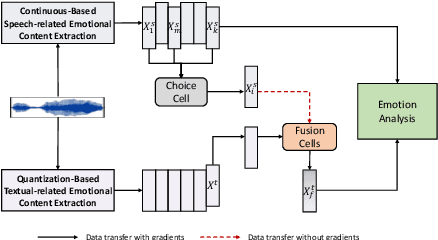

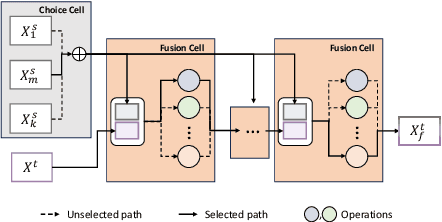
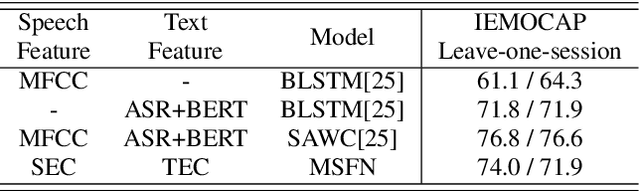
Speech emotion recognition aims to identify and analyze emotional states in target speech similar to humans. Perfect emotion recognition can greatly benefit a wide range of human-machine interaction tasks. Inspired by the human process of understanding emotions, we demonstrate that compared to quantized modeling, understanding speech content from a continuous perspective, akin to human-like comprehension, enables the model to capture more comprehensive emotional information. Additionally, considering that humans adjust their perception of emotional words in textual semantic based on certain cues present in speech, we design a novel search space and search for the optimal fusion strategy for the two types of information. Experimental results further validate the significance of this perception adjustment. Building on these observations, we propose a novel framework called Multiple perspectives Fusion Architecture Search (MFAS). Specifically, we utilize continuous-based knowledge to capture speech semantic and quantization-based knowledge to learn textual semantic. Then, we search for the optimal fusion strategy for them. Experimental results demonstrate that MFAS surpasses existing models in comprehensively capturing speech emotion information and can automatically adjust fusion strategy.