 Add to Chrome
 Add to Firefox
 Add to Edge
Information Bottleneck Learning for Faithful Time Series Forecasting Explanations
Jul 30, 2026
As forecasts increasingly drive decisions in fields such as energy, transportation, and healthcare, understanding the historical data behind these predictions has become as crucial as the predictions themselves. Although existing interpretable-by-design forecasters reveal their internal structures, they offer no guarantee that these structures faithfully reflect the underlying evidence driving the predictions. In contrast, while faithfulness-oriented methods explicitly verify model behavior, they are almost exclusively designed for post-hoc classification tasks. To bridge this gap, we propose IB-Forecast, an inherently interpretable multivariate time-series forecasting framework. It decomposes forecasting into a learned periodic component and a residual component computed with explainable masks over input tokens. With a budget-constrained information bottleneck, end-to-end optimization enables users to directly control explanation sparsity. With a rigorous faithfulness evaluation protocol, extensive experiments demonstrate that IB-Forecast matches the forecasting error of leading black-box models while providing faithful explanations at no additional inference cost. Furthermore, under a matched sparsity budget, these native explanations consistently surpass gradient-based, occlusion-based, and optimization-based baselines across all evaluated datasets. Ultimately, whereas the native explanations of existing interpretable forecasters exhibit poor faithfulness, IB-Forecast guarantees high explanation fidelity, requiring only 14-20% of the observations to deliver low-error predictions.

Leveraging Trajectory Graphs for Pre-Execution Error Diagnosis in Agentic LLM Systems
Jul 29, 2026Large Language Model~(LLM)-based agents have demonstrated exceptional performance across a wide range of complex interactive tasks. However, they often struggle with long-horizon interactive tasks common in domains, such as embodied AI. The complexity and vast action spaces in these settings lead to compounding errors, where a single suboptimal action can derail an entire trajectory, causing the agent to exhaust its limited step budget on inefficient or unrecoverable paths. To overcome this without costly fine-tuning, we draw inspiration from software debugging, where execution logs are analyzed to preemptively catch errors. We propose \textit{Trajectory Graph Copilot}, a novel framework that acts as a ``copilot'' for LLM agents by diagnosing potential action errors before they are executed. At its core,\textit{Graph Debugger} models historical trajectories as a probabilistic graph and uses a Graph Neural Network to identify sequential action patterns that frequently lead to failure. Functioning as a proactive diagnostic sandbox, our method provides early warnings on potentially flawed actions, prompting the agent to self-correct. This pre-action error diagnosis prevents costly mistakes, significantly enhancing the agent's ability to complete long-horizon tasks successfully. The extensive experiments on four benchmarks with three LLM agents demonstrate a $14.69\%$ pass ratio improvement on average.
Bridging Inference-Time Scaling and Episodic Memory with Action-Centric Graphs
Jul 29, 2026Recent advancements in inference-time scaling have significantly unlocked the complex reasoning capabilities of Large Language Models~(LLMs). However, for agents, these approaches suffer from a critical inefficiency, operating in a stateless manner and engaging in redundant search processes. Existing memory mechanisms largely rely on the reasoning capabilities of LLMs, leading to prohibitive computational costs. In this paper, we propose a novel framework, \textit{GAMER}~(Graph-based Action-centric Memory with Episodic Reasoning), that bridges the gap between inference scaling and episodic memory. Our approach models historical reasoning as a dynamic \textit{Action-Centric Graph}. By decoupling the memory mechanism from LLMs, our method can save token/money usage by providing less memory context than memory mechanism baselines. To extract knowledge from the graph effectively, we use a dual-stream Temporal Difference learning mechanism to estimate the positive~(suggestion) and negative~(avoidance) value of action nodes based on past successes and failures. During the inference phase, this learned value function optimizes decision-making bi-directionally, so that positive values provide action suggestions, while negative values indicate high-risk actions. By performing efficient searches on the graph, our method significantly improves the efficiency of inference scaling. Experiments on multiple benchmarks demonstrate that \textit{GAMER} achieves superior performance by \textbf{20.81\%/6.17\%} for success/progress rate compared to vanilla baselines.
DecoSearch: Complexity-Aware Routing and Plan-Level Repair for Text-to-SQL
Jun 16, 2026Large Language Models (LLMs) have demonstrated remarkable capabilities in translating natural language to SQL, yet existing methods still falter on complex queries requiring multi-step, data-aware reasoning. We introduce DecoSearch, a training-free framework that addresses this by routing each query to the appropriate level of reasoning effort. A lightweight Schema Selector first prunes the full database schema to the relevant tables and columns. An LLM Judger then decides whether the question requires decomposition: straightforward questions follow a direct generation path and complex ones are escalated to a Directed Acyclic Graph (DAG) of atomic sub-questions, each solved by a targeted SQL generation step. A RAG component grounds the decomposer with semantically similar training examples, and a Topology Refiner restructures the reasoning plan when execution failures signal a flawed decomposition rather than a fixable SQL error. DecoSearch achieves 70.53% execution accuracy on BIRD and 88.31% on Spider with a DeepSeek backbone, surpassing all training-free baselines while consuming an order of magnitude fewer tokens than competing methods. It also functions as a model-agnostic wrapper, consistently improving fine-tuned SQL generation backbones without any modification to the pipeline.
Time Series Reasoning via Process-Verifiable Thinking Data Synthesis and Scheduling for Tailored LLM Reasoning
Feb 08, 2026Time series is a pervasive data type across various application domains, rendering the reasonable solving of diverse time series tasks a long-standing goal. Recent advances in large language models (LLMs), especially their reasoning abilities unlocked through reinforcement learning (RL), have opened new opportunities for tackling tasks with long Chain-of-Thought (CoT) reasoning. However, leveraging LLM reasoning for time series remains in its infancy, hindered by the absence of carefully curated time series CoT data for training, limited data efficiency caused by underexplored data scheduling, and the lack of RL algorithms tailored for exploiting such time series CoT data. In this paper, we introduce VeriTime, a framework that tailors LLMs for time series reasoning through data synthesis, data scheduling, and RL training. First, we propose a data synthesis pipeline that constructs a TS-text multimodal dataset with process-verifiable annotations. Second, we design a data scheduling mechanism that arranges training samples according to a principled hierarchy of difficulty and task taxonomy. Third, we develop a two-stage reinforcement finetuning featuring fine-grained, multi-objective rewards that leverage verifiable process-level CoT data. Extensive experiments show that VeriTime substantially boosts LLM performance across diverse time series reasoning tasks. Notably, it enables compact 3B, 4B models to achieve reasoning capabilities on par with or exceeding those of larger proprietary LLMs.
LM$^2$otifs : An Explainable Framework for Machine-Generated Texts Detection
May 18, 2025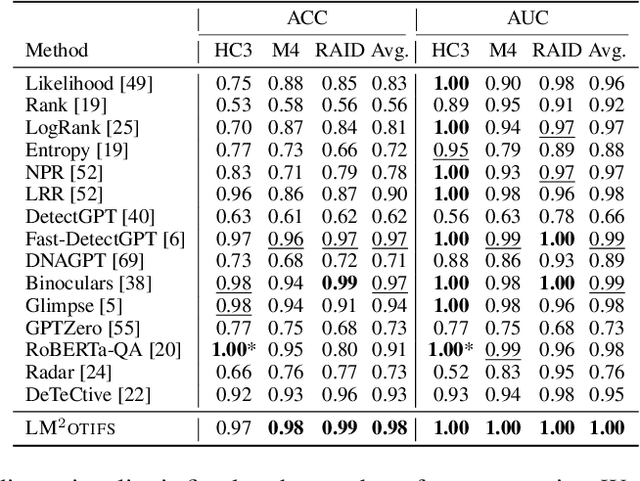
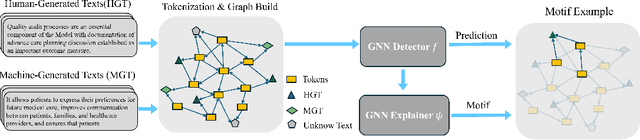
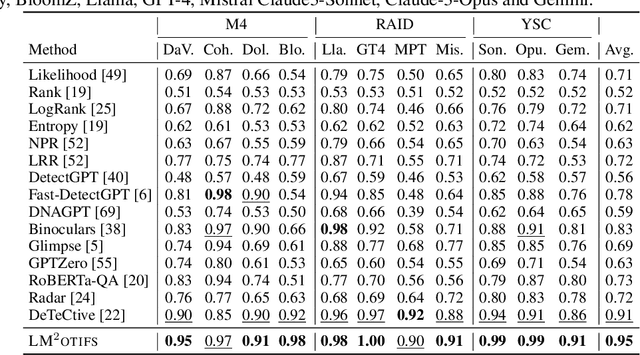
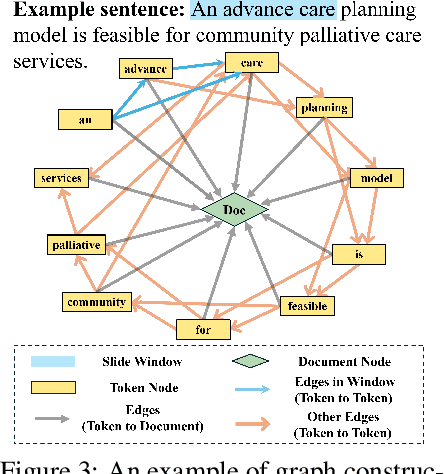
The impressive ability of large language models to generate natural text across various tasks has led to critical challenges in authorship authentication. Although numerous detection methods have been developed to differentiate between machine-generated texts (MGT) and human-generated texts (HGT), the explainability of these methods remains a significant gap. Traditional explainability techniques often fall short in capturing the complex word relationships that distinguish HGT from MGT. To address this limitation, we present LM$^2$otifs, a novel explainable framework for MGT detection. Inspired by probabilistic graphical models, we provide a theoretical rationale for the effectiveness. LM$^2$otifs utilizes eXplainable Graph Neural Networks to achieve both accurate detection and interpretability. The LM$^2$otifs pipeline operates in three key stages: first, it transforms text into graphs based on word co-occurrence to represent lexical dependencies; second, graph neural networks are used for prediction; and third, a post-hoc explainability method extracts interpretable motifs, offering multi-level explanations from individual words to sentence structures. Extensive experiments on multiple benchmark datasets demonstrate the comparable performance of LM$^2$otifs. The empirical evaluation of the extracted explainable motifs confirms their effectiveness in differentiating HGT and MGT. Furthermore, qualitative analysis reveals distinct and visible linguistic fingerprints characteristic of MGT.
Explanation-Preserving Augmentation for Semi-Supervised Graph Representation Learning
Oct 16, 2024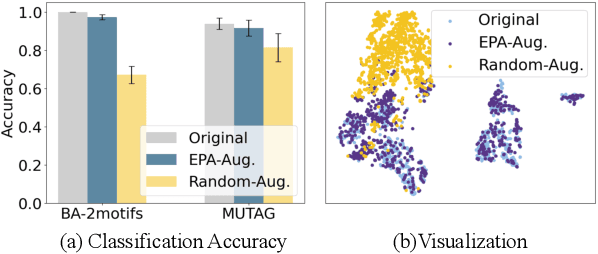
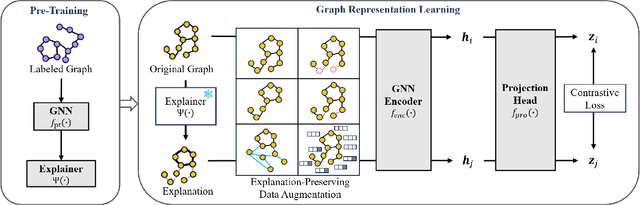
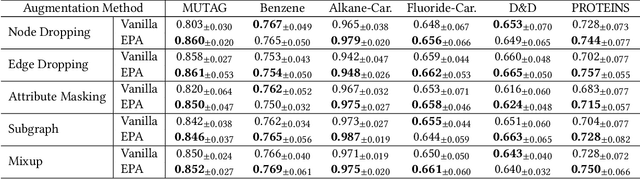
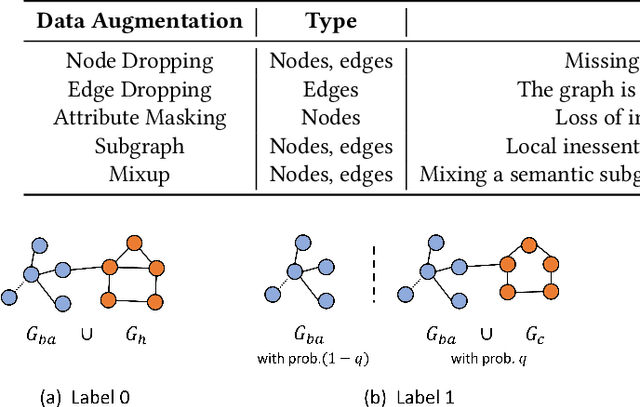
Graph representation learning (GRL), enhanced by graph augmentation methods, has emerged as an effective technique achieving performance improvements in wide tasks such as node classification and graph classification. In self-supervised GRL, paired graph augmentations are generated from each graph. Its objective is to infer similar representations for augmentations of the same graph, but maximally distinguishable representations for augmentations of different graphs. Analogous to image and language domains, the desiderata of an ideal augmentation method include both (1) semantics-preservation; and (2) data-perturbation; i.e., an augmented graph should preserve the semantics of its original graph while carrying sufficient variance. However, most existing (un-)/self-supervised GRL methods focus on data perturbation but largely neglect semantics preservation. To address this challenge, in this paper, we propose a novel method, Explanation-Preserving Augmentation (EPA), that leverages graph explanation techniques for generating augmented graphs that can bridge the gap between semantics-preservation and data-perturbation. EPA first uses a small number of labels to train a graph explainer to infer the sub-structures (explanations) that are most relevant to a graph's semantics. These explanations are then used to generate semantics-preserving augmentations for self-supervised GRL, namely EPA-GRL. We demonstrate theoretically, using an analytical example, and through extensive experiments on a variety of benchmark datasets that EPA-GRL outperforms the state-of-the-art (SOTA) GRL methods, which are built upon semantics-agnostic data augmentations.
F-Fidelity: A Robust Framework for Faithfulness Evaluation of Explainable AI
Oct 03, 2024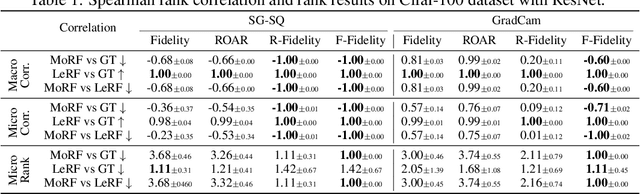
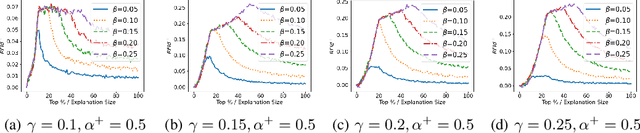
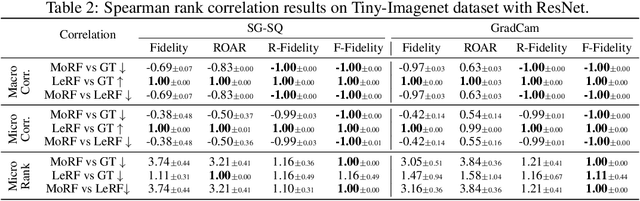
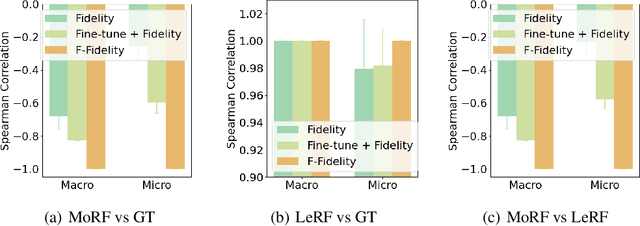
Recent research has developed a number of eXplainable AI (XAI) techniques. Although extracting meaningful insights from deep learning models, how to properly evaluate these XAI methods remains an open problem. The most widely used approach is to perturb or even remove what the XAI method considers to be the most important features in an input and observe the changes in the output prediction. This approach although efficient suffers the Out-of-Distribution (OOD) problem as the perturbed samples may no longer follow the original data distribution. A recent method RemOve And Retrain (ROAR) solves the OOD issue by retraining the model with perturbed samples guided by explanations. However, the training may not always converge given the distribution difference. Furthermore, using the model retrained based on XAI methods to evaluate these explainers may cause information leakage and thus lead to unfair comparisons. We propose Fine-tuned Fidelity F-Fidelity, a robust evaluation framework for XAI, which utilizes i) an explanation-agnostic fine-tuning strategy, thus mitigating the information leakage issue and ii) a random masking operation that ensures that the removal step does not generate an OOD input. We designed controlled experiments with state-of-the-art (SOTA) explainers and their degraded version to verify the correctness of our framework. We conducted experiments on multiple data structures, such as images, time series, and natural language. The results demonstrate that F-Fidelity significantly improves upon prior evaluation metrics in recovering the ground-truth ranking of the explainers. Furthermore, we show both theoretically and empirically that, given a faithful explainer, F-Fidelity metric can be used to compute the sparsity of influential input components, i.e., to extract the true explanation size.
TimeX++: Learning Time-Series Explanations with Information Bottleneck
May 15, 2024Explaining deep learning models operating on time series data is crucial in various applications of interest which require interpretable and transparent insights from time series signals. In this work, we investigate this problem from an information theoretic perspective and show that most existing measures of explainability may suffer from trivial solutions and distributional shift issues. To address these issues, we introduce a simple yet practical objective function for time series explainable learning. The design of the objective function builds upon the principle of information bottleneck (IB), and modifies the IB objective function to avoid trivial solutions and distributional shift issues. We further present TimeX++, a novel explanation framework that leverages a parametric network to produce explanation-embedded instances that are both in-distributed and label-preserving. We evaluate TimeX++ on both synthetic and real-world datasets comparing its performance against leading baselines, and validate its practical efficacy through case studies in a real-world environmental application. Quantitative and qualitative evaluations show that TimeX++ outperforms baselines across all datasets, demonstrating a substantial improvement in explanation quality for time series data. The source code is available at \url{https://github.com/zichuan-liu/TimeXplusplus}.
Interpreting Graph Neural Networks with In-Distributed Proxies
Feb 03, 2024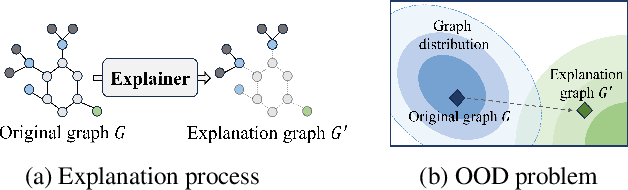
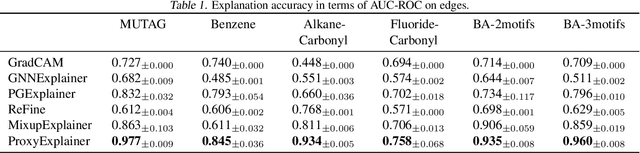
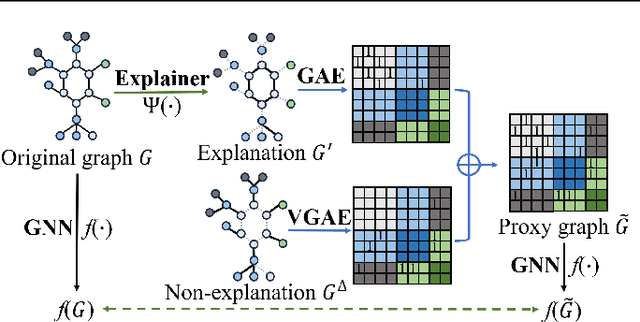
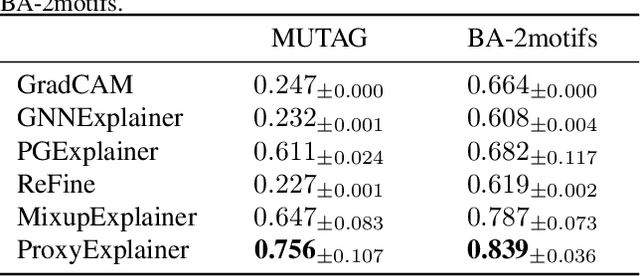
Graph Neural Networks (GNNs) have become a building block in graph data processing, with wide applications in critical domains. The growing needs to deploy GNNs in high-stakes applications necessitate explainability for users in the decision-making processes. A popular paradigm for the explainability of GNNs is to identify explainable subgraphs by comparing their labels with the ones of original graphs. This task is challenging due to the substantial distributional shift from the original graphs in the training set to the set of explainable subgraphs, which prevents accurate prediction of labels with the subgraphs. To address it, in this paper, we propose a novel method that generates proxy graphs for explainable subgraphs that are in the distribution of training data. We introduce a parametric method that employs graph generators to produce proxy graphs. A new training objective based on information theory is designed to ensure that proxy graphs not only adhere to the distribution of training data but also preserve essential explanatory factors. Such generated proxy graphs can be reliably used for approximating the predictions of the true labels of explainable subgraphs. Empirical evaluations across various datasets demonstrate our method achieves more accurate explanations for GNNs.