 Add to Chrome
 Add to Firefox
 Add to Edge
Leveraging Trajectory Graphs for Pre-Execution Error Diagnosis in Agentic LLM Systems
Jul 29, 2026
Large Language Model~(LLM)-based agents have demonstrated exceptional performance across a wide range of complex interactive tasks. However, they often struggle with long-horizon interactive tasks common in domains, such as embodied AI. The complexity and vast action spaces in these settings lead to compounding errors, where a single suboptimal action can derail an entire trajectory, causing the agent to exhaust its limited step budget on inefficient or unrecoverable paths. To overcome this without costly fine-tuning, we draw inspiration from software debugging, where execution logs are analyzed to preemptively catch errors. We propose \textit{Trajectory Graph Copilot}, a novel framework that acts as a ``copilot'' for LLM agents by diagnosing potential action errors before they are executed. At its core,\textit{Graph Debugger} models historical trajectories as a probabilistic graph and uses a Graph Neural Network to identify sequential action patterns that frequently lead to failure. Functioning as a proactive diagnostic sandbox, our method provides early warnings on potentially flawed actions, prompting the agent to self-correct. This pre-action error diagnosis prevents costly mistakes, significantly enhancing the agent's ability to complete long-horizon tasks successfully. The extensive experiments on four benchmarks with three LLM agents demonstrate a $14.69\%$ pass ratio improvement on average.

Bridging Inference-Time Scaling and Episodic Memory with Action-Centric Graphs
Jul 29, 2026Recent advancements in inference-time scaling have significantly unlocked the complex reasoning capabilities of Large Language Models~(LLMs). However, for agents, these approaches suffer from a critical inefficiency, operating in a stateless manner and engaging in redundant search processes. Existing memory mechanisms largely rely on the reasoning capabilities of LLMs, leading to prohibitive computational costs. In this paper, we propose a novel framework, \textit{GAMER}~(Graph-based Action-centric Memory with Episodic Reasoning), that bridges the gap between inference scaling and episodic memory. Our approach models historical reasoning as a dynamic \textit{Action-Centric Graph}. By decoupling the memory mechanism from LLMs, our method can save token/money usage by providing less memory context than memory mechanism baselines. To extract knowledge from the graph effectively, we use a dual-stream Temporal Difference learning mechanism to estimate the positive~(suggestion) and negative~(avoidance) value of action nodes based on past successes and failures. During the inference phase, this learned value function optimizes decision-making bi-directionally, so that positive values provide action suggestions, while negative values indicate high-risk actions. By performing efficient searches on the graph, our method significantly improves the efficiency of inference scaling. Experiments on multiple benchmarks demonstrate that \textit{GAMER} achieves superior performance by \textbf{20.81\%/6.17\%} for success/progress rate compared to vanilla baselines.
MTCAE-DFER: Multi-Task Cascaded Autoencoder for Dynamic Facial Expression Recognition
Dec 25, 2024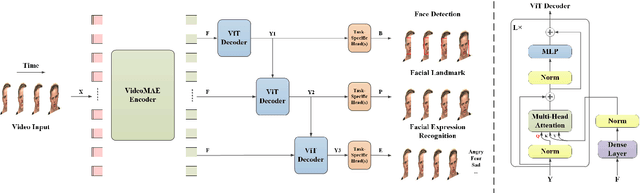
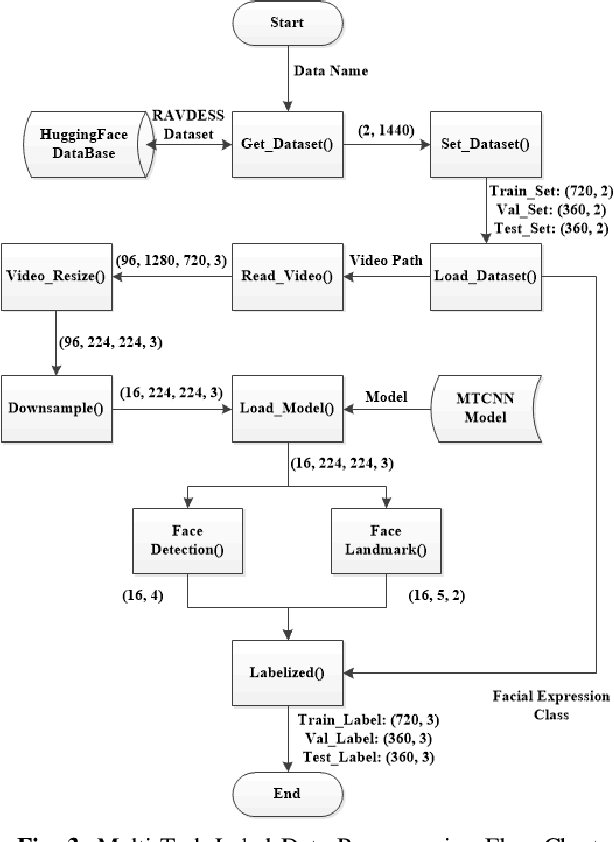
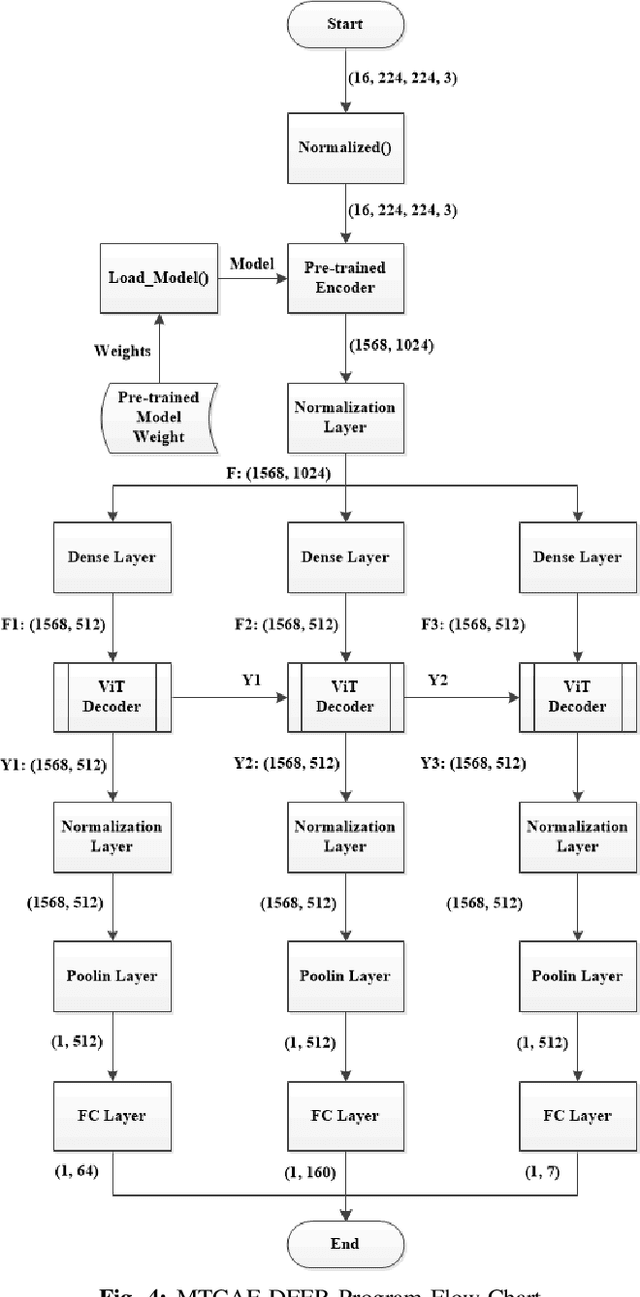
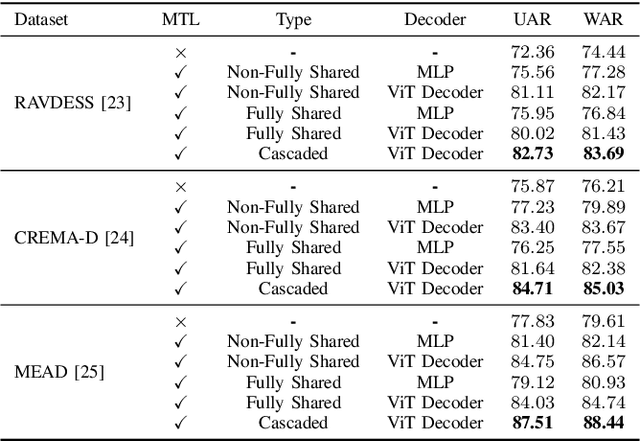
This paper expands the cascaded network branch of the autoencoder-based multi-task learning (MTL) framework for dynamic facial expression recognition, namely Multi-Task Cascaded Autoencoder for Dynamic Facial Expression Recognition (MTCAE-DFER). MTCAE-DFER builds a plug-and-play cascaded decoder module, which is based on the Vision Transformer (ViT) architecture and employs the decoder concept of Transformer to reconstruct the multi-head attention module. The decoder output from the previous task serves as the query (Q), representing local dynamic features, while the Video Masked Autoencoder (VideoMAE) shared encoder output acts as both the key (K) and value (V), representing global dynamic features. This setup facilitates interaction between global and local dynamic features across related tasks. Additionally, this proposal aims to alleviate overfitting of complex large model. We utilize autoencoder-based multi-task cascaded learning approach to explore the impact of dynamic face detection and dynamic face landmark on dynamic facial expression recognition, which enhances the model's generalization ability. After we conduct extensive ablation experiments and comparison with state-of-the-art (SOTA) methods on various public datasets for dynamic facial expression recognition, the robustness of the MTCAE-DFER model and the effectiveness of global-local dynamic feature interaction among related tasks have been proven.
F-Fidelity: A Robust Framework for Faithfulness Evaluation of Explainable AI
Oct 03, 2024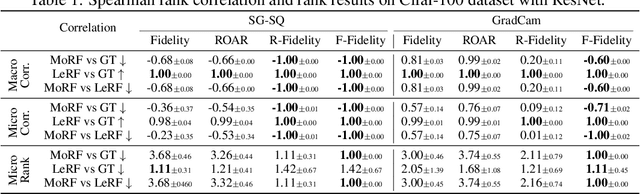
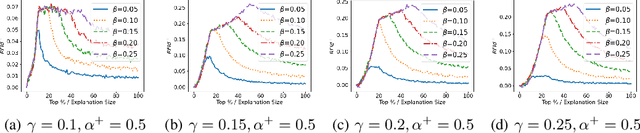
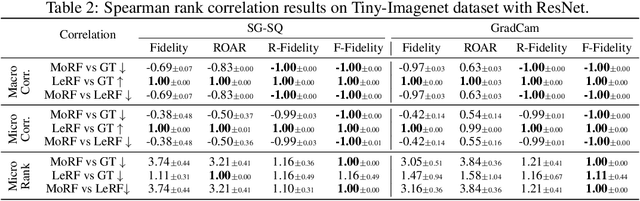
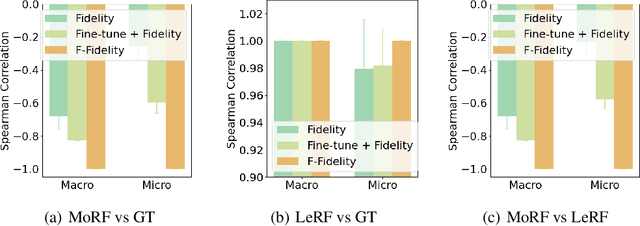
Recent research has developed a number of eXplainable AI (XAI) techniques. Although extracting meaningful insights from deep learning models, how to properly evaluate these XAI methods remains an open problem. The most widely used approach is to perturb or even remove what the XAI method considers to be the most important features in an input and observe the changes in the output prediction. This approach although efficient suffers the Out-of-Distribution (OOD) problem as the perturbed samples may no longer follow the original data distribution. A recent method RemOve And Retrain (ROAR) solves the OOD issue by retraining the model with perturbed samples guided by explanations. However, the training may not always converge given the distribution difference. Furthermore, using the model retrained based on XAI methods to evaluate these explainers may cause information leakage and thus lead to unfair comparisons. We propose Fine-tuned Fidelity F-Fidelity, a robust evaluation framework for XAI, which utilizes i) an explanation-agnostic fine-tuning strategy, thus mitigating the information leakage issue and ii) a random masking operation that ensures that the removal step does not generate an OOD input. We designed controlled experiments with state-of-the-art (SOTA) explainers and their degraded version to verify the correctness of our framework. We conducted experiments on multiple data structures, such as images, time series, and natural language. The results demonstrate that F-Fidelity significantly improves upon prior evaluation metrics in recovering the ground-truth ranking of the explainers. Furthermore, we show both theoretically and empirically that, given a faithful explainer, F-Fidelity metric can be used to compute the sparsity of influential input components, i.e., to extract the true explanation size.
MultiMAE-DER: Multimodal Masked Autoencoder for Dynamic Emotion Recognition
Apr 28, 2024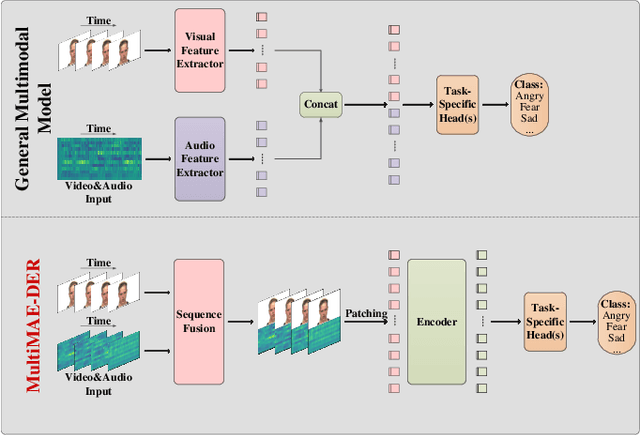
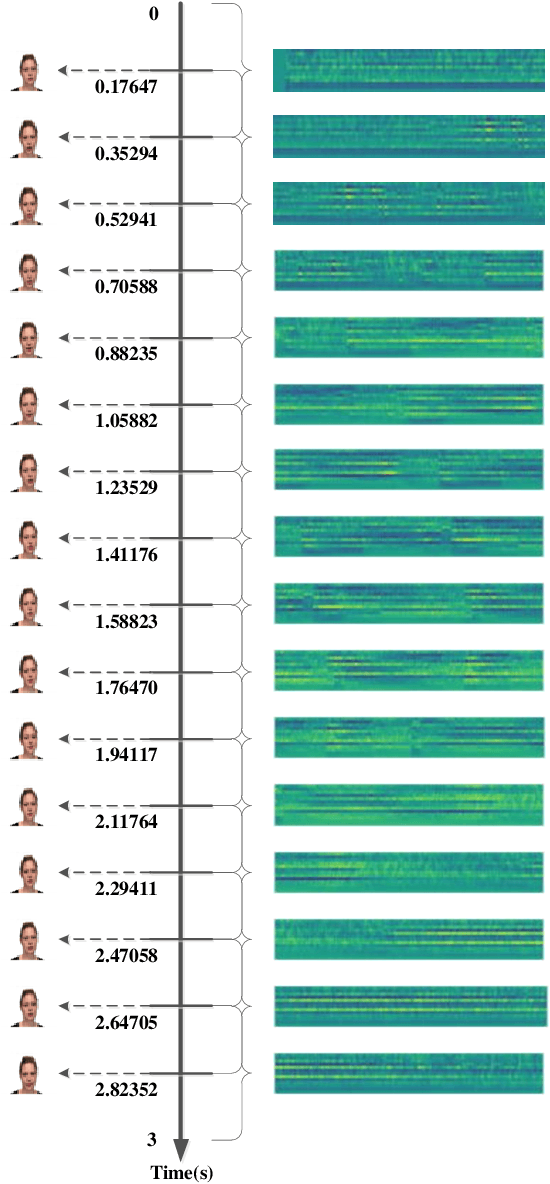
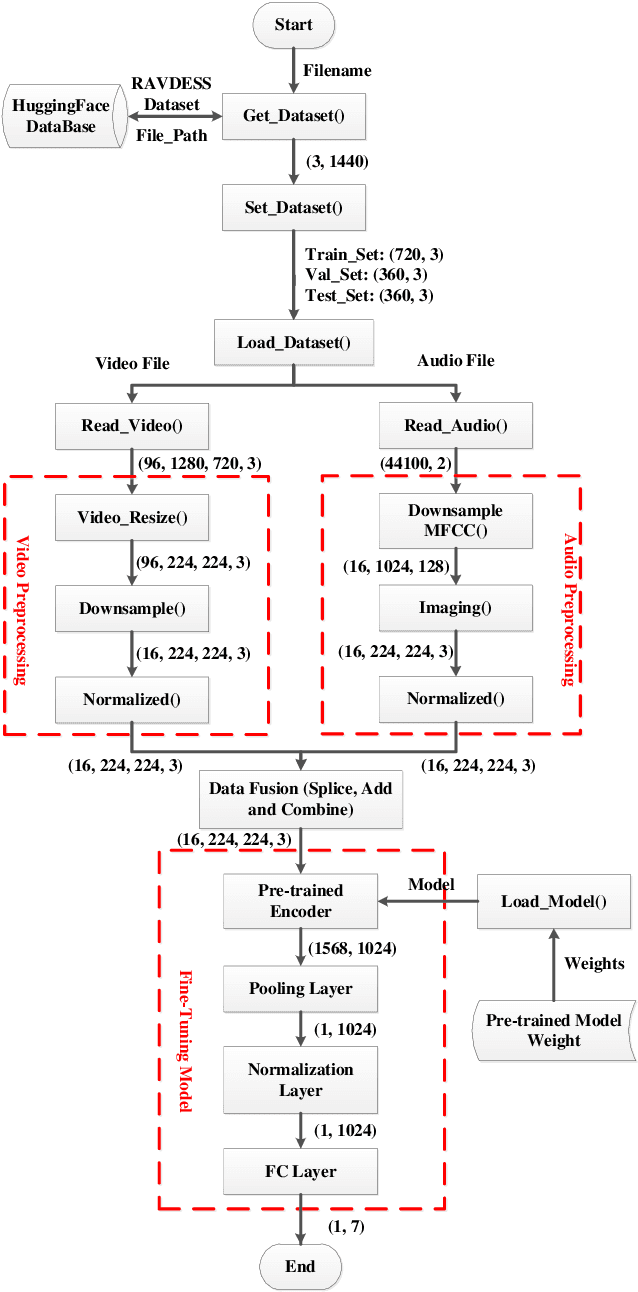
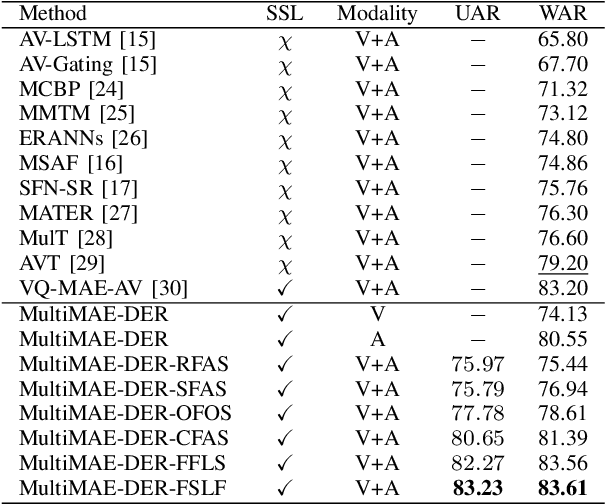
This paper presents a novel approach to processing multimodal data for dynamic emotion recognition, named as the Multimodal Masked Autoencoder for Dynamic Emotion Recognition (MultiMAE-DER). The MultiMAE-DER leverages the closely correlated representation information within spatiotemporal sequences across visual and audio modalities. By utilizing a pre-trained masked autoencoder model, the MultiMAEDER is accomplished through simple, straightforward finetuning. The performance of the MultiMAE-DER is enhanced by optimizing six fusion strategies for multimodal input sequences. These strategies address dynamic feature correlations within cross-domain data across spatial, temporal, and spatiotemporal sequences. In comparison to state-of-the-art multimodal supervised learning models for dynamic emotion recognition, MultiMAE-DER enhances the weighted average recall (WAR) by 4.41% on the RAVDESS dataset and by 2.06% on the CREMAD. Furthermore, when compared with the state-of-the-art model of multimodal self-supervised learning, MultiMAE-DER achieves a 1.86% higher WAR on the IEMOCAP dataset.