 Add to Chrome
 Add to Firefox
 Add to Edge
Failure-Aware Bimanual Teleoperation via Conservative Value Guided Assistance
Feb 01, 2026
Teleoperation of high-precision manipulation is con-strained by tight success tolerances and complex contact dy-namics, which make impending failures difficult for human operators to anticipate under partial observability. This paper proposes a value-guided, failure-aware framework for bimanual teleoperation that provides compliant haptic assistance while pre-serving continuous human authority. The framework is trained entirely from heterogeneous offline teleoperation data containing both successful and failed executions. Task feasibility is mod-eled as a conservative success score learned via Conservative Value Learning, yielding a risk-sensitive estimate that remains reliable under distribution shift. During online operation, the learned success score regulates the level of assistance, while a learned actor provides a corrective motion direction. Both are integrated through a joint-space impedance interface on the master side, yielding continuous guidance that steers the operator away from failure-prone actions without overriding intent. Experimental results on contact-rich manipulation tasks demonstrate improved task success rates and reduced operator workload compared to conventional teleoperation and shared-autonomy baselines, indicating that conservative value learning provides an effective mechanism for embedding failure awareness into bilateral teleoperation. Experimental videos are available at https://www.youtube.com/watch?v=XDTsvzEkDRE

UniBiDex: A Unified Teleoperation Framework for Robotic Bimanual Dexterous Manipulation
Jan 08, 2026We present UniBiDex a unified teleoperation framework for robotic bimanual dexterous manipulation that supports both VRbased and leaderfollower input modalities UniBiDex enables realtime contactrich dualarm teleoperation by integrating heterogeneous input devices into a shared control stack with consistent kinematic treatment and safety guarantees The framework employs nullspace control to optimize bimanual configurations ensuring smooth collisionfree and singularityaware motion across tasks We validate UniBiDex on a longhorizon kitchentidying task involving five sequential manipulation subtasks demonstrating higher task success rates smoother trajectories and improved robustness compared to strong baselines By releasing all hardware and software components as opensource we aim to lower the barrier to collecting largescale highquality human demonstration datasets and accelerate progress in robot learning.
Blind Source Separation Based on Sparsity
Apr 27, 2025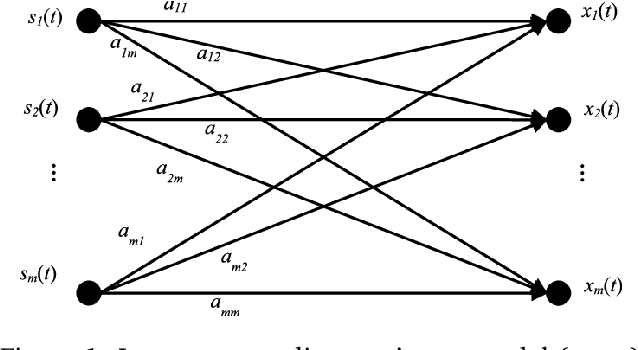


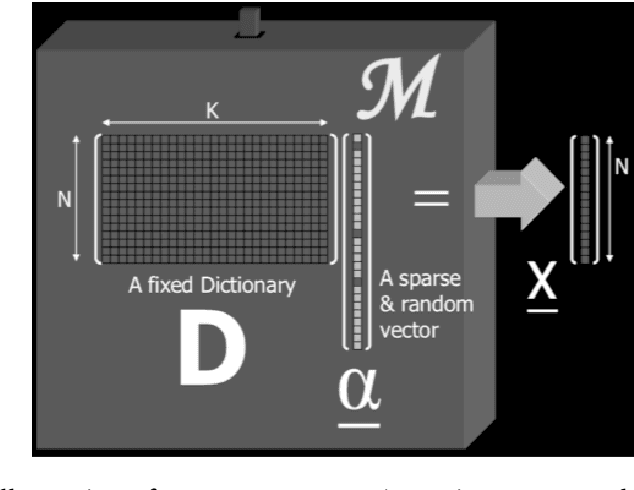
Blind source separation (BSS) is a key technique in array processing and data analysis, aiming to recover unknown sources from observed mixtures without knowledge of the mixing matrix. Classical independent component analysis (ICA) methods rely on the assumption that sources are mutually independent. To address limitations of ICA, sparsity-based methods have been introduced, which decompose source signals sparsely in a predefined dictionary. Morphological Component Analysis (MCA), based on sparse representation theory, assumes that a signal is a linear combination of components with distinct geometries, each sparsely representable in one dictionary and not in others. This approach has recently been applied to BSS with promising results. This report reviews key approaches derived from classical ICA and explores sparsity-based methods for BSS. It introduces the theory of sparse representation and decomposition, followed by a block coordinate relaxation MCA algorithm, whose variants are used in Multichannel MCA (MMCA) and Generalized MCA (GMCA). A local dictionary learning method using K-SVD is then presented. Finally, we propose an improved algorithm, SAC+BK-SVD, which enhances K-SVD by learning a block-sparsifying dictionary that clusters and updates similar atoms in blocks. The implementation includes experiments on image segmentation and blind image source separation using the discussed techniques. We also compare the proposed block-sparse dictionary learning algorithm with K-SVD. Simulation results demonstrate that our method yields improved blind image separation quality.
PHYBench: Holistic Evaluation of Physical Perception and Reasoning in Large Language Models
Apr 22, 2025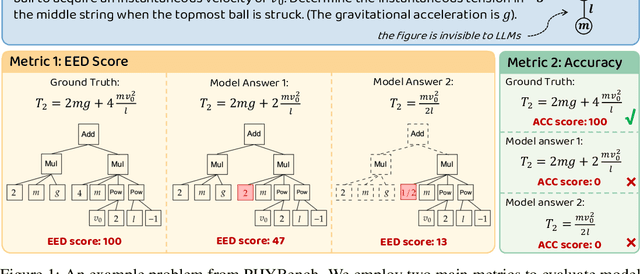

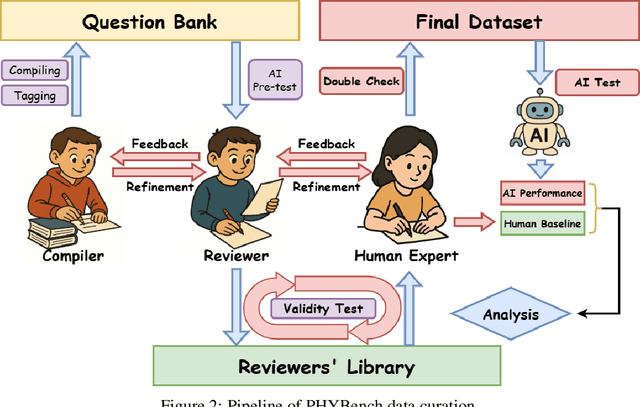
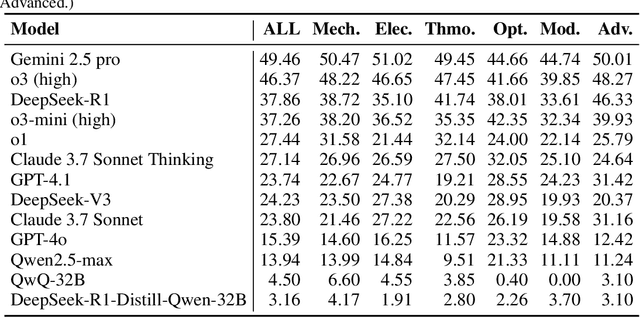
We introduce PHYBench, a novel, high-quality benchmark designed for evaluating reasoning capabilities of large language models (LLMs) in physical contexts. PHYBench consists of 500 meticulously curated physics problems based on real-world physical scenarios, designed to assess the ability of models to understand and reason about realistic physical processes. Covering mechanics, electromagnetism, thermodynamics, optics, modern physics, and advanced physics, the benchmark spans difficulty levels from high school exercises to undergraduate problems and Physics Olympiad challenges. Additionally, we propose the Expression Edit Distance (EED) Score, a novel evaluation metric based on the edit distance between mathematical expressions, which effectively captures differences in model reasoning processes and results beyond traditional binary scoring methods. We evaluate various LLMs on PHYBench and compare their performance with human experts. Our results reveal that even state-of-the-art reasoning models significantly lag behind human experts, highlighting their limitations and the need for improvement in complex physical reasoning scenarios. Our benchmark results and dataset are publicly available at https://phybench-official.github.io/phybench-demo/.