 Add to Chrome
 Add to Firefox
 Add to Edge
Nanbeige4.2-3B: Unlocking Agentic Capabilities in a Compact Model
Jul 27, 2026
We present Nanbeige4.2-3B, a compact general agentic model with 3B non-embedding parameters. It delivers strong performance across code-agent, office-agent, and complex tool-use tasks while maintaining highly competitive reasoning capabilities in mathematics, coding, and science. Nanbeige4.2-3B is pretrained from scratch on 28T tokens with a Looped Transformer that reuses the layer stack to increase capacity without adding parameters. For SFT data and trajectory construction, we expand the diversity of executable environments, task assets, and agentic scaffolds through real-world deployment and large-scale synthesis. Our RL pipeline applies mixed-mode RLHF over Think and Non-Think responses to improve overall model quality and reduce failure cases, length-controlled reasoning RL to balance accuracy and reasoning efficiency, and agentic RL with outcome and process rewards to stabilize long-horizon training. Extensive evaluations show that Nanbeige4.2-3B outperforms larger models, including Qwen3.5-9B and Gemma4-12B, across diverse agentic benchmarks while remaining competitive on reasoning and alignment tasks. Performance with OpenClaw further supports its use as a compact local personal assistant.

PHYBench: Holistic Evaluation of Physical Perception and Reasoning in Large Language Models
Apr 22, 2025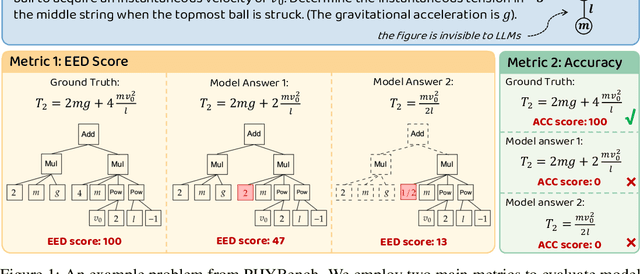

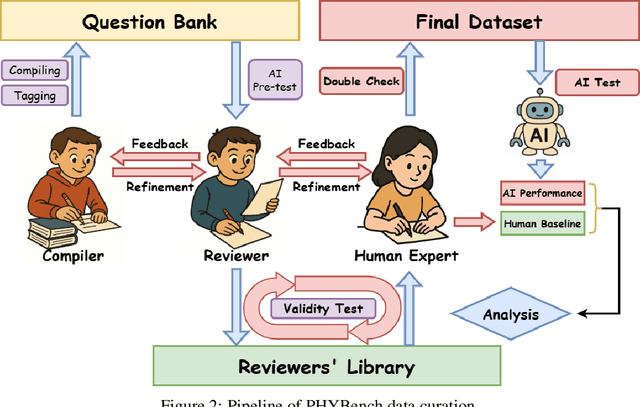
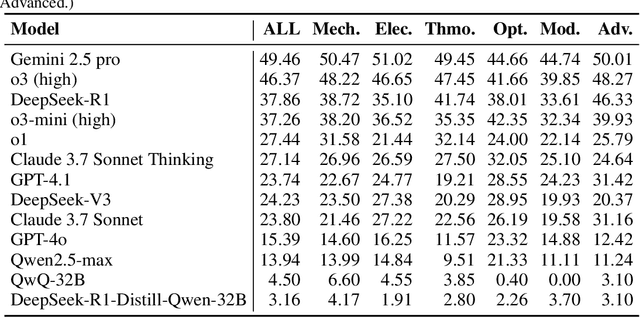
We introduce PHYBench, a novel, high-quality benchmark designed for evaluating reasoning capabilities of large language models (LLMs) in physical contexts. PHYBench consists of 500 meticulously curated physics problems based on real-world physical scenarios, designed to assess the ability of models to understand and reason about realistic physical processes. Covering mechanics, electromagnetism, thermodynamics, optics, modern physics, and advanced physics, the benchmark spans difficulty levels from high school exercises to undergraduate problems and Physics Olympiad challenges. Additionally, we propose the Expression Edit Distance (EED) Score, a novel evaluation metric based on the edit distance between mathematical expressions, which effectively captures differences in model reasoning processes and results beyond traditional binary scoring methods. We evaluate various LLMs on PHYBench and compare their performance with human experts. Our results reveal that even state-of-the-art reasoning models significantly lag behind human experts, highlighting their limitations and the need for improvement in complex physical reasoning scenarios. Our benchmark results and dataset are publicly available at https://phybench-official.github.io/phybench-demo/.