 Add to Chrome
 Add to Firefox
 Add to Edge
VIOLET: High-Fidelity Violin Synthesis with Techniques and Dynamics
Aug 08, 2026
Neural synthesis for musical instruments has the potential to revolutionize current practices that use concatenative synthesis and a sample library. However, most research focused on piano synthesis and expressive performance generation; little work has been done on continuously articulated instruments like the violin, let alone rendering them with playing techniques and dynamics. We present VIOLET, a latent-diffusion framework for controllable violin synthesis, which uses a Diffusion Transformer (DiT) with rectified flow to synthesize high-fidelity audio from MIDI notes, playing techniques, and continuous dynamics. To train VIOLET, in addition to using a few existing datasets, we curate a new dataset named CSV-TD, which contains 39 h of 48 kHz synthetic audio and time-aligned annotations of MIDI notes, note-level techniques, and continuous dynamics curves. Objective and subjective evaluations show that VIOLET synthesizes violin performances with high technique adherence, accurate pitch and timing alignment, and good dynamics control. It outperforms the current state-of-the-art neural violin synthesis system and approaches a top commercial virtual instrument in terms of technique clarity, naturalness, and dynamics following.

Summary of DCASE 2026 Task 5: Audio-Dependent Question Answering
Jul 21, 2026DCASE~2026 Task~5 introduces Audio-Dependent Question Answering (ADQA), which tests whether large audio-language models answer from the audio rather than from textual priors. An Audio-Dependency Filtering (ADF) pipeline combines silent-audio probing, per-option perplexity, a large language model (LLM) commonsense check, and human review to remove items solvable from text alone. The 3000 items that pass form the ADQA-Bench evaluation set, spanning music, speech, and environmental audio. The inaugural edition draws 14 teams and 36 submissions across two tracks defined by total parameter count (up to 100B and under 10B). A Chung-Ang University ensemble of MOSS-Audio-8B-Thinking and Qwen3-Omni-30B reaches the top overall accuracy at \pct{58.33}, and a MOSS-only configuration from the same team leads the sub-10B track at \pct{57.30}. Across the 30 submissions with a comparable development score, evaluation accuracy falls by 11.91 percentage points (pp) on average (median 10.91\,pp) on the hidden evaluation split, which is designed to be harder than the development split. The most common building blocks are: the MOSS-Audio-8B-Thinking backbone (13 of 36 submissions), Low-Rank Adaptation (LoRA) fine-tuning on AudioMCQ-StrongAC, and preference or reinforcement-learning objectives -- Group Relative Policy Optimization (GRPO) in five teams, Group reward-Decoupled Normalization Policy Optimization (GDPO) in two. At test time, prompt engineering is near-universal, and majority or choice-permutation voting is common. Every system misses the same set of 233 evaluation items.
NouveauVoice: Generating Novel Pseudo Speakers for Voice Anonymization
Jul 04, 2026Advanced neural technologies in speech synthesis and voice conversion (VC) have introduced severe risks to personal privacy, necessitating robust Speaker Anonymization Systems (SAS). Existing SAS approaches modify voice characteristics in the hand-crafted feature space or speaker embedding space, often struggling to provide sufficient identity variance across generated voices. In this paper, we propose NouveauVoice, a novel pseudo-speaker generation framework based on a Hierarchical Deep Variational Autoencoder (NVAE). Integrated as a standalone plug-in module on top of state-of-the-art architectures (FACodec and CosyVoice2), our approach leverages tractable sampling and the Evidence Lower Bound (ELBO) objective to synthesize highly expressive pseudo-speaker embeddings with significantly enhanced speaker diversity. Evaluating our framework under a protocol similar to the VoicePrivacy Challenge alongside Maximum Mean Discrepancy (MMD) analysis, we demonstrate that NouveauVoice achieves strong identity concealment, yielding an Equal Error Rate (EER) exceeding 38% against an automatic speaker verification attacker model. Our system shows a reasonable trade-off between strict anonymity, rich pseudo-speaker diversity, and downstream speech utility, such as intelligibility and emotional expressiveness.
Single-Eye View: Monocular Real-time Perception Package for Autonomous Driving
Mar 22, 2026Amidst the rapid advancement of camera-based autonomous driving technology, effectiveness is often prioritized with limited attention to computational efficiency. To address this issue, this paper introduces LRHPerception, a real-time monocular perception package for autonomous driving that uses single-view camera video to interpret the surrounding environment. The proposed system combines the computational efficiency of end-to-end learning with the rich representational detail of local mapping methodologies. With significant improvements in object tracking and prediction, road segmentation, and depth estimation integrated into a unified framework, LRHPerception processes monocular image data into a five-channel tensor consisting of RGB, road segmentation, and pixel-level depth estimation, augmented with object detection and trajectory prediction. Experimental results demonstrate strong performance, achieving real-time processing at 29 FPS on a single GPU, representing a 555% speedup over the fastest mapping-based approach.
Generating Novel and Realistic Speakers for Voice Conversion
Nov 10, 2025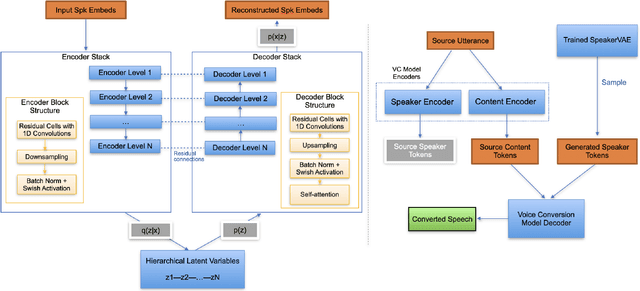
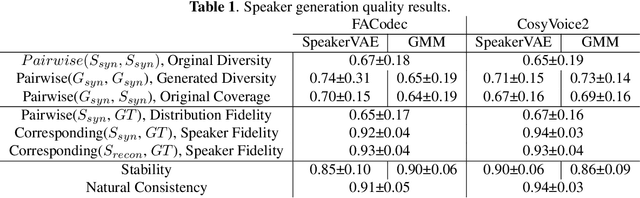
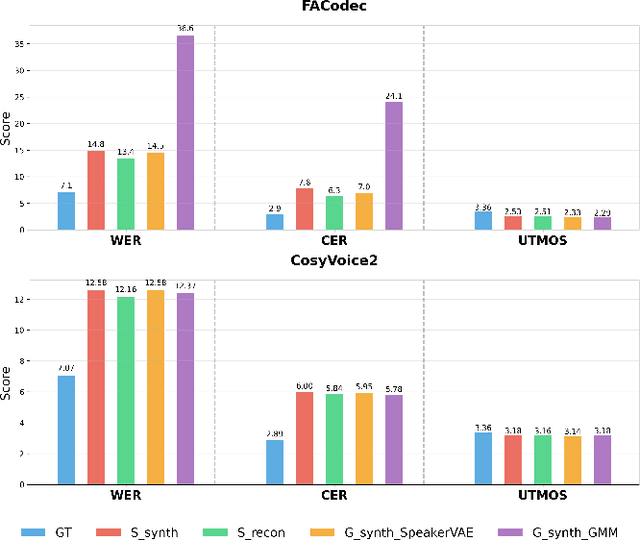
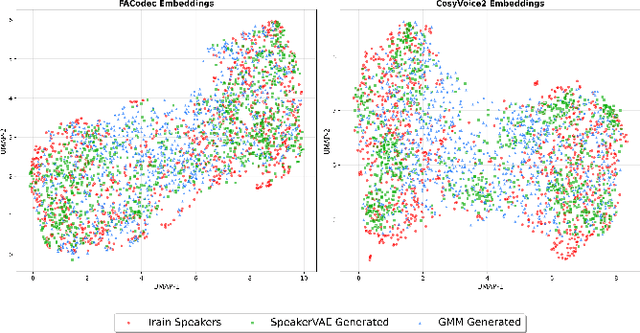
Voice conversion models modify timbre while preserving paralinguistic features, enabling applications like dubbing and identity protection. However, most VC systems require access to target utterances, limiting their use when target data is unavailable or when users desire conversion to entirely novel, unseen voices. To address this, we introduce a lightweight method SpeakerVAE to generate novel speakers for VC. Our approach uses a deep hierarchical variational autoencoder to model the speaker timbre space. By sampling from the trained model, we generate novel speaker representations for voice synthesis in a VC pipeline. The proposed method is a flexible plug-in module compatible with various VC models, without co-training or fine-tuning of the base VC system. We evaluated our approach with state-of-the-art VC models: FACodec and CosyVoice2. The results demonstrate that our method successfully generates novel, unseen speakers with quality comparable to that of the training speakers.
Twenty-Five Years of MIR Research: Achievements, Practices, Evaluations, and Future Challenges
Nov 10, 2025In this paper, we trace the evolution of Music Information Retrieval (MIR) over the past 25 years. While MIR gathers all kinds of research related to music informatics, a large part of it focuses on signal processing techniques for music data, fostering a close relationship with the IEEE Audio and Acoustic Signal Processing Technical Commitee. In this paper, we reflect the main research achievements of MIR along the three EDICS related to music analysis, processing and generation. We then review a set of successful practices that fuel the rapid development of MIR research. One practice is the annual research benchmark, the Music Information Retrieval Evaluation eXchange, where participants compete on a set of research tasks. Another practice is the pursuit of reproducible and open research. The active engagement with industry research and products is another key factor for achieving large societal impacts and motivating younger generations of students to join the field. Last but not the least, the commitment to diversity, equity and inclusion ensures MIR to be a vibrant and open community where various ideas, methodologies, and career pathways collide. We finish by providing future challenges MIR will have to face.
Towards Perception-Informed Latent HRTF Representations
Jul 03, 2025Personalized head-related transfer functions (HRTFs) are essential for ensuring a realistic auditory experience over headphones, because they take into account individual anatomical differences that affect listening. Most machine learning approaches to HRTF personalization rely on a learned low-dimensional latent space to generate or select custom HRTFs for a listener. However, these latent representations are typically learned in a manner that optimizes for spectral reconstruction but not for perceptual compatibility, meaning they may not necessarily align with perceptual distance. In this work, we first study whether traditionally learned HRTF representations are well correlated with perceptual relations using auditory-based objective perceptual metrics; we then propose a method for explicitly embedding HRTFs into a perception-informed latent space, leveraging a metric-based loss function and supervision via Metric Multidimensional Scaling (MMDS). Finally, we demonstrate the applicability of these learned representations to the task of HRTF personalization. We suggest that our method has the potential to render personalized spatial audio, leading to an improved listening experience.
A Review on Score-based Generative Models for Audio Applications
Jun 10, 2025Diffusion models have emerged as powerful deep generative techniques, producing high-quality and diverse samples in applications in various domains including audio. These models have many different design choices suitable for different applications, however, existing reviews lack in-depth discussions of these design choices. The audio diffusion model literature also lacks principled guidance for the implementation of these design choices and their comparisons for different applications. This survey provides a comprehensive review of diffusion model design with an emphasis on design principles for quality improvement and conditioning for audio applications. We adopt the score modeling perspective as a unifying framework that accommodates various interpretations, including recent approaches like flow matching. We systematically examine the training and sampling procedures of diffusion models, and audio applications through different conditioning mechanisms. To address the lack of audio diffusion model codebases and to promote reproducible research and rapid prototyping, we introduce an open-source codebase at https://github.com/gzhu06/AudioDiffuser that implements our reviewed framework for various audio applications. We demonstrate its capabilities through three case studies: audio generation, speech enhancement, and text-to-speech synthesis, with benchmark evaluations on standard datasets.
HARP 2.0: Expanding Hosted, Asynchronous, Remote Processing for Deep Learning in the DAW
Mar 04, 2025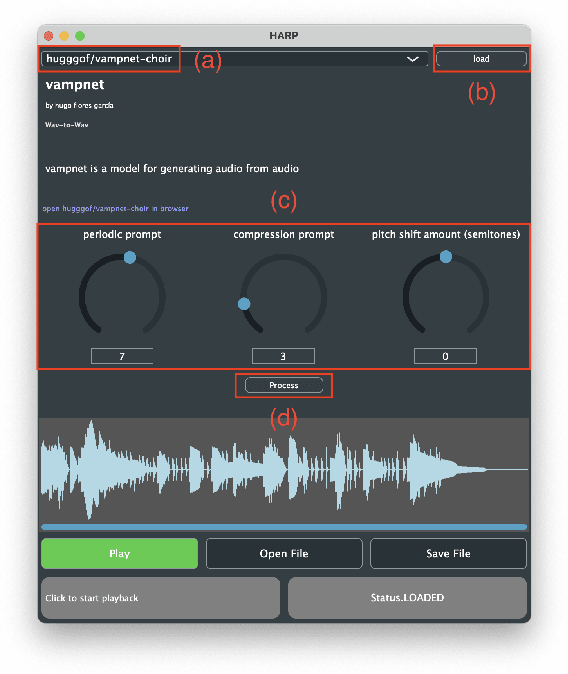
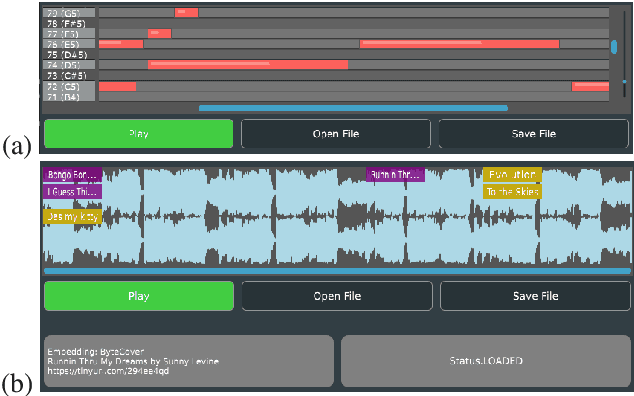
HARP 2.0 brings deep learning models to digital audio workstation (DAW) software through hosted, asynchronous, remote processing, allowing users to route audio from a plug-in interface through any compatible Gradio endpoint to perform arbitrary transformations. HARP renders endpoint-defined controls and processed audio in-plugin, meaning users can explore a variety of cutting-edge deep learning models without ever leaving the DAW. In the 2.0 release we introduce support for MIDI-based models and audio/MIDI labeling models, provide a streamlined pyharp Python API for model developers, and implement numerous interface and stability improvements. Through this work, we hope to bridge the gap between model developers and creatives, improving access to deep learning models by seamlessly integrating them into DAW workflows.
Audio Visual Segmentation Through Text Embeddings
Feb 22, 2025The goal of Audio-Visual Segmentation (AVS) is to localize and segment the sounding source objects from the video frames. Researchers working on AVS suffer from limited datasets because hand-crafted annotation is expensive. Recent works attempt to overcome the challenge of limited data by leveraging the segmentation foundation model, SAM, prompting it with audio to enhance its ability to segment sounding source objects. While this approach alleviates the model's burden on understanding visual modality by utilizing pre-trained knowledge of SAM, it does not address the fundamental challenge of the limited dataset for learning audio-visual relationships. To address these limitations, we propose \textbf{AV2T-SAM}, a novel framework that bridges audio features with the text embedding space of pre-trained text-prompted SAM. Our method leverages multimodal correspondence learned from rich text-image paired datasets to enhance audio-visual alignment. Furthermore, we introduce a novel feature, $\mathbf{\textit{\textbf{f}}_{CLIP} \odot \textit{\textbf{f}}_{CLAP}}$, which emphasizes shared semantics of audio and visual modalities while filtering irrelevant noise. Experiments on the AVSBench dataset demonstrate state-of-the-art performance on both datasets of AVSBench. Our approach outperforms existing methods by effectively utilizing pretrained segmentation models and cross-modal semantic alignment.