 Add to Chrome
 Add to Firefox
 Add to Edge
UniFS: Unified Fast-to-Slow Hierarchical Architecture for Vision-Language-Action Models
Jun 22, 2026
Mainstream Fast-Slow dual system vision-language-action models decouple a high-frequency action expert from a low-frequency vision-language model for efficiency, yet they face a fundamental frequency dilemma: large update gaps cause semantic drift from stale context, while small gaps erode the intended computational savings. Moreover, because the action expert receives only the VLM's final-layer representation at a single fixed frequency, rich intermediate features are discarded, limiting both information coupling and manipulation precision. Inspired by multi-timescale neural processing in the human brain, we introduce UniFS, a unified fast-to-slow architecture that resolves these challenges through three key designs. First, we stratify the VLM layers into groups with progressively decreasing update frequencies, enabling shallow layers to capture fast-changing dynamics while deeper layers cache stable semantic context. Second, a latent vector inversion mechanism re-routes the interaction order between multi-scale VLM features and the action expert, aligning fast-varying representations with fine-grained action decoding and slow-varying ones with coarse planning. Third, a multi-level supervision strategy enforces a coarse-to-fine learning hierarchy across temporal scales. Together, these designs enable richer cross-frequency information transfer within a single backbone, while the low-frequency pathways additionally preserve temporal context across steps. Experiments on LIBERO show that UniFS achieves state-of-the-art performance (98.3\% average success rate, a 2.5\% gain over VLA-Adapter baseline) while reducing average inference latency from 36.5~ms to 17.8~ms (2.1$\times$ speedup). Real-robot experiments on a Franka platform further validate its practical applicability. Code is opensourced at https://github.com/linsun449/UniFS.

Widget Captioning: Generating Natural Language Description for Mobile User Interface Elements
Oct 08, 2020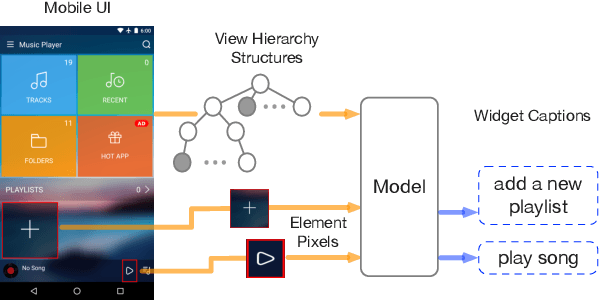
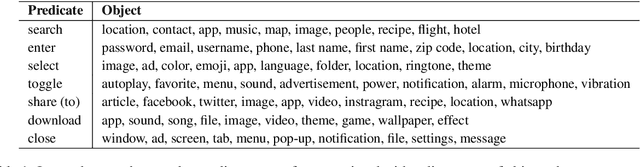
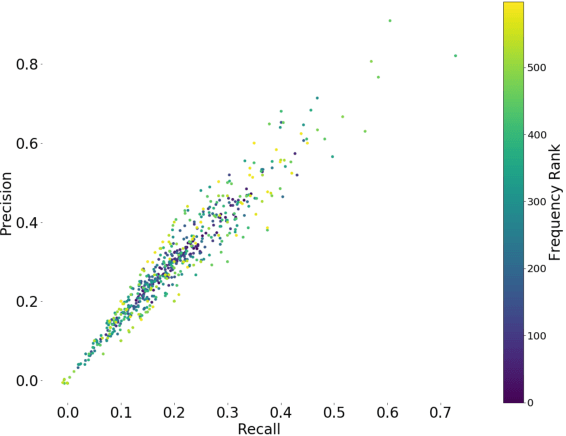

Natural language descriptions of user interface (UI) elements such as alternative text are crucial for accessibility and language-based interaction in general. Yet, these descriptions are constantly missing in mobile UIs. We propose widget captioning, a novel task for automatically generating language descriptions for UI elements from multimodal input including both the image and the structural representations of user interfaces. We collected a large-scale dataset for widget captioning with crowdsourcing. Our dataset contains 162,859 language phrases created by human workers for annotating 61,285 UI elements across 21,750 unique UI screens. We thoroughly analyze the dataset, and train and evaluate a set of deep model configurations to investigate how each feature modality as well as the choice of learning strategies impact the quality of predicted captions. The task formulation and the dataset as well as our benchmark models contribute a solid basis for this novel multimodal captioning task that connects language and user interfaces.