 Add to Chrome
 Add to Firefox
 Add to Edge
UniFS: Unified Fast-to-Slow Hierarchical Architecture for Vision-Language-Action Models
Jun 22, 2026
Mainstream Fast-Slow dual system vision-language-action models decouple a high-frequency action expert from a low-frequency vision-language model for efficiency, yet they face a fundamental frequency dilemma: large update gaps cause semantic drift from stale context, while small gaps erode the intended computational savings. Moreover, because the action expert receives only the VLM's final-layer representation at a single fixed frequency, rich intermediate features are discarded, limiting both information coupling and manipulation precision. Inspired by multi-timescale neural processing in the human brain, we introduce UniFS, a unified fast-to-slow architecture that resolves these challenges through three key designs. First, we stratify the VLM layers into groups with progressively decreasing update frequencies, enabling shallow layers to capture fast-changing dynamics while deeper layers cache stable semantic context. Second, a latent vector inversion mechanism re-routes the interaction order between multi-scale VLM features and the action expert, aligning fast-varying representations with fine-grained action decoding and slow-varying ones with coarse planning. Third, a multi-level supervision strategy enforces a coarse-to-fine learning hierarchy across temporal scales. Together, these designs enable richer cross-frequency information transfer within a single backbone, while the low-frequency pathways additionally preserve temporal context across steps. Experiments on LIBERO show that UniFS achieves state-of-the-art performance (98.3\% average success rate, a 2.5\% gain over VLA-Adapter baseline) while reducing average inference latency from 36.5~ms to 17.8~ms (2.1$\times$ speedup). Real-robot experiments on a Franka platform further validate its practical applicability. Code is opensourced at https://github.com/linsun449/UniFS.

OmniEEG-Bench: A Standardized Evaluation Benchmark for EEG Foundation Models
May 30, 2026Electroencephalography (EEG) supports a variety of brain-computer interface (BCI) tasks ranging from brain-state monitoring to human-LLM interactions. EEG foundation models are emerging, but evaluation remains fragmented due to heterogeneous datasets and nconsistent task protocols. Here, we introduce OmniEEG-Bench, a unified benchmark and downstream task roadmap for EEG foundation models (FMs). It organizes evaluation of EEG FMs into six task families spanning (i) signal reliability, (ii) biometrics and disease, (iii) consciousness and state, (iv) cognition and emotion, (v) naturalistic stimulus decoding, and (vi) motor and interaction, introducing a new generation of tasks not systematically benchmarked in prior EEG FM work. OmniEEG-Bench standardizes model deployment, task definitions, and metrics through a task-card specification, and unifies 54 EEG datasets with consistent evaluation protocols. We benchmark 10 representative EEG foundation models and report a leaderboard that covers diverse evaluation settings. Both pretraining dataset diversity and model size are significantly associated with better average ranks across datasets, revealing scaling-law behavior in EEG foundation models (Figure 1). These results suggest that scaling EEG foundation models requires not only larger architectures but also broader and more diverse pretraining data. The benchmark code is available at https://github.com/ncclab-sustech/omni-eegbench.git.
Forecasting Epileptic Seizures from Contactless Camera via Cross-Species Transfer Learning
Mar 13, 2026Epileptic seizure forecasting is a clinically important yet challenging problem in epilepsy research. Existing approaches predominantly rely on neural signals such as electroencephalography (EEG), which require specialized equipment and limit long-term deployment in real-world settings. In contrast, video data provide a non-invasive and accessible alternative, yet existing video-based studies mainly focus on post-onset seizure detection, leaving seizure forecasting largely unexplored. In this work, we formulate a novel task of video-based epileptic seizure forecasting, where short pre-ictal video segments (3-10 seconds) are used to predict whether a seizure will occur within the subsequent 5 seconds. To address the scarcity of annotated human epilepsy videos, we propose a cross-species transfer learning framework that leverages large-scale rodent video data for auxiliary pretraining. This enables the model to capture seizure-related behavioral dynamics that generalize across species. Experimental results demonstrate that our approach achieves over 70% prediction accuracy under a strictly video-only setting and outperforms existing baselines. These findings highlight the potential of cross-species learning for building non-invasive, scalable early-warning systems for epilepsy.
Perturbing a Neural Network to Infer Effective Connectivity: Evidence from Synthetic EEG Data
Jul 19, 2023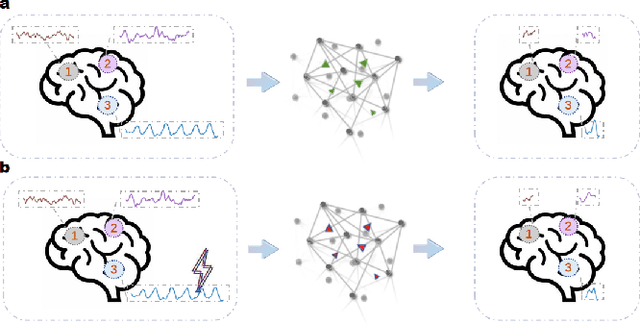
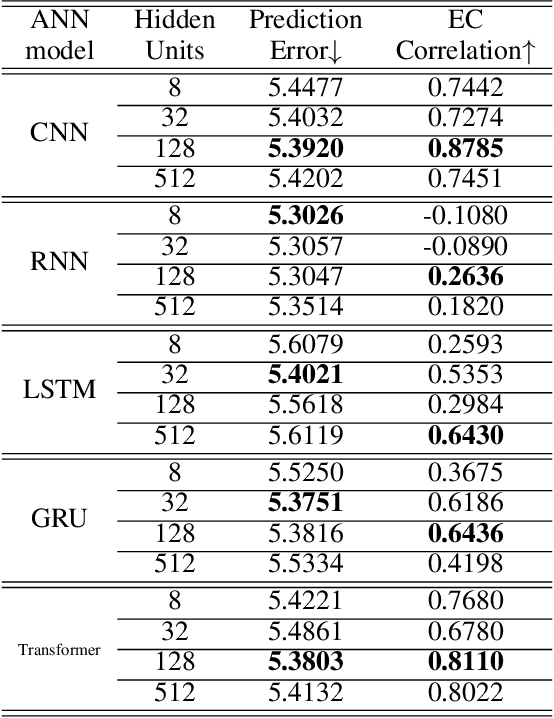
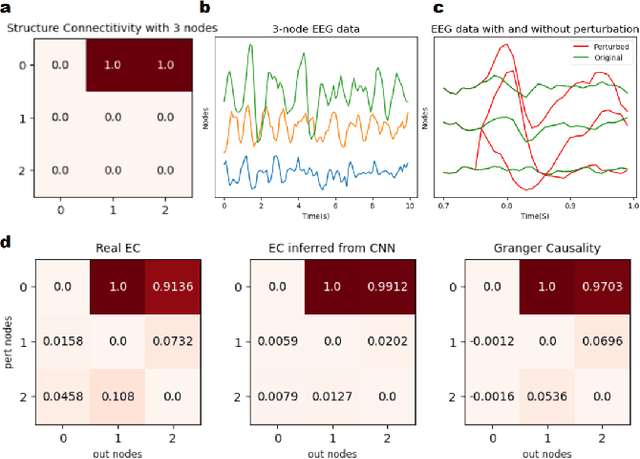
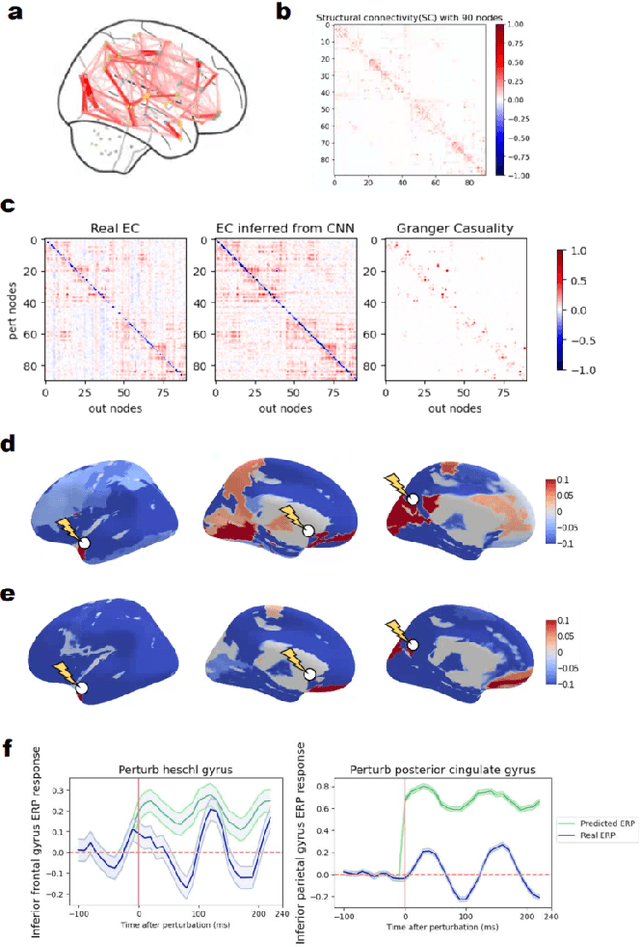
Identifying causal relationships among distinct brain areas, known as effective connectivity, holds key insights into the brain's information processing and cognitive functions. Electroencephalogram (EEG) signals exhibit intricate dynamics and inter-areal interactions within the brain. However, methods for characterizing nonlinear causal interactions among multiple brain regions remain relatively underdeveloped. In this study, we proposed a data-driven framework to infer effective connectivity by perturbing the trained neural networks. Specifically, we trained neural networks (i.e., CNN, vanilla RNN, GRU, LSTM, and Transformer) to predict future EEG signals according to historical data and perturbed the networks' input to obtain effective connectivity (EC) between the perturbed EEG channel and the rest of the channels. The EC reflects the causal impact of perturbing one node on others. The performance was tested on the synthetic EEG generated by a biological-plausible Jansen-Rit model. CNN and Transformer obtained the best performance on both 3-channel and 90-channel synthetic EEG data, outperforming the classical Granger causality method. Our work demonstrated the potential of perturbing an artificial neural network, learned to predict future system dynamics, to uncover the underlying causal structure.