 Add to Chrome
 Add to Firefox
 Add to Edge
Towards Safe Mobility: A Unified Transportation Foundation Model enabled by Open-Ended Vision-Language Dataset
Apr 24, 2026
Urban transportation systems face growing safety challenges that require scalable intelligence for emerging smart mobility infrastructures. While recent advances in foundation models and large-scale multimodal datasets have strengthened perception and reasoning in intelligent transportation systems (ITS), existing research remains largely centered on microscopic autonomous driving (AD), with limited attention to city-scale traffic analysis. In particular, open-ended safety-oriented visual question answering (VQA) and corresponding foundation models for reasoning over heterogeneous roadside camera observations remain underexplored. To address this gap, we introduce the Land Transportation Dataset (LTD), a large-scale open-source vision-language dataset for open-ended reasoning in urban traffic environments. LTD contains 11.6K high-quality VQA pairs collected from heterogeneous roadside cameras, spanning diverse road geometries, traffic participants, illumination conditions, and adverse weather. The dataset integrates three complementary tasks: fine-grained multi-object grounding, multi-image camera selection, and multi-image risk analysis, requiring joint reasoning over minimally correlated views to infer hazardous objects, contributing factors, and risky road directions. To ensure annotation fidelity, we combine multi-model vision-language generation with cross-validation and human-in-the-loop refinement. Building upon LTD, we further propose UniVLT, a transportation foundation model trained via curriculum-based knowledge transfer to unify microscopic AD reasoning and macroscopic traffic analysis within a single architecture. Extensive experiments on LTD and multiple AD benchmarks demonstrate that UniVLT achieves SOTA performance on open-ended reasoning tasks across diverse domains, while exposing limitations of existing foundation models in complex multi-view traffic scenarios.

AutoMoT: A Unified Vision-Language-Action Model with Asynchronous Mixture-of-Transformers for End-to-End Autonomous Driving
Mar 16, 2026Integrating vision-language models (VLMs) into end-to-end (E2E) autonomous driving (AD) systems has shown promise in improving scene understanding. However, existing integration strategies suffer from several limitations: they either struggle to resolve distribution misalignment between reasoning and action spaces, underexploit the general reasoning capabilities of pretrained VLMs, or incur substantial inference latency during action policy generation, which degrades driving performance. To address these challenges, we propose \OURS in this work, an end-to-end AD framework that unifies reasoning and action generation within a single vision-language-action (VLA) model. Our approach leverages a mixture-of-transformer (MoT) architecture with joint attention sharing, which preserves the general reasoning capabilities of pre-trained VLMs while enabling efficient fast-slow inference through asynchronous execution at different task frequencies. Extensive experiments on multiple benchmarks, under both open- and closed-loop settings, demonstrate that \OURS achieves competitive performance compared to state-of-the-art methods. We further investigate the functional boundary of pre-trained VLMs in AD, examining when AD-tailored fine-tuning is necessary. Our results show that pre-trained VLMs can achieve competitive multi-task scene understanding performance through semantic prompting alone, while fine-tuning remains essential for action-level tasks such as decision-making and trajectory planning. We refer to \href{https://automot-website.github.io/}{Project Page} for the demonstration videos and qualitative results.
Synthetic Datasets for Autonomous Driving: A Survey
Apr 24, 2023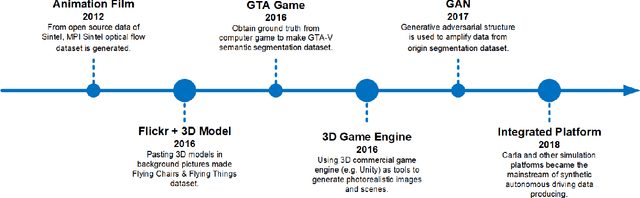
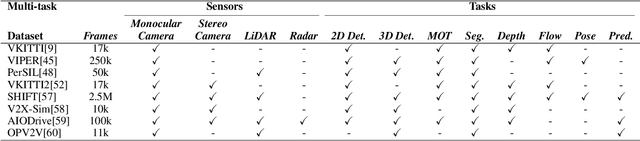
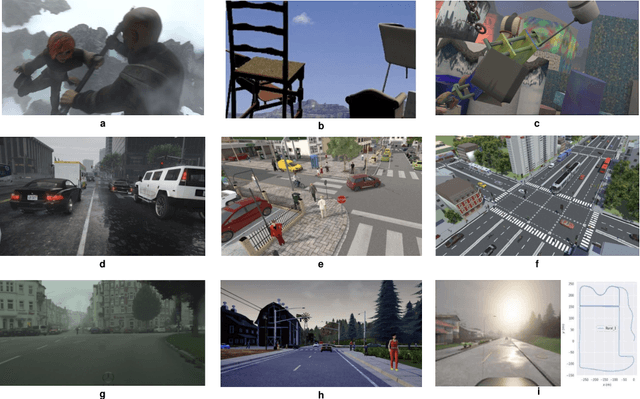
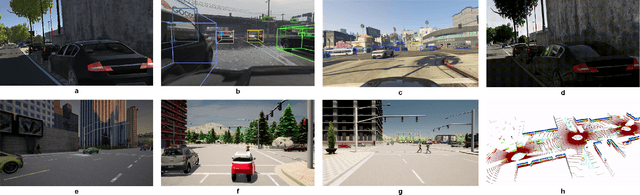
Autonomous driving techniques have been flourishing in recent years while thirsting for huge amounts of high-quality data. However, it is difficult for real-world datasets to keep up with the pace of changing requirements due to their expensive and time-consuming experimental and labeling costs. Therefore, more and more researchers are turning to synthetic datasets to easily generate rich and changeable data as an effective complement to the real world and to improve the performance of algorithms. In this paper, we summarize the evolution of synthetic dataset generation methods and review the work to date in synthetic datasets related to single and multi-task categories for to autonomous driving study. We also discuss the role that synthetic dataset plays the evaluation, gap test, and positive effect in autonomous driving related algorithm testing, especially on trustworthiness and safety aspects. Finally, we discuss general trends and possible development directions. To the best of our knowledge, this is the first survey focusing on the application of synthetic datasets in autonomous driving. This survey also raises awareness of the problems of real-world deployment of autonomous driving technology and provides researchers with a possible solution.