 Add to Chrome
 Add to Firefox
 Add to Edge
Ego-Dynamics-Augmented World Model for Autonomous Driving with Zero-Shot Cross-Chassis Adaptation
Jul 15, 2026
World model (WM)-based reinforcement learning enables sample-efficient end-to-end autonomous driving learning by imagining long-horizon trajectories in latent space. However, most driving WMs operate on bird's-eye-view (BEV) representations that are inherently egocentric: the transition between consecutive frames entangles the ego vehicle's own motion with scene dynamics. As a result, the WM devotes significant capacity to recovering ego-motion from warped observations, at the cost of scene modeling fidelity and imagination accuracy. This work proposes DynaDreamer, a dynamics-augmented Dreamer-style reinforcement learning method to address this problem by augmenting the WM with an explicit ego-dynamics prior. A physics-informed ego-dynamics encoder-decoder extracts the ego-state history into a compact and identifiable context, which modulates a causal Transformer WM to condition both its prior and posterior latents. During imagination, the ego-dynamics predictor propagates this context forward to keep the ego-dynamics prior synchronized with the rollout. An information-theoretic analysis shows that conditioning on this context reduces both the predictive entropy of the observation transition and the prior--posterior Kullback--Leibler divergence, confining the WM's modeling burden to the scene dynamics beyond ego-motion. An additional benefit is zero-shot cross-chassis adaptation: the ego-dynamics context depends on identifiable chassis parameters, so that a vehicle with previously unseen dynamic characteristics can adapt the WM to the new chassis without retraining. Experiments demonstrate that DynaDreamer improves task success rates over the strongest baseline by 28% and 61% in urban and highway driving scenarios, respectively, with the advantage rising to 73% when extrapolating to unseen chassis.

AutoMoT: A Unified Vision-Language-Action Model with Asynchronous Mixture-of-Transformers for End-to-End Autonomous Driving
Mar 16, 2026Integrating vision-language models (VLMs) into end-to-end (E2E) autonomous driving (AD) systems has shown promise in improving scene understanding. However, existing integration strategies suffer from several limitations: they either struggle to resolve distribution misalignment between reasoning and action spaces, underexploit the general reasoning capabilities of pretrained VLMs, or incur substantial inference latency during action policy generation, which degrades driving performance. To address these challenges, we propose \OURS in this work, an end-to-end AD framework that unifies reasoning and action generation within a single vision-language-action (VLA) model. Our approach leverages a mixture-of-transformer (MoT) architecture with joint attention sharing, which preserves the general reasoning capabilities of pre-trained VLMs while enabling efficient fast-slow inference through asynchronous execution at different task frequencies. Extensive experiments on multiple benchmarks, under both open- and closed-loop settings, demonstrate that \OURS achieves competitive performance compared to state-of-the-art methods. We further investigate the functional boundary of pre-trained VLMs in AD, examining when AD-tailored fine-tuning is necessary. Our results show that pre-trained VLMs can achieve competitive multi-task scene understanding performance through semantic prompting alone, while fine-tuning remains essential for action-level tasks such as decision-making and trajectory planning. We refer to \href{https://automot-website.github.io/}{Project Page} for the demonstration videos and qualitative results.
A clustering adaptive Gaussian process regression method: response patterns based real-time prediction for nonlinear solid mechanics problems
Sep 15, 2024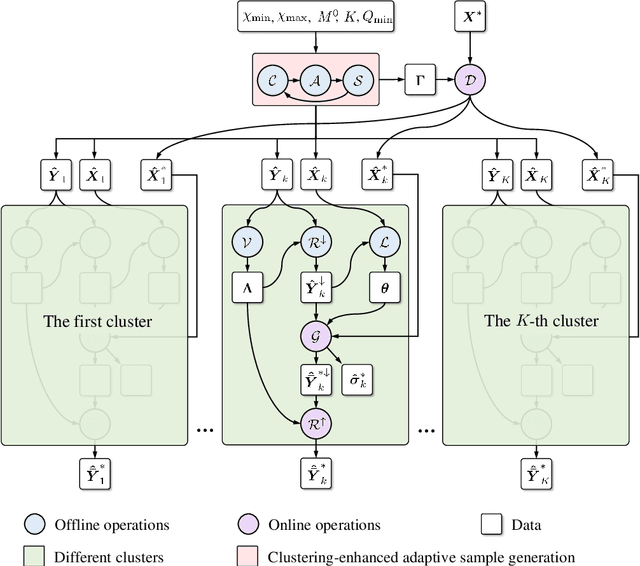
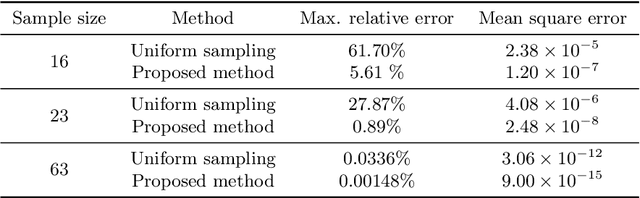
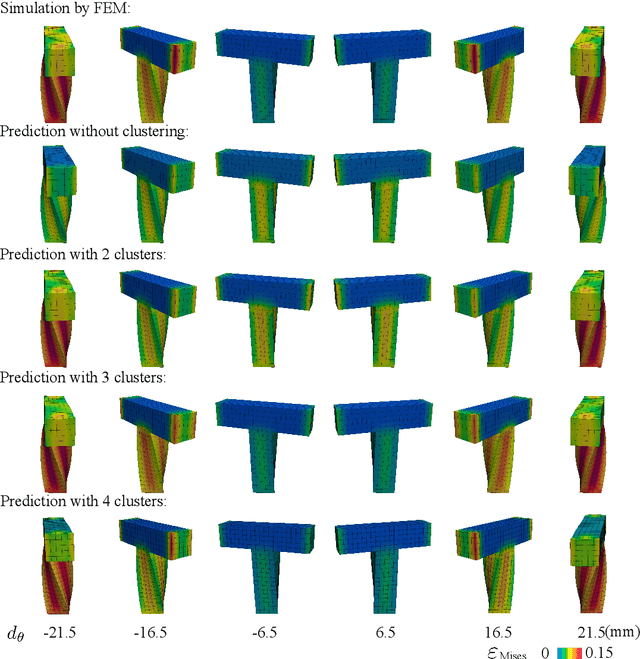
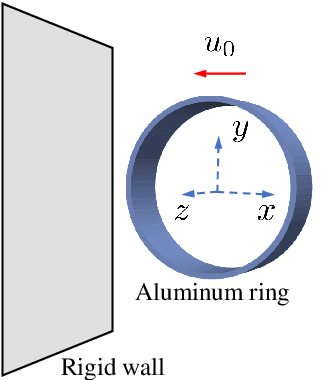
Numerical simulation is powerful to study nonlinear solid mechanics problems. However, mesh-based or particle-based numerical methods suffer from the common shortcoming of being time-consuming, particularly for complex problems with real-time analysis requirements. This study presents a clustering adaptive Gaussian process regression (CAG) method aiming for real-time prediction for nonlinear structural responses in solid mechanics. It is a data-driven machine learning method featuring a small sample size, high accuracy, and high efficiency, leveraging nonlinear structural response patterns. Similar to the traditional Gaussian process regression (GPR) method, it operates in offline and online stages. In the offline stage, an adaptive sample generation technique is introduced to cluster datasets into distinct patterns for demand-driven sample allocation. This ensures comprehensive coverage of the critical samples for the solution space of interest. In the online stage, following the divide-and-conquer strategy, a pre-prediction classification categorizes problems into predefined patterns sequentially predicted by the trained multi-pattern Gaussian process regressor. In addition, dimension reduction and restoration techniques are employed in the proposed method to enhance its efficiency. A set of problems involving material, geometric, and boundary condition nonlinearities is presented to demonstrate the CAG method's abilities. The proposed method can offer predictions within a second and attain high precision with only about 20 samples within the context of this study, outperforming the traditional GPR using uniformly distributed samples for error reductions ranging from 1 to 3 orders of magnitude. The CAG method is expected to offer a powerful tool for real-time prediction of nonlinear solid mechanical problems and shed light on the complex nonlinear structural response pattern.