 Add to Chrome
 Add to Firefox
 Add to Edge
An Electric Potential-Augmented Benchmark Dataset for Physics-Guided Image Reconstruction of Electrical Capacitance Tomography
Jun 10, 2026
While deep learning has significantly advanced image reconstruction of Electrical Capacitance Tomography (ECT), most data-driven methods map directly between capacitance and permittivity distribution, treating the sensor as a black box. This overlooks the electric potential field -- the fundamental physical link governing the nonlinear and ill-posed ``soft-field'' effect. To address this, we propose an electric potential-augmented ECT benchmark dataset designed to explicitly integrate latent physics behind ECT into the learning process. Generated via a COMSOL-MATLAB pipeline for an eight-electrode sensor as an example, the dataset comprises 20,000 randomized samples across four typical flow patterns. Crucially, alongside the conventional capacitance vectors and permittivity distributions depicted as images, each sample preserves eight excitation-wise full-field potential maps. Beyond data release, we provide illustrative evaluation protocols for both forward and inverse problems of ECT. Through comprehensive testing on both in-distribution (IID) and out-of-distribution (OOD) scenarios, we systematically demonstrate how the inclusion of electric potential maps enhances modeling accuracy and robustness. Fundamentally, the explicit inclusion of latent field information significantly lowers the barrier to integrating physical laws into ECT modeling, thereby establishing a standardized foundation for future physics-guided machine learning of ECT image reconstruction.

Synthetic Datasets for Autonomous Driving: A Survey
Apr 24, 2023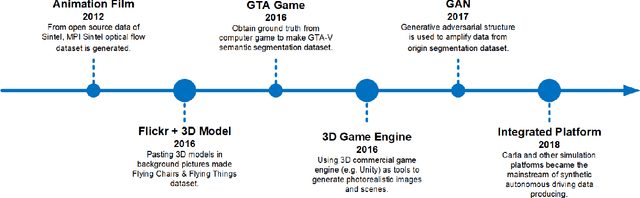
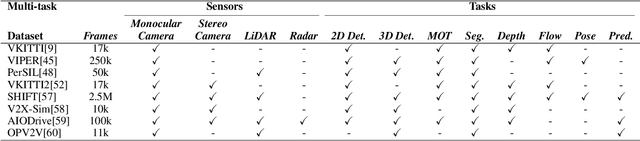
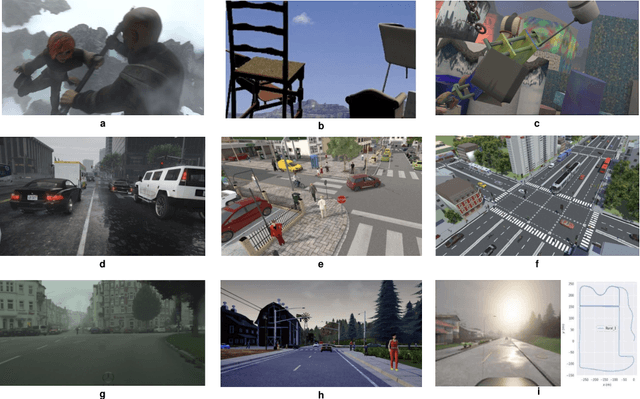
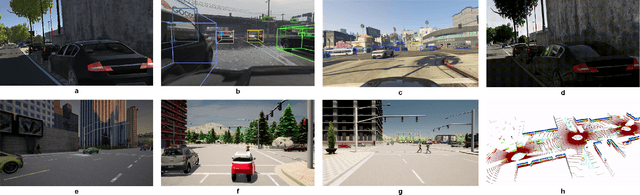
Autonomous driving techniques have been flourishing in recent years while thirsting for huge amounts of high-quality data. However, it is difficult for real-world datasets to keep up with the pace of changing requirements due to their expensive and time-consuming experimental and labeling costs. Therefore, more and more researchers are turning to synthetic datasets to easily generate rich and changeable data as an effective complement to the real world and to improve the performance of algorithms. In this paper, we summarize the evolution of synthetic dataset generation methods and review the work to date in synthetic datasets related to single and multi-task categories for to autonomous driving study. We also discuss the role that synthetic dataset plays the evaluation, gap test, and positive effect in autonomous driving related algorithm testing, especially on trustworthiness and safety aspects. Finally, we discuss general trends and possible development directions. To the best of our knowledge, this is the first survey focusing on the application of synthetic datasets in autonomous driving. This survey also raises awareness of the problems of real-world deployment of autonomous driving technology and provides researchers with a possible solution.
A Hardware Friendly Unsupervised Memristive Neural Network with Weight Sharing Mechanism
Jan 01, 2019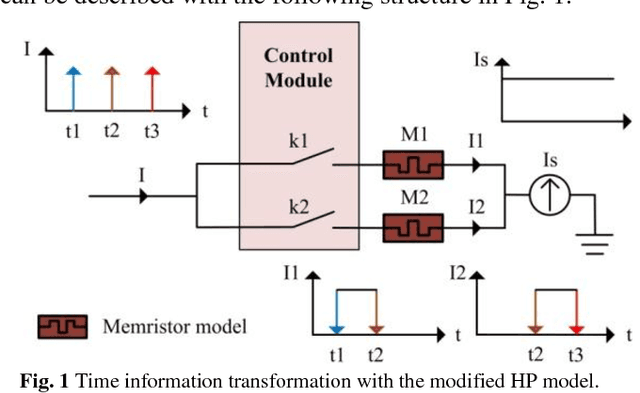
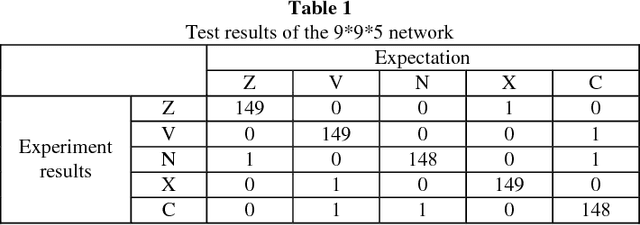
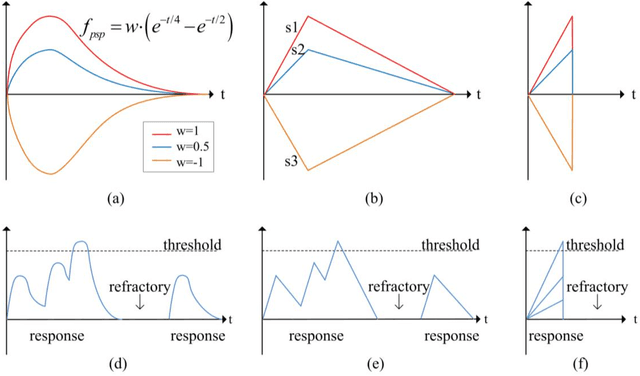
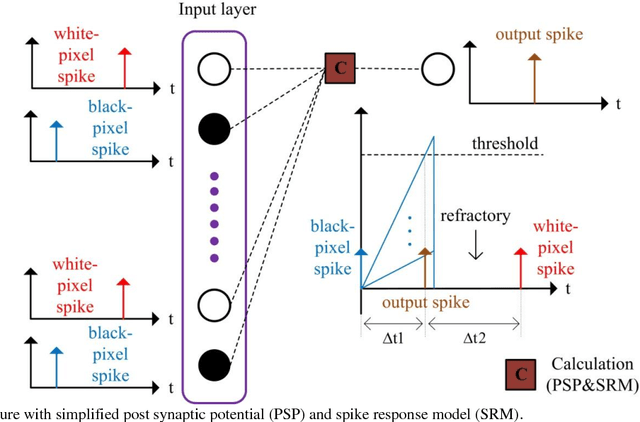
Memristive neural networks (MNNs), which use memristors as neurons or synapses, have become a hot research topic recently. However, most memristors are not compatible with mainstream integrated circuit technology and their stabilities in large-scale are not very well so far. In this paper, a hardware friendly MNN circuit is introduced, in which the memristive characteristics are implemented by digital integrated circuit. Through this method, spike timing dependent plasticity (STDP) and unsupervised learning are realized. A weight sharing mechanism is proposed to bridge the gap of network scale and hardware resource. Experiment results show the hardware resource is significantly saved with it, maintaining good recognition accuracy and high speed. Moreover, the tendency of resource increase is slower than the expansion of network scale, which infers our method's potential on large scale neuromorphic network's realization.
* 10 pages, 11 figures